Insider Brief
- NVIDIA has launched cBottle, the first generative AI model designed to simulate Earth’s climate at kilometer-scale resolution, promising a major leap in speed and efficiency for climate modeling.
- Part of the Earth-2 platform, cBottle compresses petabyte-scale climate data up to 3,000x per sample, allowing researchers to generate and analyze accurate atmospheric scenarios thousands of times faster than traditional numerical methods.
- Early adopters include the Max Planck Institute for Meteorology and the Allen Institute for AI, who are using cBottle to improve precision in climate forecasts and enable localized insights critical for weather response and climate resilience.
NVIDIA has unveiled a powerful new artificial intelligence tool designed to transform climate modeling by dramatically accelerating forecasts while cutting the massive data demands of traditional simulations.
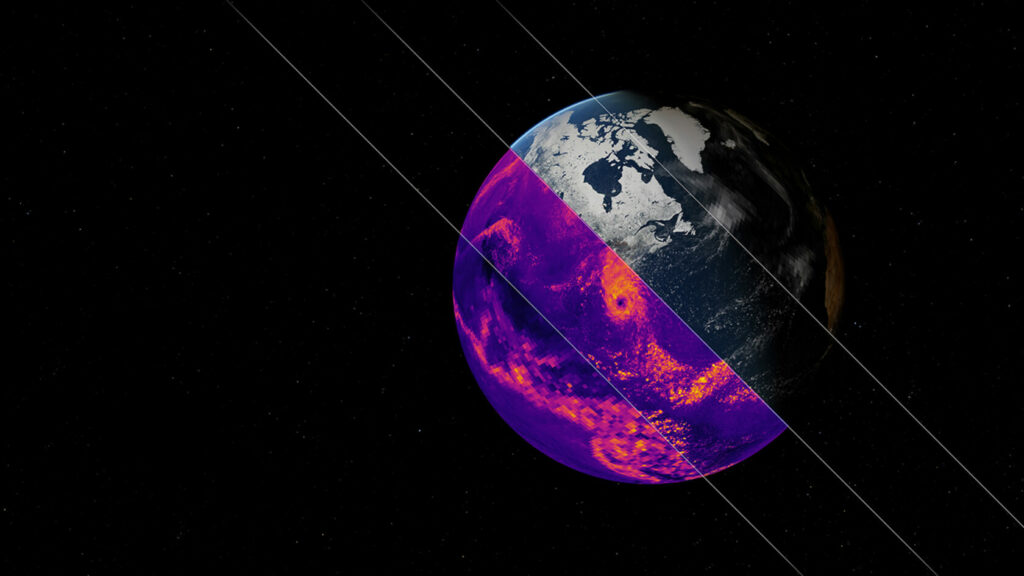
The new model, called cBottle, short for “Climate in a Bottle” is the first generative AI foundation model built to simulate the Earth’s climate at kilometer-scale resolution, according to NVIDIA.
Developed as part of NVIDIA’s Earth-2 platform, it allows scientists and developers to generate high-resolution atmospheric scenarios conditioned on variables like time of day and sea surface temperatures. With its ability to create accurate climate simulations thousands of times faster than standard numerical models, NVIDIA expects cBottle could reshape how researchers study and respond to climate change.
Climate simulations typically require vast computing resources and generate data volumes in the petabyte range. The company noted cBottle addresses these challenges by compressing and distilling climate data up to 3,000 times per sample, allowing climate researchers to analyze extreme weather events and long-term changes with less infrastructure and more speed.
According to NVIDIA, which is kicking off NVIDIA GTC Paris thise week, cBottle uses AI trained on five decades of observational data and physical simulations to emulate realistic atmospheric conditions. The model can fill gaps in missing data, correct biased outputs from older climate models, sharpen blurry simulation outputs, and generate new scenarios based on historical trends. With only four weeks of high-resolution training data, the model learned to recreate kilometer-scale climate behavior.
Institutions such as the Max Planck Institute for Meteorology (MPI-M) and the Allen Institute for AI (Ai2) are already using cBottle to improve simulation precision and accessibility. MPI-M used NVIDIA’s Earth-2 platform and GPUs to perform the first full-Earth kilometer-scale simulation using its ICON model. Ai2 is exploring cBottle to accelerate local weather prediction, including modeling events like flash floods and wildfire-prone heat waves.
“In the face of a rapidly changing climate, the latest progress with Earth-2 represents a transformative leap in our ability to understand, predict and adapt to the world around us,” Bjorn Stevens, director of the Max Planck Institute for Meteorology, said in a statement. “By harnessing NVIDIA’s advanced AI and accelerated computing, we’re building a digital twin of the planet — marking a new era where climate science becomes accessible and actionable for all, enabling informed decisions that safeguard our collective future.”
cBottle’s capabilities were field-tested during the World Climate Research Programme’s Global KM-Scale Hackathon, which brought together scientists from 10 simulation centers in eight countries. Researchers collaborated to expand access to high-fidelity, high-resolution climate data while improving analysis tools for real-world application.
The Earth-2 platform integrates GPU-accelerated simulation tools, computer graphics, and AI into one system, enabling interactive digital twins of the planet. With cBottle, scientists can generate realistic climate data faster and more energy-efficiently, making it a tool not just for global forecasts but for tailored local insights critical to emergency planning and climate resilience, the company noted.
Researchers can now access cBottle in early release. The codebase is available on GitHub, and NVIDIA has published a preprint on arXiv to help climate scientists retrain and adapt the model for their own needs. The move reflects a broader push to democratize high-resolution climate modeling through open-source AI tools.