Insider Brief
- Liquid Instruments introduced Generative Instrumentation, a breakthrough AI-powered system that allows engineers to create and configure custom test instruments using natural language prompts.
- This capability debuts on Moku:Delta, the company’s most advanced platform to date, featuring 2 GHz bandwidth, up to 8 instrument slots, and over 2 billion potential configurations.
- By merging hardware performance with software flexibility and agentic AI, Liquid Instruments aims to redefine test and measurement across sectors including aerospace, quantum, and semiconductors.
PRESS RELEASE – Liquid Instruments, a leader in software-defined instrumentation, today announced the introduction of Generative Instrumentation, a revolutionary approach to test and measurement. Generative Instrumentation enables engineers to create custom instruments and configure complex systems to fit their exact needs using AI and natural language prompts.
This represents a significant leap beyond traditional instrument design, vastly improving users’ productivity and ability to customize and optimize their test setup. Agentic AI opens up the capability to adapt to specialized applications, automate complex test scenarios, and respond to dynamically changing requirements.
“We see a future where engineers and scientists describe what they want, and the instrument configures itself,” said Dr. Rory Smith, Lead AI Instrumentation Engineer at Liquid Instruments. “Generative Instrumentation won’t just simplify everyday tasks — it will enable the creation of entirely new capabilities on demand, unlocking test setups that were previously impossible or impractical.”
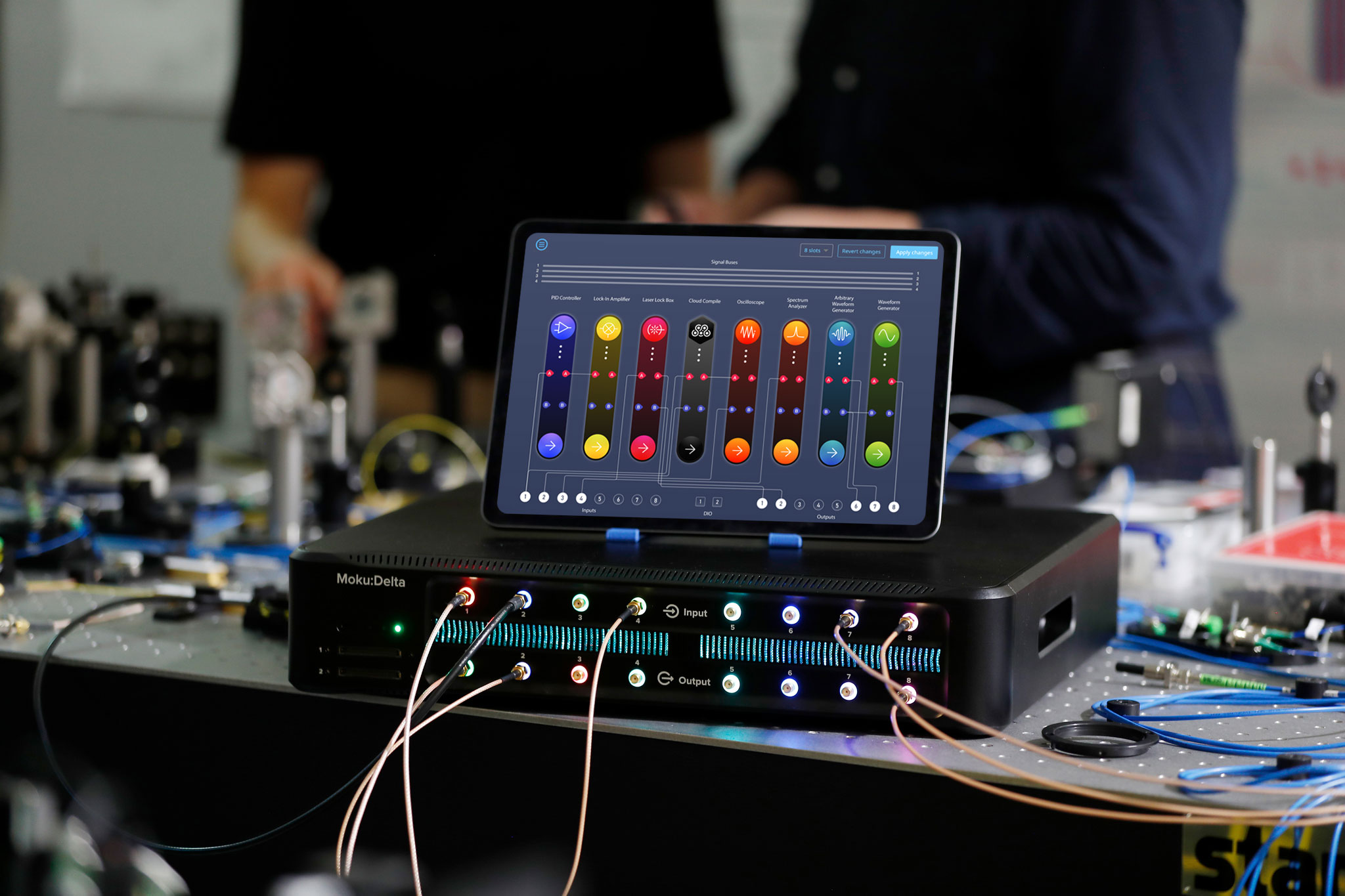
This new capability, supported in an upcoming release of MokuOS, is enabled by the launch of Moku:Delta, the fourth generation hardware platform from Liquid Instruments. Moku:Delta delivers best-in-class instrument performance, including:
- The highest resolution, 2 GHz oscilloscope
- The only spectrum analyzer that provides full 2 GHz bandwidth down to 0 Hz for 1/f noise measurements
- The highest-channel count, ultra-low noise, microwave lock-in amplifier
- Up to 8 instrument slots and 15 standard instruments
- More than 2 billion possible custom instrument configurations
“We created Moku:Delta to help engineers go faster, think bigger, and stay focused on the hard problems,” said Daniel Shaddock, CEO of Liquid Instruments. “It’s also the first step in a new era of generative instrumentation, bringing together the performance of hardware, the flexibility of software, and the creative potential of AI.”
With a growing suite of Moku platforms, including Moku:Go, Moku:Lab, Moku:Pro, and now Moku:Delta, Liquid Instruments continues to empower engineers and scientists to drive innovation in industries including quantum, semiconductor, and aerospace and defence.
“Moku:Delta’s leap in bandwidth and channel count is exactly what we’ve been waiting for. We’ve never had this level of flexibility and performance combined in a single platform,” said Associate Professor Francis Bennet, laser communication research group leader at the ANU Research School of Astronomy and Astrophysics. “With 2 GHz bandwidth and 8 analog inputs and outputs, it delivers everything we need — all in one device.”