
Insider Brief
- The International Federation of Robotics reports humanoid robots are moving from concept to commercial viability in 2025, driven by labor shortages, AI advances, and demographic shifts.
- China is leading the push, with detailed plans to mass-produce humanoids, viewing them as disruptive technologies on par with smartphones and computers, according to the Ministry of Industry and Information Technology.
- At WAIC 2025 in Shanghai, companies including Keenon Robotics, Shanghai Electric, and Unitree Robotics showcased humanoids for hospitality, industrial automation, and social interaction, signaling a shift toward deployment in real-world applications.
Humanoid robots, once confined to science fiction, are stepping into commercial viability in 2025, according to a July report from the International Federation of Robotics (IFR). Fueled by labor shortages, demographic changes, and AI breakthroughs, these human-like machines are gaining traction in industrial and service sectors, though widespread use remains a future prospect.
According to the report, humanoid robots are the center of China’s national strategy, and establishing a scalable supply chain to build them is a priority.
“There is a strong emphasis on usinghumanoids in the service sectors, such as customer service,” the report pointed out. “The use in manufacturing to automate production lines and reduce reliance on human labor seems only a second step.”
The Ministry of Industry and Information Technology views humanoids as a disruptive force on par with computers and smartphones. The initiative marks a strategic push to integrate robotics with other emerging technologies and reshape both manufacturing and everyday life, the report noted.
Humanoid robots took center stage at the World Artificial Intelligence Conference in Shanghai this past week, as Chinese robotics companies showcased a new generation of machines designed to serve, entertain, and work alongside humans. The unveiling of several high-profile humanoids signals China’s accelerating ambitions to lead in both industrial automation and consumer-facing robotics. Here are three of China’s leading robotics companies:
Keenon Robotics
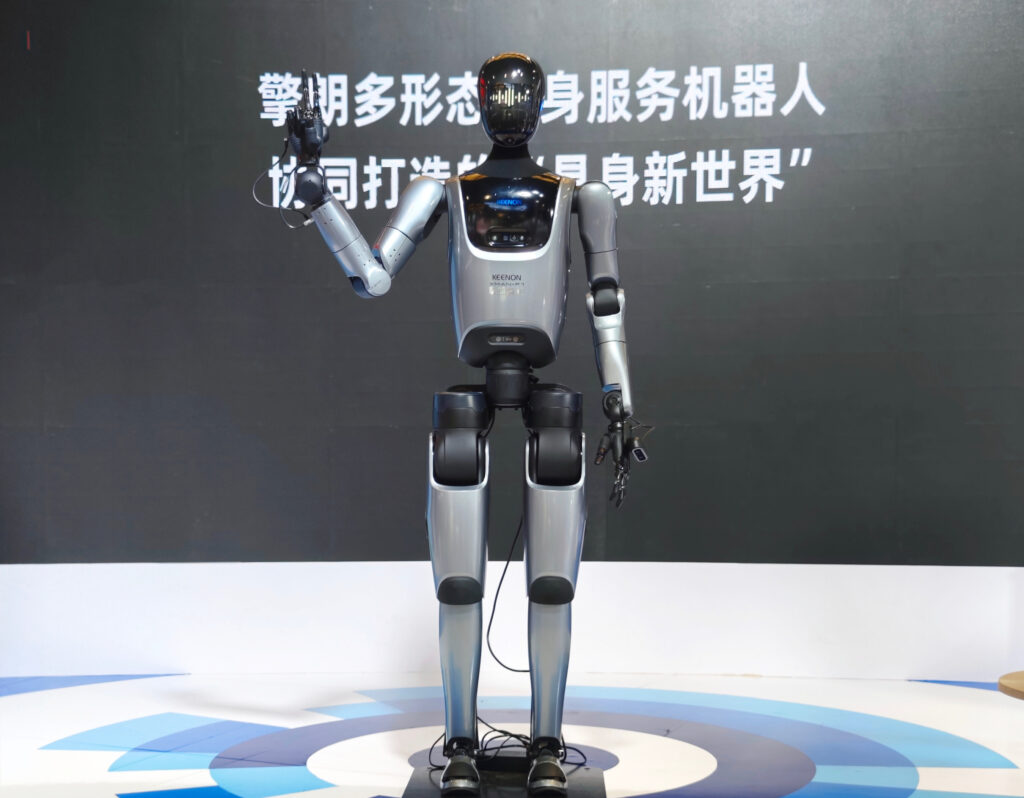
Keenon Robotics, a leading commercial service automation company, debuted its bipedal humanoid robot XMAN-F1. The robot demonstrated an ability to interact with people using smooth motion and task precision. At the company’s interactive booth, XMAN-F1 was seen preparing beverages, delivering presentations, and collaborating with other robots in simulated real-world settings such as a hospital station and a cocktail bar. According to Keenon, the robot is powered by large language models and multi-modal sensors, allowing it to carry out diverse actions in unpredictable environments. The company cited an IDC China report that indicated Keenon now leads the commercial service robotics market, with over 29.8% of global shipments and more than 40% market share in food delivery robots.
Shanghai Electric

Shanghai Electric also used WAIC to introduce SUYUAN, its first industrial humanoid robot. The robot stands 167 centimeters tall, weighs 50 kilograms, and is capable of carrying up to 10 kilograms. Designed for logistics and assembly line environments, SUYUAN includes 38 degrees of freedom—a measure of joint flexibility—and runs on a 275 TOPS (trillion operations per second) chip for on-board AI processing, according to the company. These features enable it to perform complex movements while interpreting tasks using language models and spatial data from sensors. Shanghai Electric’s display emphasized the robot’s ability to lift, move, and organize crates of various sizes, a practical capability for warehouse and manufacturing settings.
Beyond hardware launches, Shanghai Electric used the event to highlight its LINGKE dual-arm robot and new joint venture with Johnson Electric. According to the company, the LINGKE system incorporates closed-loop data systems for real-time feedback and task adaptation. Designed for high-precision industrial roles, it can train itself from collected data and adjust its movements accordingly. This approach, described as “active learning,” marks a shift from rigid programming to flexible operation. The joint venture revealed new robotic components including dexterous finger joints and quiet rotary actuators, aimed at the next wave of humanoid and service robots.
Unitree Robotics
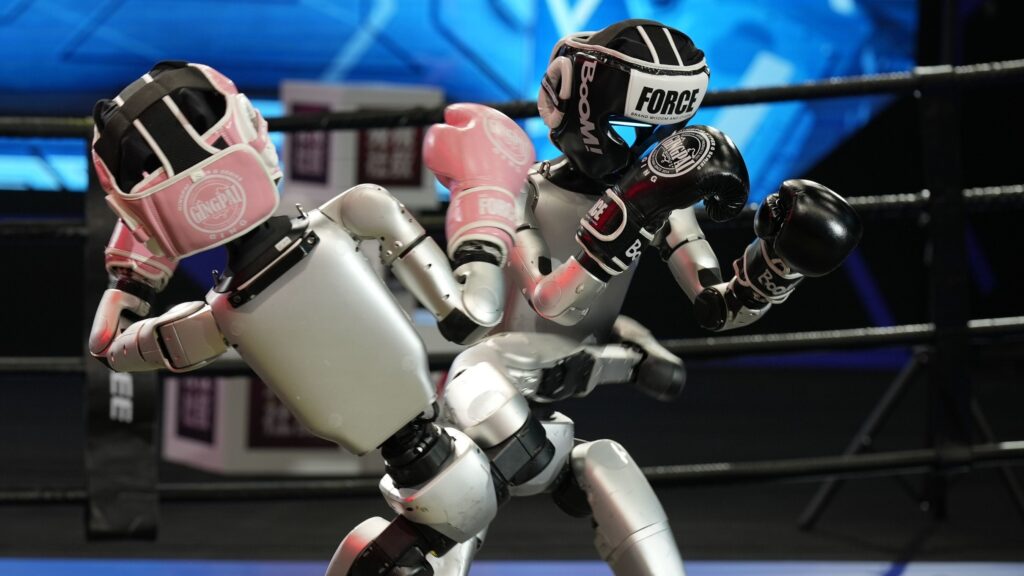
Unitree Robotics brought a different flavor to WAIC, with robots designed for fun, entertainment, and social interaction. Known for its viral humanoid robots featured in boxing matches and on livestreams, Unitree indicated it aimed to show how robotics can cross from the factory floor to the cultural mainstream. One of its robots, a G1dubbed “Jake the Rizzbot,” gained online fame for street performances in Austin, Texas, combining lifelike gestures with modern slang. In addition to humanoids, Unitree’s quadrupeds are already being deployed in agriculture, firefighting, and utility inspection—suggesting that the company’s playfulness does not come at the cost of utility.
The event highlighted a shift from lab prototypes to service and industrial deployment, showing use cases in hospitality, healthcare, and education, as more than 60 humanoid robots were on display, the Chutian Golden Post reported. Officials positioned humanoids as the next disruptive platform, following smartphones and EVs. Startups and state-backed centers rolled out initiatives to drive standardization, open-source collaboration, and ecosystem growth.
For more information on how generative AI and embodied intelligence converge are pushing China to define the global trajectory of intelligent robotics, check out the full report here.