Insider Brief
- Google is rolling out a demand response strategy to manage the energy needs of its data centers by shifting non-urgent machine learning workloads away from peak hours, according to Head of Advanced Energy Michael Terrell.
- In new utility agreements with Indiana Michigan Power and Tennessee Valley Authority, Google will treat ML tasks as flexible loads—the first such move by a major AI operator to incorporate demand response at scale.
- Piloted with Omaha Public Power District and already applied in Belgium and Taiwan, the approach aims to stabilize power grids, reduce infrastructure strain, and support Google’s 24/7 carbon-free energy goal.
As artificial intelligence drives soaring energy demand, Google announced it is reshaping how its data centers interact with the power grid.
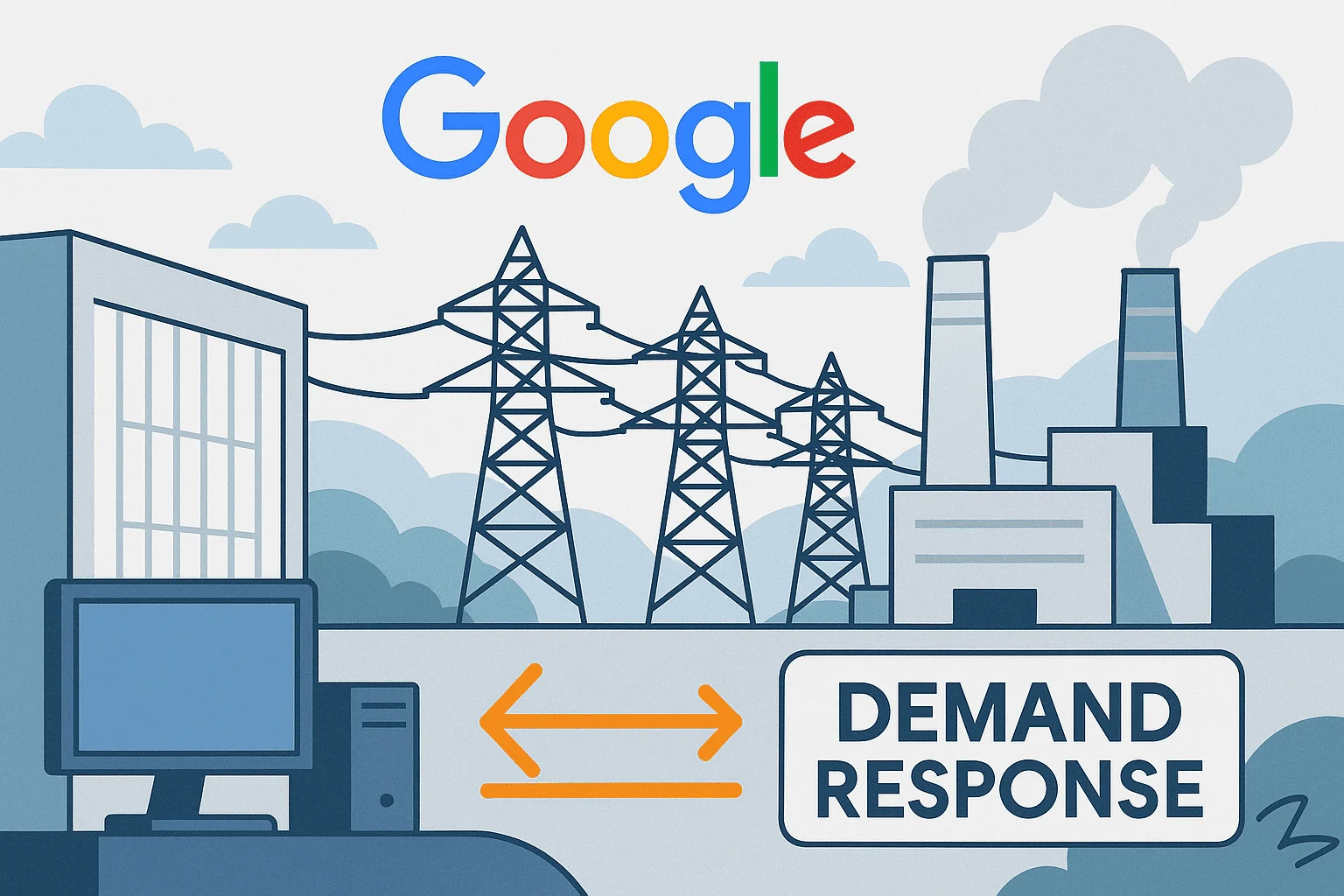
Google’s Head of Advanced Energy Michael Terrell said in a blog post Monday that company has begun rolling out a system that shifts energy use away from peak hours by dynamically adjusting machine learning workloads. Known as demand response, the strategy helps stabilize grids under strain and reduces the need for new power plants and transmission infrastructure. According to Terrell, it also positions Google to help modernize energy systems as AI accelerates.
In new agreements with Indiana Michigan Power and the Tennessee Valley Authority, Google will begin using machine learning tasks as flexible loads, marking the first time AI workloads have been incorporated into a utility demand response strategy. The company piloted the concept last year with the Omaha Public Power District, successfully lowering data center energy use during three grid stress events.
“As we add new large loads to our system, it is critical that we partner with our customers to effectively manage the generation and transmission resources necessary to serve them,” Steve Baker, president and chief operating officer of I&M, noted in the post. “Google’s ability to leverage load flexibility as part of the strategy to serve their load will be a highly valuable tool to meet their future energy needs,” said Steve Baker, president and chief operating officer of I&M.”
By targeting non-urgent compute tasks—such as video processing—Google can modulate power use without sacrificing performance in core services like Search, Maps, or critical cloud operations. The approach reflects Google’s broader ambition to operate on 24/7 carbon-free energy, a goal that requires both clean energy procurement and demand-side coordination, Terrell pointed out.
The program is still in its early stages and may not be feasible at all facilities, the company noted. Data centers serving hospitals or other mission-critical clients, for example, require constant uptime. But in select locations, load flexibility is proving to be a powerful tool for smoothing out energy use and speeding up grid interconnection for large data centers.
Terrell said Google has already deployed similar strategies overseas. In Belgium, the company works with Centrica Energy and the transmission operator Elia to shift workloads in response to local grid conditions. In Taiwan, it collaborates with the national utility to help balance seasonal demand spikes.
“As AI adoption accelerates, we see a significant opportunity to expand our demand response toolkit, develop capabilities specifically for ML workloads, and leverage them to manage large new energy loads,” Terrell noted. “By including load flexibility in our overall energy plan, we can manage AI-driven growth even where power generation and transmission are constrained. We believe this is a promising tool for managing large new energy loads and facilitating investment and growth.”