
Insider Brief
- Backed by U.S. National Science Foundation funding, Harvard researchers have developed a soft robotic vest that uses machine learning and physics-based models to provide personalized arm support for people with movement impairments.
- In tests with nine volunteers — including stroke survivors and ALS patients — the device distinguished shoulder movements with 94% accuracy, reduced arm-lowering force by a third, and improved ranges of motion while enabling more precise completion of daily tasks.
- Published in Nature Communications and developed with Massachusetts General Hospital and Harvard Medical School, the research points toward future home-use rehabilitation tools designed to improve independence and quality of life through personalized assistance.
Harvard researchers, backed by U.S. National Science Foundation funding, have developed a soft robotic device that uses machine learning to deliver personalized assistance for people with impaired arm movement, marking a step forward in rehabilitation technology.
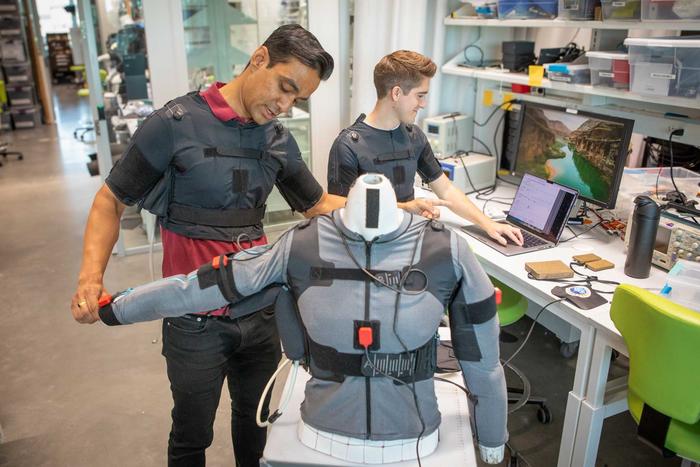
According to Harvard, the wearable device consists of a vest fitted with sensors and an inflatable support under the arm. By combining a machine learning model with a physics-based model, the system learns how each user moves and adjusts the level of support in real time. Unlike earlier versions that sometimes left users struggling to push their arms down, the updated model reduces the force required and produces smoother, more natural assistance.
“Some people didn’t have enough residual strength to overcome any kind of mistake the robot was making,” co- first author and graduate student James Arnold pointed out.
The work, published in Nature Communications, was led by the Harvard John A. Paulson School of Engineering and Applied Sciences in collaboration with Massachusetts General Hospital and Harvard Medical School. According to Harvard, the project received support from the National Science Foundation’s Convergence Accelerator program and NSF Graduate Research Fellowships.
Nine volunteers that included five people that had suffered strokes and four living with ALS, tested the system in collaboration with clinicians at Massachusetts General Hospital. The study found the device distinguished shoulder movements with 94% accuracy, researchers noted. Participants needed about a third less force to lower their arms, and demonstrated improved ranges of motion in the shoulder, elbow, and wrist. This reduced compensatory movements, such as leaning or twisting, and enabled more precise completion of daily tasks like eating or drinking.
The findings suggest the robot could improve independence and quality of life for patients with degenerative conditions like ALS, where movement assistance is the primary goal, as well as for stroke survivors, who focus on regaining strength and mobility. Researchers emphasized personalization as a key factor, since no two individuals move in exactly the same way.
“What we did here was look at simulated activities of daily living, using a highly accurate motion capture system — similar to systems used in movies,” said co-first author and postdoctoral fellow Prabhat Pathak. “We looked at how each and every joint movement changed, and if they were able to do the tasks more efficiently.”
Researchers said they will continue to work on the technology to someday enable users to independently use it at home. Feedback from patients helped shape successive versions of the device, highlighting the importance of incorporating user experience alongside clinical evaluation.
“They’ve done a great job incorporating and including the person,” said volunteer user Kate Nycz, who has lived with ALS since 2018. “They’re not sitting in the lab just playing with the robot. I felt like they were really engaged with me. I didn’t feel like a lab rat or a cog in a wheel.”