Insider Brief
- The University of Michigan will lead a $19.4 million Department of Energy–funded center to use artificial intelligence for solving complex physics problems, with applications in hypersonic flight.
- The Center for Prediction, Reasoning and Intelligence for Multiphysics Exploration (C-PRIME) will develop AI agents that build trustworthy physics models, run simulations on supercomputers, and support the design of rotating detonation combustors.
- The project involves 13 Michigan investigators, partners from Princeton University, and collaborations with Sandia, Los Alamos, and Lawrence Livermore national laboratories.
The University of Michigan will lead a $19.4 million federal project to create an artificial intelligence–based “oracle” capable of solving complex physics problems, with an initial focus on technologies for hypersonic flight.
The U.S. Department of Energy’s National Nuclear Security Administration (NNSA) awarded the funding to establish the Center for Prediction, Reasoning and Intelligence for Multiphysics Exploration, or C-PRIME. The center’s goal is to build AI agents that can develop trustworthy physics models, accelerate supercomputer simulations, and provide tools for designing advanced propulsion systems.
While equations describing physics are well established, using them to predict real-world behavior—such as fuel-air mixing inside an engine or airflow across a high-speed aircraft—is computationally overwhelming. C-PRIME researchers aim to bridge that gap by training AI agents to generate simplified but accurate models from known physics principles.
“The notion is that we, as humans, should provide certain concepts we trust—Newton’s laws or E=mc^2. The machine then composes more complex ideas from these basic building blocks,” said Venkat Raman, director of C-PRIME and the James Arthur Nicholls Collegiate Professor of Engineering. “Because we trust these building blocks, we can—to a large extent—trust engineering concepts that are composed from them.”
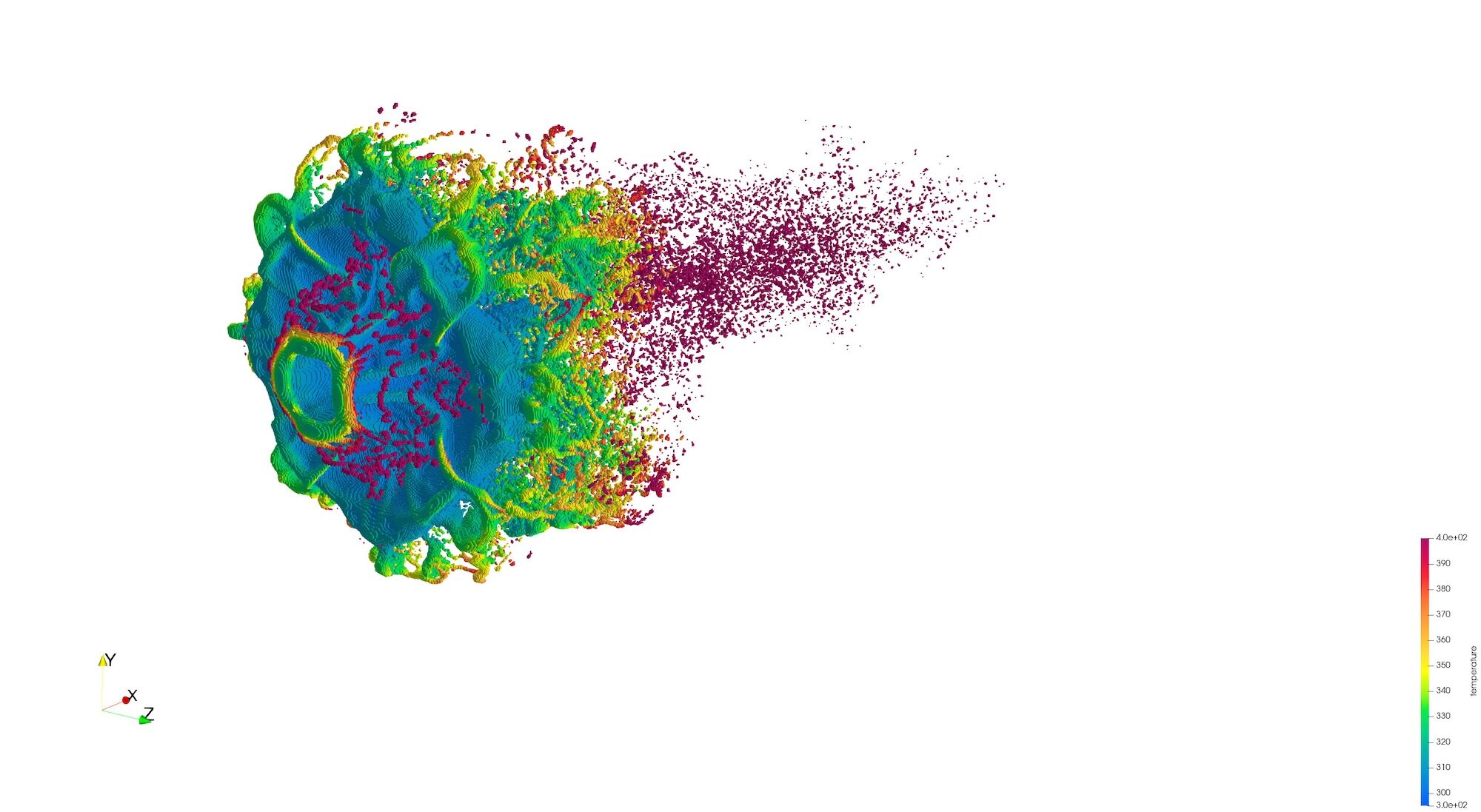
The project will rely on exascale-class supercomputers to simulate propulsion systems for hypersonic flight—vehicles that travel at least five times the speed of sound. Researchers will concentrate on rotating detonation combustors, a promising technology for both aerospace propulsion and energy generation that could deliver efficiency gains of about 25% over conventional combustion systems.
“AI and hypersonics are critical to national security and U.S. scientific leadership, and we’re committed to developing technologies and talent to move both fields forward,” said Karen A. Thole, the Robert J. Vlasic Dean of Engineering. “This federal investment enables our researchers to bring together expertise in physics, computer simulation, AI and machine learning to push the boundaries of what’s possible and develop tomorrow’s AI-savvy workforce in the process.”
The center’s work is organized into five research thrusts:
- Physics and data, led by Eric Johnsen, will refine foundational physics models and integrate new experimental data.
- Verification, validation and uncertainty quantification, led by Alex Gorodetsky, will address reliability of the models and their assumptions.
- Exascale supercomputing architecture, led by Reetuparna Das, will optimize the models for the world’s most powerful computing systems.
- Machine learning, led by Karthik Duraisamy, will design ML-based tools to accelerate physics simulations.
- AI-based integration, led by Raman, will build the agents that compose physics equations into full simulations.
In addition, laboratory experiments at Michigan will test AI-based combustor designs, led by professors Mirko Gamba and Carolyn Kuranz.
“Through our research, and the education of the next generation of researchers, we have the opportunity to shape the field on a large scale,” Johnsen said. “In particular, we need to ensure that our trainees—undergraduate and graduate students and postdoctoral researchers—understand how to leverage AI resources in their research because their success after they leave Michigan will depend on how well they do this.”
The center is part of the fourth phase of NNSA’s Predictive Science Academic Alliance Program.
“This center with its focus on AI-driven solutions for complex physics problems aligns perfectly with PSAAP’s mission to advance high-fidelity predictive simulations,” said David Etim, federal program manager in the National Nuclear Security Administration’s Office of Advanced Simulation and Computing and Institutional Research & Development. “We eagerly anticipate the groundbreaking contributions C-PRIME will make in areas critical to national security, particularly in next-generation hypersonic flight and exascale computing, further strengthening the program’s impact.”
The $19.4 million award builds on Michigan’s long history in computational science and engineering. The university’s Michigan Institute for Computational Discovery and Engineering oversees the nation’s first Ph.D. program in scientific computing, launched in 1988, and manages multiple national lab collaborations, including a $15 million partnership with Los Alamos National Laboratory and a $1.25 billion joint facility for high-performance computing and AI research.
C-PRIME brings together 13 Michigan co-investigators across four departments, along with partners from Princeton University and researchers at Sandia, Los Alamos, and Lawrence Livermore national laboratories.