- Medra launched its Continuous Science Platform, a first-of-its-kind system that integrates robotics and AI to accelerate scientific data generation and discovery.
- The platform combines Physical AI—general purpose robots with vision and language understanding that automate up to 70% of lab instruments and generate rich metadata—with Scientific AI reasoning models that analyze this “Infra-data” and suggest new experiments.
- By creating a closed-loop, self-improving system, Medra aims to overcome data scarcity in science, compressing decades of discovery into months and enabling frontier models to reach the scale needed to tackle challenges like disease eradication.
PRESS RELEASE – Medra, a startup building “Physical AI for experimentation,” announced the launch of its Continuous Science Platform, a first-of-its-kind system that integrates robotics and AI to accelerate scientific data generation and discovery.
Medra’s vision is grounded in a simple belief: if AI will one day help eradicate disease, science must first overcome the problem of data scarcity. Unlike large multimodal foundation models trained on massive datasets, scientific AI models remain constrained by decades-long bottlenecks in data creation. AlphaFold2, the protein-folding model that earned Google DeepMind the Nobel Prize in Chemistry, was trained on protein structures collected over nearly 50 years, representing just 0.3% of the data used to train today’s largest AI models.
“Scientific frontier models need 1,000X more training data to match the intelligence of current multimodal reasoning models,” said Michelle Lee, PhD, CEO of Medra. “The only way forward is to rethink how we generate scientific data, compressing decades of discovery into months.”
Continuous Science: Physical AI + Scientific AI
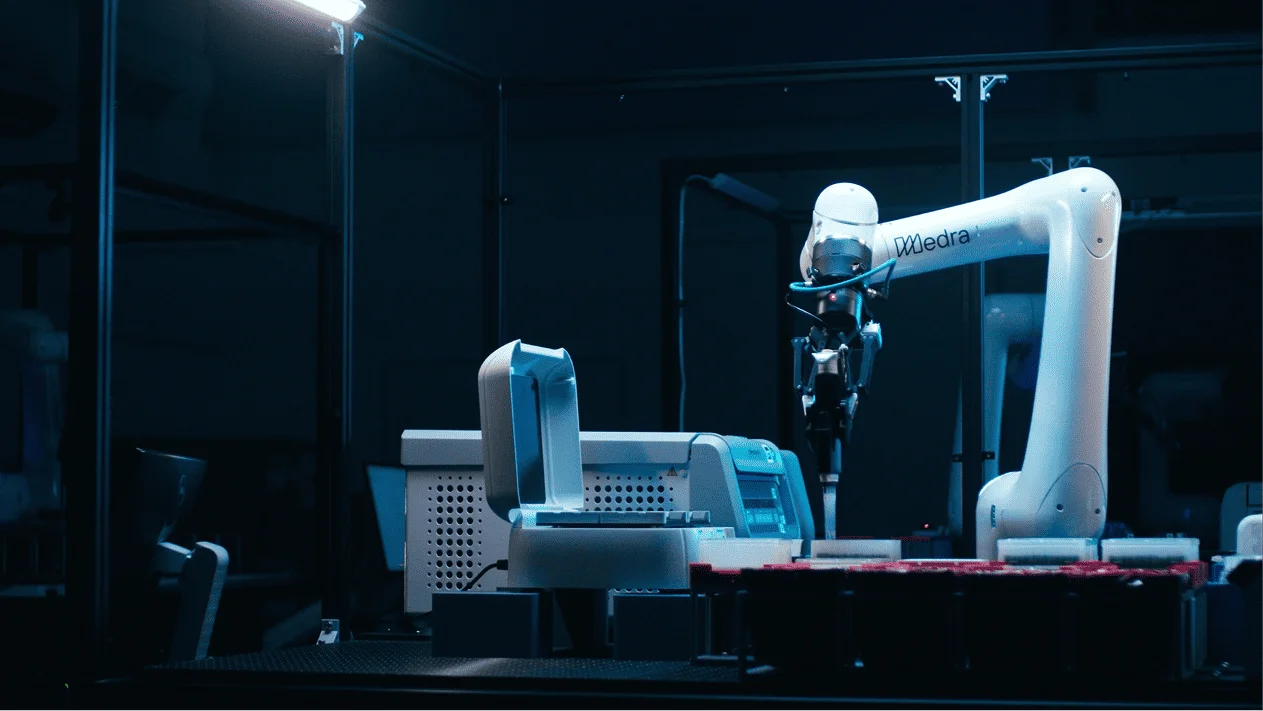
Medra has built new technology that combines the intelligence of general purpose robots with the scientific reasoning of large language models to run lab experiments at scale. It’s a self-improving, closed loop system made up of two parts: Physical AI and Scientific AI.
- Physical AI acts: By combining general purpose robots with agentic models that have visual and language understanding, our platform flexibly automates up to 70% instruments that scientists already use. We also capture images, log every motion, and record actions with unprecedented granularity, creating a new metadata layer, Infra-data, never before captured at scale.
- Scientific AI learns: Reasoning models analyze Infra-data, alongside data found in electronic lab notebooks or scientific literature, suggesting new experimental actions. Together, they form a closed-loop, self-improving system that converges on optimal protocols faster than ever before.