
Insider Brief
- UGVs expand beyond EOD: Militaries are moving from bomb disposal to multifunctional unmanned ground vehicles, with the U.S. Army fielding 675 robotic mules and DARPA pursuing autonomous medical robots.
- Army shifts strategy: The Robotic Combat Vehicle program has been halted, with $15.5 million awarded to startups in 2025 to develop autonomy kits for the Infantry Squad Vehicle instead.
- Ukraine proves the concept: With over 15,000 UGVs deployed in 2025, Ukraine has pioneered low-cost mini-tanks like the $26k DevDroid TW 12.7 and even executed the first “all-robot raid.”
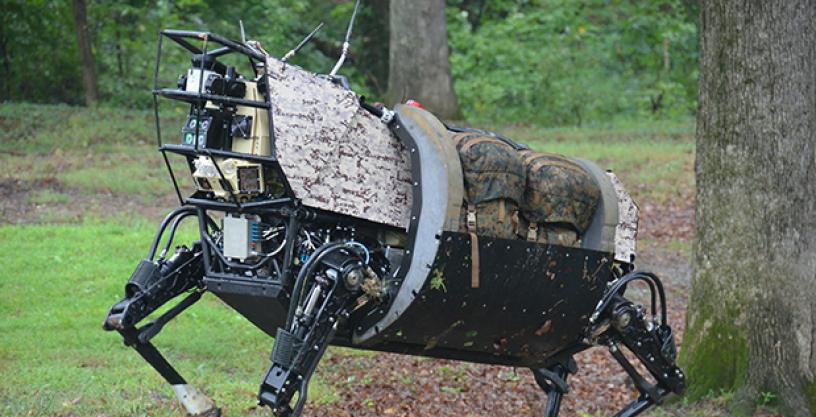
- Image: DARPA Legged Squad Support System (DARPA).
While gun-totting humanoid robots remain the stuff of science-fiction, the use of robotics and autonomous systems continue to evolve around the world.
In an era where technological advancements are reshaping the battlefield, military unmanned ground vehicles (UGVs) and other autonomous technologies beyond ariel drones are emerging as pivotal assets for armed forces worldwide. Traditionally confined to explosive ordnance disposal (EOD), UGVs are now expanding into diverse roles, driven by innovations in autonomy, artificial intelligence, and robotics.
From EOD to Multifunctional Assets: The Current State
UGVs have long been synonymous with EOD tasks, where remote-controlled robots like the TALON series from QinetiQ, first introduced in 2000, safely neutralize improvised explosive devices (IEDs). However, advancements in sensor technology, battery life, and AI have propelled UGVs into broader military applications. Today, these vehicles operate in high-risk environments, performing tasks that enhance operational efficiency and force protection.
Now, militaries around the world are looking past EOD tasks and as AI and robotics technologies advance, so have the possibilites for finding warfighting capabilities for these emerging technologies.
The U.S. Department of Defense (DoD) has been a leader in this transition. In its FY 2024 budget, the DoD allocated approximately $10.95 billion for uncrewed vehicle acquisition and development, including ground systems. How that money will be spent seems to have shifted since May of this year when Secretary of the Army Dan Driscoll and Chief of Staff of the Army Gen. Randy A. George announced the Army Transformation Initiative (ATI), which as the Congressional Research Service (CRS), a nonpartisan shared staff to congressional committees and members of Congress, noted has effectively stopped the Army’s Robotic Combat Vehicle (RCV) program.
Breaking Defense reported that Program Executive Officer for Ground Combat Systems Maj. Gen. Glenn Dean wrote in an email, “Here’s what we believe is true of today, RCV will stop development. The future of the robotic software program is unknown,”
Prototypes from teams including McQ, Textron, and others were expected to be delivered in late summer 2024, with testing focused on lethality and survivability beyond mere disposal operations, but now it appears the Army is looking to broaden the field to select from a larger pool of companies to provide autonomous ground vehicle technologies instead of narrowing it down to one or two companies at a higher cost, according to the Breaking Defense report.
In August 2025 the Army awarded $15.5 million in contracts to three startups – Overland AI (Seattle), Forterra (Maryland), and Scout AI (California) – to develop autonomous driving kits for the Infantry Squad Vehicle (ISV), according to the Army.
Under this program, each company will integrate its autonomy software onto existing ISVs and deliver prototype robotic squad vehicles by May 2026 for soldier evaluations.
“We are looking forward to seeing how our industry partner’s autonomy solutions perform on vehicles while performing relevant military missions,” Col. Ken Bernier, project manager, Future Battle Platforms, said in a statement. “We remain committed to bringing the best technologies to our warfighters and shaping the future of autonomous mobility for our Army at an unprecedented speed.”
Beyond Transportation: How is the U.S. Military Exploring Autonomous Systems?
U.S. Army is already fielding an unmanned vehicle to help foot soldiers carry equipment. The Small Multipurpose Equipment Transport (S-MET) program, a robotic mule, began deliveries of its first increment in 2021. General Dynamics Land Systems’ eight-wheeled S-MET vehicle (the “Mule”) can carry 1,000 lbs of gear and follow troops over 60 miles in 72 hours. By late 2024, 675 S-MET robots had been delivered to Army units. The Mule can also provide off-board power to charge soldiers’ radios and goggles.
DARPA has launched the Medics Autonomously Stopping Hemorrhage (MASH) program to tackle one of the deadliest battlefield injuries: non-compressible torso hemorrhage. The initiative aims to use AI-guided robotic systems with advanced sensors to locate and stop severe internal bleeding with minimal human assistance. These autonomous systems are designed to stabilize wounded warfighters for up to 48 hours, buying critical time for evacuation and surgical care.
Program manager Dr. Adam Willis compared the challenge to developing a “GPS for the inside of the human body,” guiding existing medical tools to precisely stop bleeding under extreme conditions.
“The real challenge is finding that bleed,” Willis said in a statement annoucning the program. “Imagine navigating a complex landscape of organs and blood inside the torso to find the exact spot that needs attention.”
MASH will run over three years in two phases—first integrating sensors with robotic platforms to detect hemorrhages, then building software and autonomy to stop them. DARPA envisions a user-friendly system, similar to how defibrillators transformed cardiac care, to support medics in pre-hospital combat environments. Researchers interested in contributing can join a proposers day on Sept. 18, 2025, with details available on SAM.gov.
UGVs in the Ukraine Conflict: A Proving Ground
The Russia-Ukraine war has accelerated UGV adoption, turning the battlefield into a live laboratory for unmanned systems.
While most attention has gone to aerial drones, the war has also spurred development and fielding of ground robots by both Ukraine and Russia, and accelerated investments by other nations who are learning from the conflict. American think tank Atlantic Council noted the key lessons from the war include the utility of robots for mine-clearing, logistics under fire, and reducing personnel losses in high-intensity combat.
Ukraine has deployed over 15,000 UGVs in 2025, focusing on ground robots to counter Russia’s manpower advantage. The Ukrainian Armed Forces’ “Charter Brigade” pioneered uncrewed combined-arms assaults, using UGVs alongside drones for defense, according to U.S. Army Training and Doctrine Command.
As reported, in December 2024, Ukraine’s Ministry of Defense approved a new “Droid” robotic fighting vehicle for service – the TW 12.7 UGV. This is a small tracked “mini-tank” armed with a NATO-standard 12.7 mm heavy machine gun, developed by Ukrainian startup DevDroid. It can be controlled via tablet and has proven reliable in field tests, operating in tough battlefield conditions. The Droid TW 12.7 costs as little as $26k to produce and can be delivered in under two months, reflecting a rapid, low-cost development cycle driven by wartime needs. Ukrainian forces have already used such ground robots in combat. Atlantic Council pointed out that a Ukrainian unit north of Kharkiv carried out an attack in late 2024 entirely with unmanned systems, combining machine-gun armed ground drones with loitering attack drones to assault a Russian position., making this “all-robot” raid – reportedly the first of its kind.
Looking Ahead
The 2023 NATO Parliamentary Assembly report highlights the rising importance of Robotics and Autonomous Systems (RAS) in both civilian and military domains, noting their transformative impact on modern warfare. NATO sees RAS as essential for future capabilities, particularly in surveillance, logistics, reconnaissance, combat support, and mine-clearing. Drone warfare in Ukraine is emphasized as a vivid example of their battlefield value, while swarming technology is identified as a critical next frontier. Advantages include reducing risk to soldiers, expanding operational reach, lowering costs compared to crewed systems, and enhancing situational awareness and decision-making. NATO members, particularly the U.S., UK, and Germany, are investing heavily in areas such as autonomous navigation, swarming, human-machine teaming, and counter-autonomy measures, while also stressing the need for interoperability and shared standards.
The report also reviews adversary activities, pointing out China’s dominance in the commercial drone market and expansion into military UxVs, Russia’s heavy use of UAVs in Ukraine but lagging innovation, and ongoing UAV developments in Israel and Iran. Challenges include interoperability, cybersecurity, costs, proliferation risks, and misuse by terrorists or criminals, especially given the dual-use nature of drone technology. Ethical and legal debates remain unresolved, as no global consensus exists on autonomous weapons. NATO promotes principles of responsible AI use—lawfulness, accountability, explainability, reliability, governability, and bias mitigation—and recommends balancing investments in advanced systems with mass-producible RAS, strengthening research into human-machine trust and cybersecurity, and pursuing international norms to manage proliferation and hostile use.