Insider Brief
- Texas A&M’s Robotics and Automation Design (RAD) Lab at RELLIS, led by former NASA robotics chief Robert Ambrose, is building resilient robots for extreme environments while giving graduate students and research engineers front-line responsibility.
- Flagship efforts include the spherical RoboBall for challenging terrain, the multi-limbed RARELLISD Exploration Vehicle for lunar/Mars mobility, a “Marsupial” carrier-and-daughter robot concept, and “Rover Rescue” to recover stuck rovers.
- Launched in 2022 and now 31 strong, the lab partners with the Texas A&M Space Institute for moonscape/Marsscape testing and runs a 10-week summer program, emphasizing rapid prototyping, collaboration, and a robust talent pipeline.
A low-key building at Texas A&M-RELLIS houses one of the university’s most ambitious efforts: a hands-on robotics lab turning student ideas into field-ready machines. Led by Robert Ambrose, a former chief of the Software, Robotics and Simulation Division at NASA’s Johnson Space Center, the Robotics and Automation Design (RAD) Lab is designing resilient systems for extreme environments—from lunar craters to flood zones—while giving graduate students and research engineers front-line responsibility, according to Texas A&M University.
Ambrose joined Texas A&M in 2021 after decades at NASA, bringing a portfolio that spans humanoids, rovers and exoskeletons. He now holds the J. Mike Walker ’66 Department of Mechanical Engineering endowed chair and is a University Distinguished Professor, as well as a member of the National Academy of Engineering. According to Texas A&M University, his mandate on campus echoes his NASA playbook: rapid prototyping, tight integration of research and education, and a bias toward building.
The RAD Lab launched in 2022 with five graduate students; it has grown to 31 staff, including research engineers and graduate students. Its mission is to design and deploy robots for harsh terrestrial and extraterrestrial settings while advancing safe human-robot collaboration and training the next generation of engineers. The work is not show-and-tell. Prototypes are engineered for real operations and iterated quickly on benches crowded with tools, sensors and 3D-printed parts.
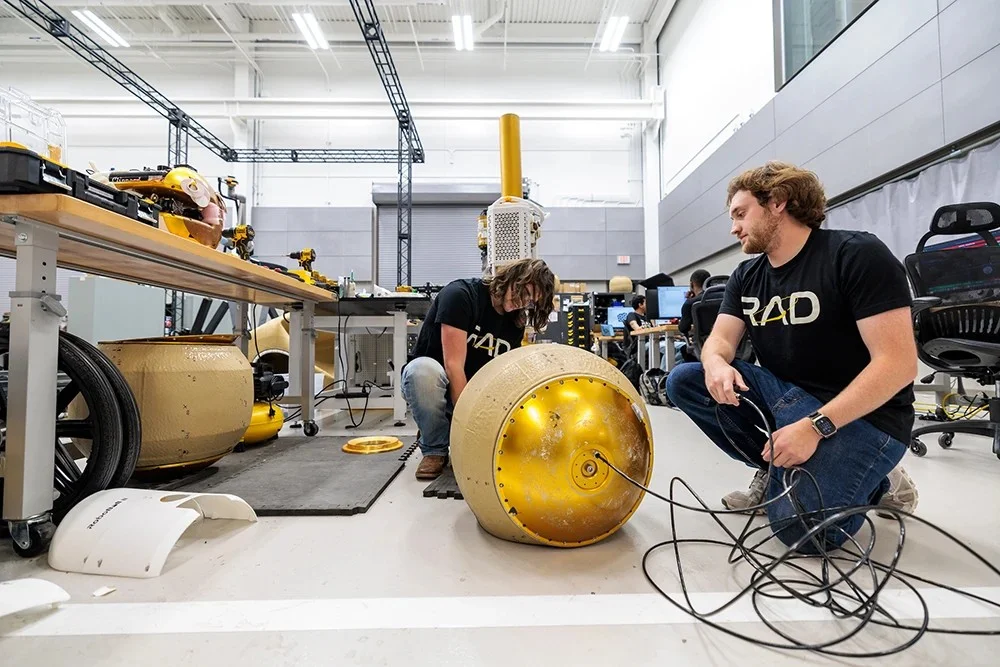
Flagship projects reflect that pragmatism. RoboBall, a spherical robot, uses an internal pendulum drive to traverse steep, debris-strewn and uneven terrain without tipping—an approach suited to disaster response or planetary exploration. The system comes in multiple sizes, with the largest built to carry scientific payloads. The RAD Exploration Vehicle (REV) is a multi-limbed platform designed to scramble over unpredictable ground on the Moon or Mars. “Marsupial” is a deployment concept in which a carrier robot launches specialized daughter robots to handle tight passages, manipulation tasks or reconnaissance. “Rover Rescue” addresses a common failure mode in space robotics by equipping a helper robot with a winch and arm to extract a stuck vehicle.
Texas A&M says the lab operates with a one-to-one mix of graduate students and full-time engineers, encouraging small, accountable teams. Culture is a differentiator: hiring emphasizes character and collaboration alongside technical skill, and the lab treats failure as data, pausing to capture lessons learned and re-spin designs. Students take on responsibility early—building, testing and leading efforts that might otherwise be reserved for mid-career engineers—reflecting both the lab’s structure and the pace of the field.
The ecosystem around the lab is expanding. Ambrose is associate director of the new Texas A&M Space Institute, which will provide testbeds—“Marsscape” and “moonscape”—for ground vehicles such as RoboBall and REV. Each summer, the RAD Lab hosts 30–40 undergraduates for a 10-week program that pairs them with graduate students and research engineers. The aim is to inculcate rapid, test-and-learn engineering and build a talent pipeline attuned to industry needs.
Photo credit: Abbey Santoro/Texas A&M University Division of Marketing & Communications