Insider Brief
- SAIA Agrobotics has raised €10 million in Series A funding led by Check24 Impact, with participation from the EIC Fund, Navus Ventures, and Oost NL, bringing its total funding to over €20 million to support a 2026 commercial rollout.
- The Netherlands-based startup, spun out of Wageningen University & Research, has developed a greenhouse automation system that moves plants to stationary robots for scanning, trimming, and harvesting—reducing labor costs by 50% and boosting yields by 20%.
- With deployments already underway at Growers United, SAIA is positioning its AI-driven “Food Factory of the Future” as a cornerstone of Europe’s sustainable, data-driven agricultural infrastructure.
SAIA Agrobotics, a Netherlands-based developer of greenhouse automation systems, has closed a €10 million Series A round led by Check24 Impact, with participation from the European Innovation Council (EIC) Fund and existing backers Navus Ventures and Oost NL. According to SAIA, the funding brings its total raised to more than €20 million and positions the company to begin commercial rollout in 2026.
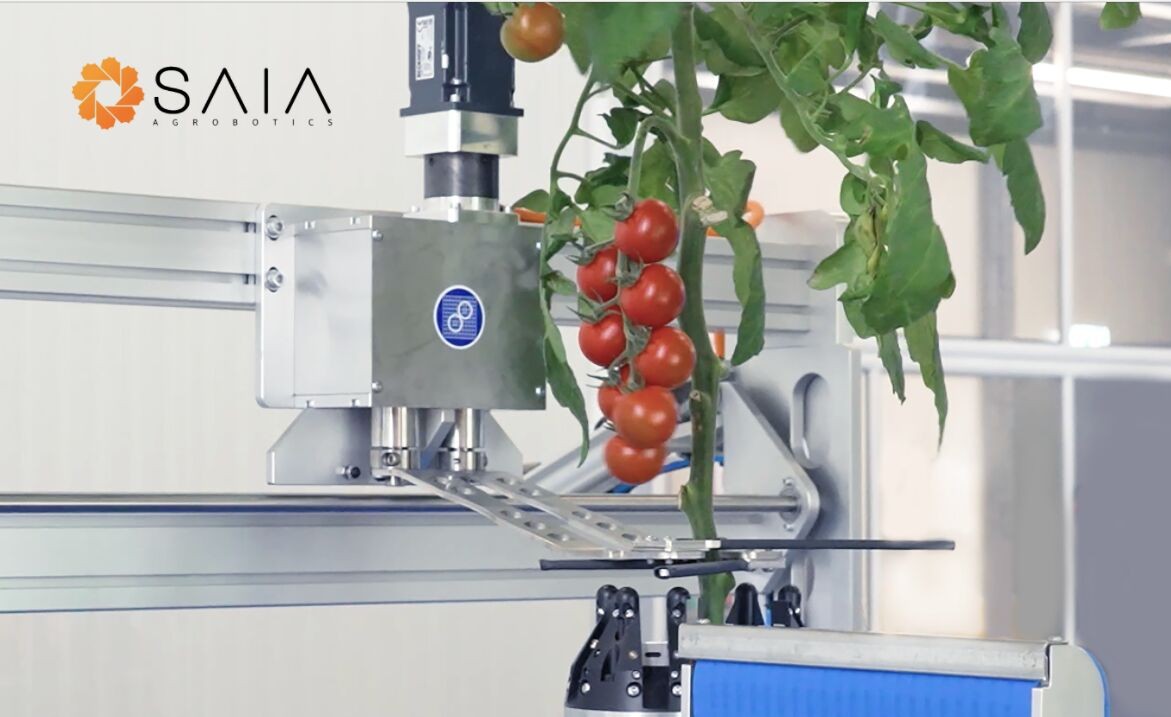
Founded out of Wageningen University & Research, SAIA said in its announcement that the company is targeting one of agriculture’s toughest constraints: labor. As global demand for fresh produce rises between 30% and 50% in the coming decades, greenhouse operators face mounting costs and worker shortages that threaten to slow production, the company noted. The company said its solution upends conventional automation by inverting the typical process — rather than sending robots through crowded greenhouses, SAIA’s system moves plants to stationary robots.
“At SAIA we recently completed the world’s first automated greenhouse, where plants go to the robot once a week for scanning and harvesting.” says Dr. Ruud Barth, CEO and Founder of SAIA. “We aim for a 20 percent increase in yields with a 50 percent total greenhouse labor reduction. This is a huge step forward in providing a local, resilient and sustainable food supply.”
By bringing crops to the robot, the company said it eliminates navigation challenges and enables faster, cleaner operations. The approach, SAIA said, lays the groundwork for what it calls the “Food Factory of the Future,” a data-driven, AI-enhanced production system where sensors, robotics, and software manage growth and yields autonomously.
The startup has already deployed its first commercial system with Growers United, one of Europe’s largest cooperative growers, where early trials have demonstrated weekly scanning and harvesting cycles.
The latest funding follows six years of development and multiple international patents covering its plant-handling and machine-vision technologies. Earlier investors included SHIFT Invest, Innovation Industries, and Oost NL, which participated in pre-seed and seed rounds.
Investors tout the company’s model as one that could reshape the economics of greenhouse farming.
”The SAIA growing systems allows harvesting 52 weeks a year, guaranteeing therefore higher annual yields per square meter,” noted Georg Heusgen, director at Check24. “The SAIA harvesting system applies what we all know from industry to the greenhouse sector. The product comes to the robot and not vice versa. There, under a standardized environment, robots can deleaf and harvest with an accuracy of over 99%, guaranteeing better product quality and the promised labor cost savings.“
“Digitization and robotization are needed to produce sufficient healthy and sustainable food now and in the future,” Wout Morrenhof, investment manager at Oost NL pointed out in the fun ding announcement. “SAIA has developed strongly over the past two years and is ready for the further commercialization of their product, which is why we, as Oost NL, are
investing again in the company.”
Jaap Zijlstra, director at Navus Ventures, added the company’s appreoach aligns “perfectly” with its investment strategy. “SAIA Agrobotics has developed innovative concepts and technology in the field of plants, automation, and logistics, creating a new approach to greenhouse growing, with the potential to take a major step in efficient and sustainable food
production.”
Svetoslava Georgieva, Chair of the EIC Fund Board, stressed SAIA’s potential impact on sustainable food production fits with the EIC’s strategy to support innovations in agrotechnology.