
Insider Brief
- UCLA has launched CellXpress.AI, a fully automated robotic system developed by Molecular Devices to grow, monitor, and analyze cells and tissues using AI, funded by a $1.9 million NIH High Impact Equipment grant.
- The system, housed at UCLA’s Molecular Screening Shared Resource (MSSR) within the California NanoSystems Institute, automates liquid handling, imaging, and data analysis, enhancing reproducibility, precision, and efficiency in biomedical research.
- Researchers will use the platform to advance stem cell and organoid studies, enabling faster, scalable, and more consistent experimentation while laying the groundwork for future autonomous and remote-controlled laboratories.
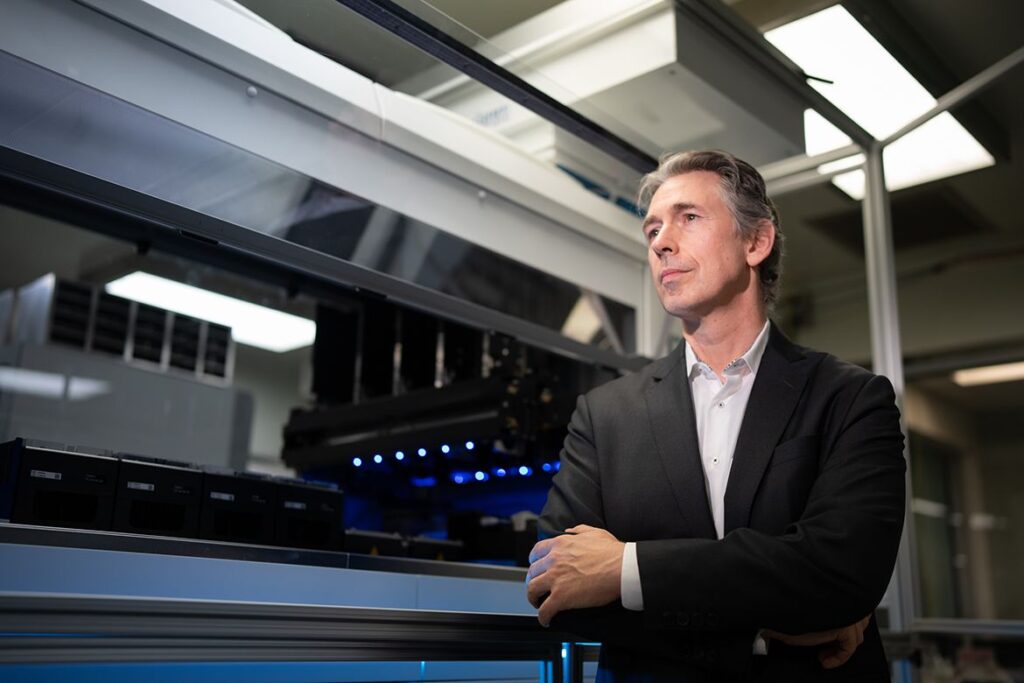
A new grant-funded robotic system at UCLA aims to transform one of the most time-consuming and labor-intensive areas of the life sciences: the cultivation of cells and tissue for biomedical research. According to the university, the fully automated CellXpress.AI platform, developed by Molecular Devices and housed within UCLA’s Molecular Screening Shared Resource (MSSR), combines robotics and artificial intelligence to grow, monitor, and analyze living cells with minimal human intervention.
Funded by a $1.9 million High Impact Equipment grant from the National Institutes of Health, the CellXpress.AI is the only instrument of its kind at a public research institution on the U.S. West Coast, according to UCLA. The device integrates seamlessly into MSSR, a core technology hub at the California NanoSystems Institute (CNSI), and is open for collaborations across academia and industry. Its introduction marks an important advance in reproducibility, accessibility, and efficiency for biomedical experimentation, the university noted.
“The bigger context for the new instrument is making science more accessible, credible, scalable and reproducible,” said Robert Damoiseaux, UCLA professor of molecular and medical pharmacology and of bioengineering and the principal investigator on the NIH grant. “These are all things we need if we’re going to ensure resources are used wisely — including precious taxpayer money.”
At its core, CellXpress.AI automates the most repetitive elements of cell biology. The platform handles liquid transfers, incubation, imaging, and data processing autonomously, while embedded AI systems track cultures, interpret images, and adjust experimental parameters in real time, UCLA noted. The system can even modify experiments midstream, bringing an unprecedented level of precision and adaptability to laboratory work that traditionally required months of manual effort.
Researchers are expected to use the system to accelerate stem cell and organoid research — fields that rely heavily on human cell models to study organ development, disease, and drug responses. Organoids, miniature three-dimensional tissues grown from stem cells, are widely regarded as better biological proxies for humans than animal models but require constant attention over long growth cycles. By automating these processes, the UCLA system allows scientists to focus on experimental design and data interpretation rather than routine maintenance.
The AI-enhanced microscope built into CellXpress.AI features a 21-megapixel camera and neural-network-based imaging analysis that eliminates the need for fluorescent or chemical staining, according to UCLA. This enables continuous monitoring without disrupting samples and produces richer datasets for model training and hypothesis testing. The combination of hardware precision and AI-driven feedback transforms the traditional “design-test-analyze” model into a continuous experimental loop, where design, testing, and analysis happen simultaneously.
“We can get as complicated or simplistic as we need to,” Damoiseaux said. “In addition, the end user can tap into the power of AI without having to be a mathematician. You can train the system to your specifications, so it doesn’t negate the individuality of your technique. But we also have experts like myself who help people delve into designs and workflows.”
The implications go beyond convenience. Automating cellular experimentation enhances reproducibility — a persistent challenge in biological research — by removing the variability introduced by manual techniques, researchers pointed out. It also makes high-throughput screening and complex experimental designs feasible for smaller laboratories that lack dedicated technical staff.
The new platform is already being integrated into collaborative research at UCLA’s David Geffen School of Medicine, the College Divisions of Life and Physical Sciences, and the Samueli School of Engineering. Its applications range from toxicology testing in drug discovery to modeling neurodegenerative and immune disorders.
Damoiseaux said while the system will make it much less expensive to find solutions and generate advanced cell and organoid models at scale that would be otherwise be impossible, the system is just the beginning of what will be possible for researchers.
“At the same time, this is just the first step toward a lab that’s more autonomous,” Damoiseaux said. “Remote experimentation is where this is heading, where your data is getting generated in the lab and you’re analyzing it at home. Right now, we’re at a good starting point.”
Image credit: Milo Mitchell/UCLA