

Guest Post By OutreachX
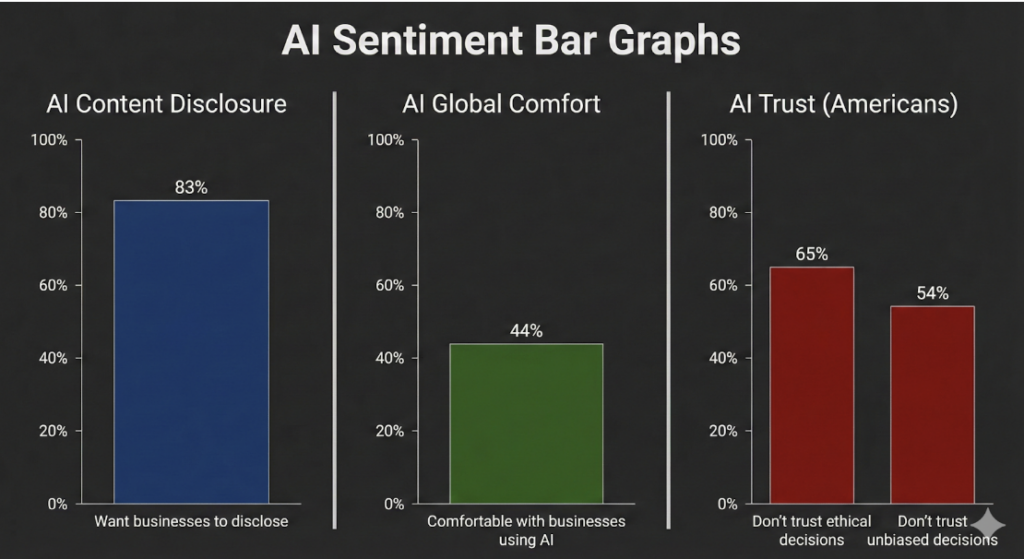
Marketers have long operated on the principle that transparency builds trust. AI has flipped the rulebook. In 2025, 83% of consumers demand disclosure when content is AI-generated, yet research suggests they immediately punish the brands honest enough to tell them. Welcome to the transparency trap.
When Transparency Backfires
Consumer trust in AI has deteriorated sharply, creating a paradox that’s catching businesses off guard. Research from Washington State University found that mentioning “AI-powered” in product descriptions decreased purchase intentions compared to “high-tech” for identical products.
“When AI is mentioned, it tends to lower emotional trust, which in turn decreases purchase intentions,” explains Mesut Cicek, clinical assistant professor of marketing and lead author of the WSU study. The effect is particularly strong for high-risk categories like expensive electronics and medical services. Separately, 78% of people say it’s harder than ever to tell AI from human-created content, yet they demand transparency, then punish companies that provide it.
The Label Effect
The Nuremberg Institute for Market Decisions ran controlled experiments across the U.S., UK, and Germany, showing consumers identical ads. One group was told the image was a normal photo; the other that it was AI-generated. The results reveal just how powerful the AI label has become.
- When labeled as AI-generated, the same ad was rated as less natural, less useful, and with more negative attitudes and lower willingness to research and purchase.
- A July 2025 CivicScience survey found that 36% of U.S. consumers are less likely to choose a brand that uses AI in advertising.
- SurveyMonkey’s State of Marketing 2025 report revealed that 46% dislike companies that use AI to generate content, and 43% are less likely to purchase from them.
- Consumer enthusiasm for AI-generated creator content crashed from 60% in 2023 to just 26% in 2025
Collectively, the data reveals a troubling awareness gap: consumers are vaguely aware AI is in the mix, don’t understand it, and default to suspicion when it’s disclosed. The AI label carries negative weight regardless of the actual quality of the content or product.
When Big Brands Get It Wrong
Even major corporations with sophisticated marketing teams are stumbling. The issue is not limited to isolated incidents, but represents a systemic challenge across the industry.
- In August 2025, Guess faced backlash after featuring an AI-generated model in an advertisement featured in Vogue.
- Coca-Cola released its second AI-generated holiday ad in November 2025, drawing criticism for choosing synthetic content over human creativity.
Interactive Advertising Bureau research from August 2025 reveals that 70% of marketers have experienced at least one “AI incident” from off-brand outputs to factual errors. Of those 70%, 40% have had to pause or pull campaigns, and over one-third report real brand damage or PR fallout. More than 60% now favor labeling AI-generated ads, even as 37% worry audiences will distrust them. Only 6% believed current safeguards were adequate.
The pattern is clear: businesses are rushing to deploy AI in marketing without adequate safeguards, then discovering the reputational costs only after campaigns go live. This confirms that the gap between AI’s promise and its current reality in consumer-facing applications is wider than most executives anticipated.
“The backlash we’re seeing isn’t really about AI, it’s about brands using it as a shortcut,” says Anirudh Agarwal, CEO of OutreachX. “When campaigns feel synthetic or lazy, audiences read that as a lack of effort and honesty. The winners won’t be the loudest about their ‘AI stack,’ but the ones who quietly align AI with human taste, brand safety, and real craft.”
What Companies Should Do
The evidence suggests a clear strategy: use AI to improve operations, customer service, and product quality, but keep it out of your marketing message. Focus on outcomes, faster service, better recommendations, improved experiences, not the technology enabling them.
Brands taking anti-AI stances are gaining goodwill. Dove pledged never to use AI-generated women in advertising. Nintendo’s president emphasized delivering “value that is unique to Nintendo and cannot be created by technology alone.”
The new strategic reality for 2025 is clear: The companies winning consumer trust are not shouting about their AI adoption. They are delivering authentic, human-centered experiences, regardless of the powerful technology enabling them behind the scenes. In a market where transparency is conventionally the path to trust, AI adoption represents the rare and critical exception where strategic silence is not just smarter, but essential for brand preservation and competitive advantage.
About OutreachX – OutreachX is an AI-driven marketing agency that helps leading enterprises, eCommerce brands, and SaaS companies grow worldwide.