
Insider Brief
- Investor Michael Burry’s renewed skepticism toward Big Tech’s AI spending has revived concerns that the current AI-driven market rally may be exhibiting early bubble dynamics concentrated in a small group of dominant technology companies.
- Itay Goldstein, a financial crises expert at the Wharton School at the University of Pennsylvania, explains that bubbles often form when asset prices move beyond disputed estimates of fundamental value and investor behavior shifts from valuation-based analysis to momentum-driven expectations.
- Goldstein cautions that although today’s AI boom differs from past housing-era leverage, growing household exposure to tech stocks and rapid expansion of lightly regulated private credit could increase systemic risk if AI valuations decline.
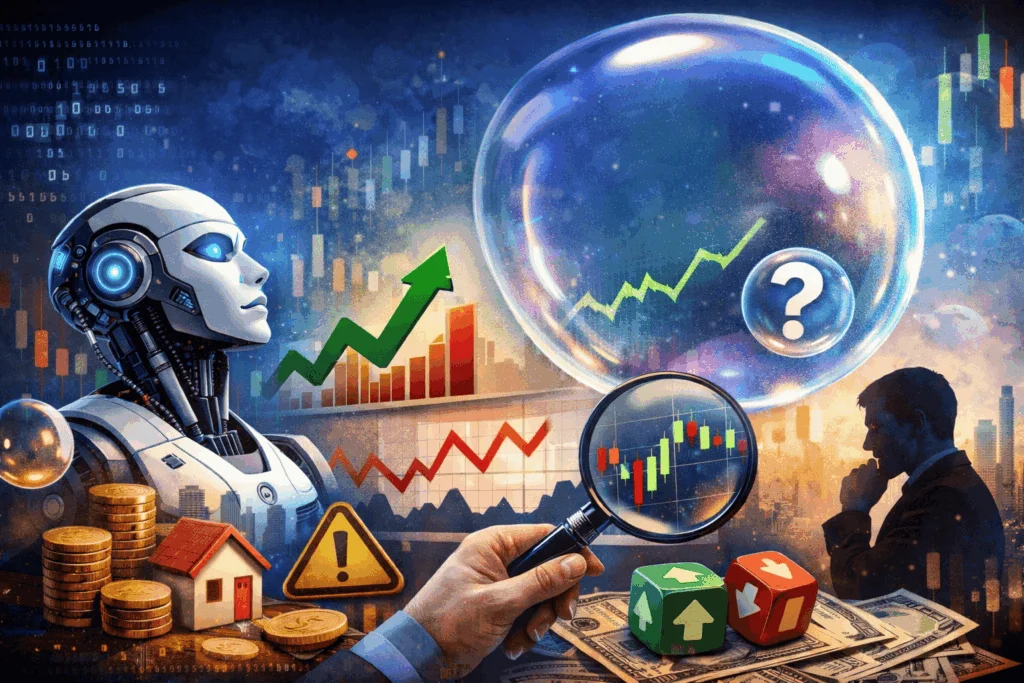
Investor Michael Burry’s renewed skepticism toward Big Tech’s artificial intelligence spending has reopened a familiar question on Wall Street: whether today’s AI-driven market surge reflects lasting economic transformation or the early stages of another speculative bubble. The debate comes as AI-related capital spending and stock gains draw comparisons to the dot-com era, with a small group of technology giants accounting for an outsized share of market performance.
According to Itay Goldstein, a financial crises expert at the Wharton School at the University of Pennsylvania, the presence of bubble-like behavior is less controversial than understanding what kind of bubble may be forming, the university reports. A financial bubble, he explains, occurs when asset prices rise well above their fundamental value, though that benchmark is inherently difficult to pin down.
“The challenge with fundamental value, however,” Goldstein said, “is that it is not a fixed, universally agreed upon number. Its calculation is subject to debate because it depends entirely on the financial models and assumptions used.”
Penn pointed out that Goldstein’s work emphasizes that bubbles often begin with rational optimism. Early investors buy because they believe assets are undervalued. As prices continue to climb, however, motivations tend to change. Investors gradually shift from asking what an asset is worth to asking how much higher its price might go, reinforcing momentum rather than fundamentals. This dynamic, he notes, has appeared repeatedly across financial history, including in the internet boom of the late 1990s and the housing market in the mid-2000s.
Crucially, Penn noted Goldstein distinguishes between bubbles that remain contained and those that threaten the broader economy. The dot-com crash was painful for investors but limited in its spillover effects. By contrast, the housing bubble became systemic because households, banks, and borrowers were deeply exposed through leverage. Today’s AI-related concentration carries different risks. A growing share of household wealth is tied to equity markets via retirement plans, and those portfolios are increasingly dominated by a small group of large technology companies whose valuations are closely linked to expectations around AI.
Goldstein also cautions against the assumption that spotting a bubble makes it easy to profit from one, according to the university. Markets can remain exuberant for extended periods, and betting against rising assets is highly time-sensitive. Short-selling requires deep capital reserves and exposes investors to potentially unlimited losses if prices continue to rise, making it an impractical strategy for most individuals.
Beyond AI valuations themselves, Goldstein flags broader financial vulnerabilities that could amplify a downturn. Rapid growth in private credit and other lightly regulated lending markets may be shifting risk into less visible parts of the system. When fast-expanding sectors combine with leverage and opacity, he argues, instability often builds quietly.
“The economy is an incredibly complex, interconnected system, so it’s not easy to completely map all the effects and all the spillovers that you’re going to see until the crisis starts to unravel,” he said.