
Insider Brief
- EngineAI Robotics Technology showcased two embodied intelligence platforms at CES 2026—the PM01 lightweight general-purpose agent and the T800 full-scale humanoid—positioning both as application-oriented systems rather than experimental prototypes.
- Live demonstrations emphasized full-body coordination and fine motor control, drawing sustained interest from industry partners and developers and prompting discussions around deployment scenarios for human–robot collaboration across multiple sectors.
- EngineAI said the PM01 is moving toward scaled deployment in areas such as transportation services, retail guidance, and inspection, while the T800 highlights the company’s system-level integration capabilities as it advances toward real-world industrial use cases.
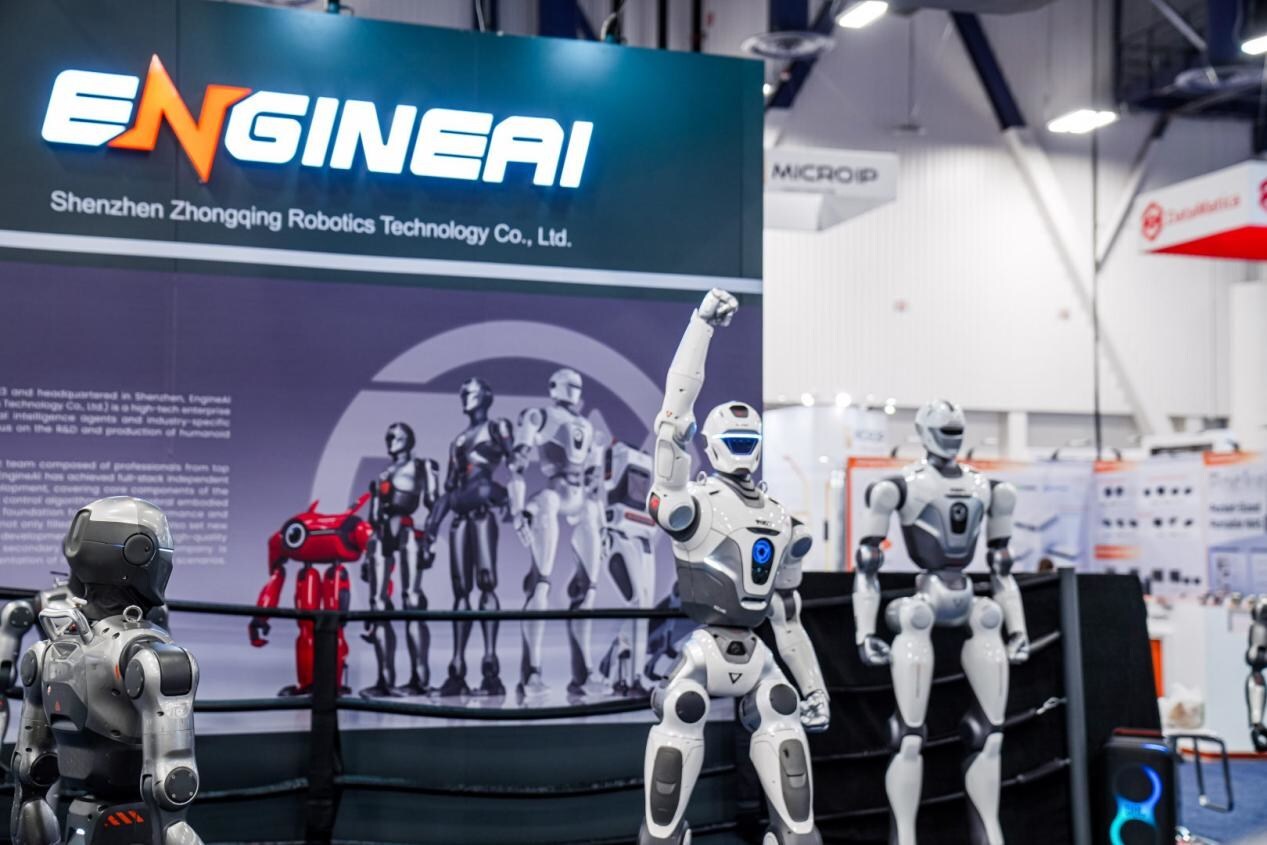
At CES 2026, China’s EngineAI presented two embodied robotics systems — the PM01 and the T800 — framing them as platforms intended to showcase their potential for practical human-robot collaboration.
The PM01 is EngineAI’s smaller and more mobile system, designed as a general-purpose embodied agent, according to the company. At CES, the company emphasized its stability, repeatability and ability to operate in structured public environments. EngineAI said the PM01 is moving toward scaled use in applications such as public transportation support, guided tours, retail services and automated inspection and patrol tasks. The focus is on consistency and adaptability rather than peak performance, with the platform aimed at environments where reliability and predictable behavior matter more than raw power.
The larger T800 humanoid marked its global debut at the show and reflects a different design objective. EngineAI presented the T800 as a system-level demonstration of its capabilities in high-torque actuation, joint design and full-body coordination. The robot uses an integrated joint module architecture capable of delivering up to 450 newton-meters of peak torque and 14 kilowatts of instantaneous joint power, according to the company. EngineAI paired that output with a high degree of freedom in the neck, waist and hands, enabling a wide range of anthropomorphic motion.
During demonstrations, the T800 was shown performing dynamic movements that placed stress on balance, load handling, and coordinated motion. EngineAI framed these capabilities as relevant to future industrial and service applications that require strength combined with dexterity, rather than as demonstrations meant to emphasize spectacle. The company said the platform is designed for real-world deployment scenarios where motion efficiency, control, and mechanical robustness are critical.
Looking ahead, EngineAI said it plans to focus on incremental system refinement and broader application coverage through 2026. The strategy prioritizes core technology development, system integration and alignment with global market requirements. Rather than expanding its portfolio rapidly, the company is emphasizing maturity, scalability, and the transition from controlled demonstrations to sustained use in operational environments.