Insider Brief
- Fauna Robotics is emerging from stealth with Sprout, a compact humanoid robot designed to operate safely around people and serve as a development platform for embodied AI applications.
- Sprout is shipping immediately in a Creator Edition and is already in use by organizations including Disney, Boston Dynamics, University of California San Diego, and New York University across retail, entertainment, education, and service-oriented settings.
- Sprout’s smaller, lightweight design, built-in safety features, and unified software platform are intended to reduce deployment friction and enable developers to move humanoid systems from research into real-world, shared human environments.
Fauna Robotics announced it is emerging from stealth with the launch of Sprout, a compact humanoid robot designed to operate safely in spaces shared with people and to serve as a development platform for embodied AI applications.
The New York–based company said Sprout is shipping immediately in a “Creator Edition” aimed at developers, researchers, and organizations looking to deploy humanoid systems outside controlled industrial settings. According to Fauna Robotics, the platform is intended to address a persistent gap in humanoid robotics: while hardware and AI capabilities have advanced, few systems are designed for routine use around people in real environments.
Fauna said Sprout is already being used by several organizations exploring applications in retail, entertainment, education, and service-oriented settings. Early users include Disney, Boston Dynamics, and academic institutions such as University of California San Diego and New York University.
“We started Fauna with a simple premise: robots belong around people,” Co-founder and CEO of Fauna Robotics Rob Cochran said in the announcement. “To date, robotics efforts have delivered heavy machinery poorly suited to working alongside people, in the places we spend the most time. Sprout is different. It is a canvas for developers — designed from first principles with safety in mind, so creators can focus on what excites them rather than building hardware and core software from scratch.”
The company presents Sprout as a departure from traditional humanoid platforms, which are often heavy, rigid, and designed for lab or industrial environments that require physical barriers and safety infrastructure. Fauna said those constraints have limited experimentation and slowed broader adoption of humanoid systems in settings where people are present.
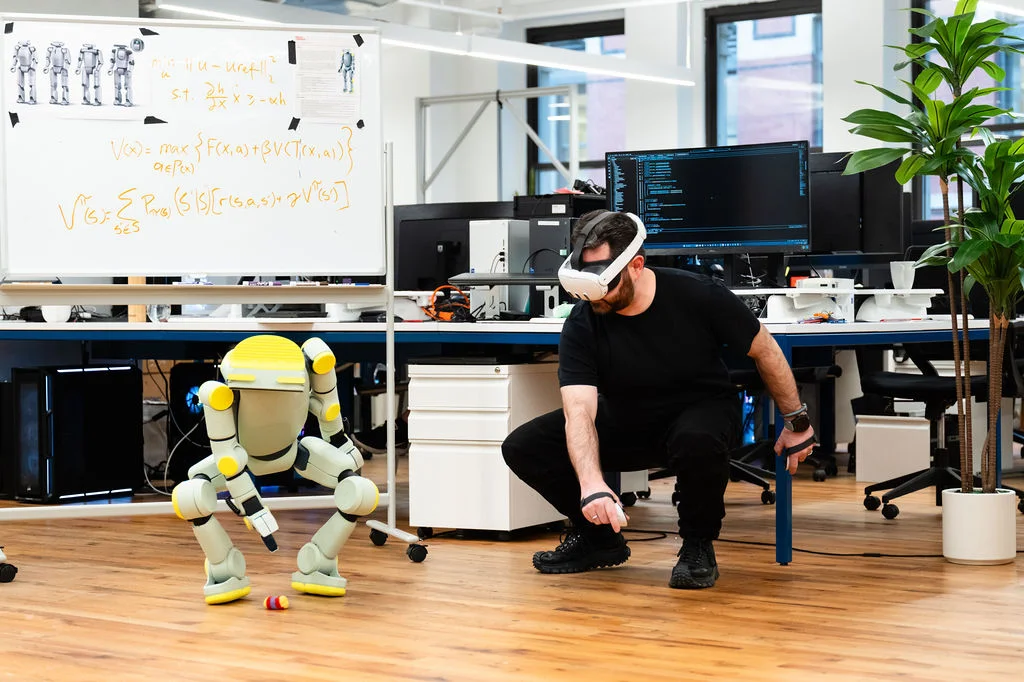
Sprout was designed with safety as a primary design constraint, according to the company. The robot stands about 1.07 meters (3.5 feet) tall and weighs roughly 22.7 kilograms (50 lbs.), placing it well below the size and mass of most full-scale humanoids. Fauna said the robot’s soft exterior, reduced pinch points, and low center of gravity are intended to lower the risk of injury in close-contact scenarios.
“Having a platform that’s smaller and safer to use gives our graduate and even undergraduate students the confidence to learn with less physical risk and experiment more boldly.” noted Ludovic Righetti, Professor of Electrical and Computer Engineering and Mechanical and Aerospace Engineering at NYU. “We are excited to see Sprout solve locomanipulation and reasoning problems both in a lab setting and in real-world environments, among people.”
Additional safety features include compliant motor control that allows joints to yield to external forces, software-enforced torque limits, and integrated sensing for obstacle detection. Fauna said these design choices allow Sprout to be used without gantries, cages, or other industrial safeguards, enabling it to sit on chairs, stand at desks, and operate in ordinary indoor environments.
Sprout is equipped with:
- Modular AI Architecture: A flexible software stack that allows developers to integrate and run their own models across the system.
- Ready-to-Use Motion Capabilities: Pre-trained motor control for core movements such as walking, kneeling, crawling, and sitting, with additional expressive motions available out of the box.
- Integrated Autonomy: Built-in mapping and localization paired with full-body teleoperation and integrated grippers for manipulation tasks.
- U.S.-Based Support: Domestic production, data handling, and technical support intended to speed development and support security oversight.
Fauna said Sprout is designed to reduce deployment friction through a unified software platform and SDK that allow developers to begin building applications quickly, avoiding the lengthy integration of perception, control, and autonomy systems typical in robotics. The platform supports a modular AI architecture, preconfigured motion capabilities, and built-in mapping, localization, teleoperation, and manipulation tools.
The company positioned Sprout as a general-purpose system intended to bridge research and production use and to be accessible to developers without deep hardware expertise. Fauna also emphasized approachability, citing voice interaction and expressive visual cues designed to support more natural human–robot interaction.
Sprout is manufactured in the United States, with engineering and production based in New York City, which Fauna said supports faster iteration and tighter control over security and reliability. The platform is available immediately to researchers, educators, and commercial developers, with pricing undisclosed.