Insider Brief
- Faraday Future Intelligent Electric has formed a new U.S.-based robotics subsidiary and unveiled its first humanoid and quadruped robots, expanding beyond electric vehicles into what it describes as embodied artificial intelligence.
- The company plans initial deliveries as early as late February, with more than 1,200 units reportedly covered by paid, non-binding deposits, primarily from business customers and co-creation partners across enterprise and public-sector use cases.
- Faraday Future said the robotics effort leverages AI capabilities developed for its vehicles, targets applications such as security, logistics, and hospitality, and reflects a broader strategy to diversify revenue beyond automotive manufacturing.
Faraday Future Intelligent Electric said it has formed a new robotics subsidiary and unveiled its first lineup of humanoid and quadruped robots, marking an expansion beyond electric vehicles into what the company describes as embodied artificial intelligence, according to Faraday Future.
The California-based company said the new unit, FF EAI-Robotics, will be headquartered in the U.S. and will oversee development and commercialization of three initial products: two humanoid robots and a quadruped platform aimed at security and inspection tasks. Faraday Future said initial deliveries are targeted for late February, with early orders supported by paid, non-binding deposits.
The announcement was made at the National Automobile Dealers Association show in Las Vegas, where the company also outlined a broader robotics strategy that combines hardware, AI software, and data infrastructure. Faraday Future said the effort builds on internal AI capabilities originally developed for its electric vehicles and reflects a long-term push to diversify its business model.
According to the company, more than 1,200 units are currently covered by deposits tied primarily to business customers and co-creation partners. Faraday Future said it plans to focus first on enterprise, public-sector, and institutional use cases, including logistics, security, hospitality, and education, before broader consumer applications.
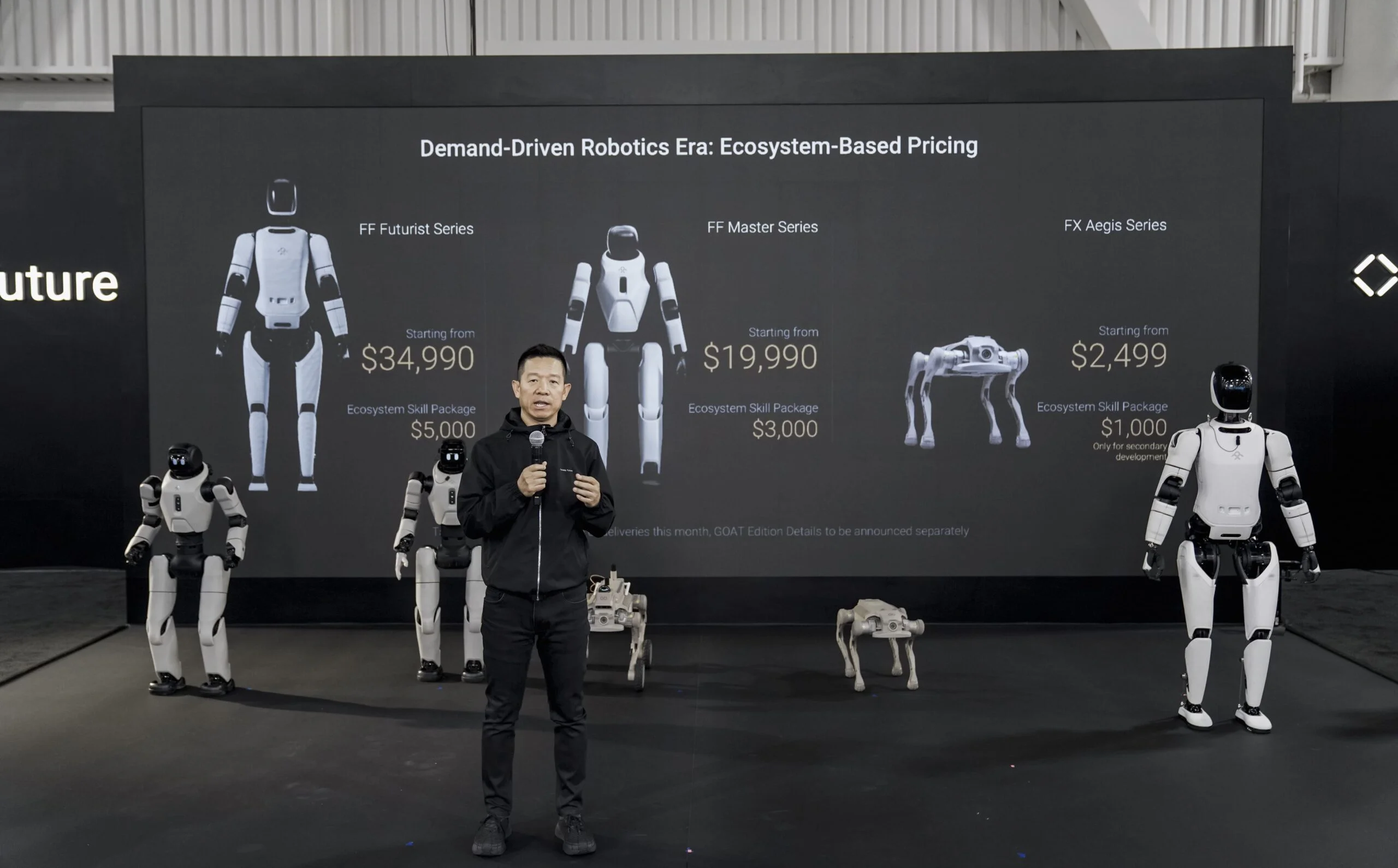
The humanoid models are positioned for customer-facing, research, and operational roles, while the quadruped robot is designed for patrol, monitoring, and hazardous environments, the company said. Pricing disclosed by Faraday Future places the humanoid robots in the tens of thousands of dollars, with the quadruped platform priced significantly lower, depending on configuration and software packages.
Faraday Future said the robotics business requires lower upfront investment than vehicle manufacturing and could reach commercial deployment more quickly. The company intends to use existing automotive sales and service channels to distribute robotics products over time, reflecting what it sees as a convergence between vehicle and robotics retail models.
Faraday Future said it will provide software updates, remote support, and after-sales service for the robotics lineup as it works to establish a foothold in the emerging U.S. market for embodied AI systems.
Image credit: Faraday Future