
Insider Brief
- MIT Sports Lab researchers are using artificial intelligence to turn figure skating jumps into quantifiable data, allowing coaches, athletes, and broadcasters to better understand the physics behind rotations, height and landings that are often invisible to the human eye.
- A system developed by former MIT Sports Lab researcher Jerry Lu analyzes standard video footage to extract metrics such as jump height, rotation speed and landing quality, benchmarking performances against elite skaters to identify marginal gains in technical execution.
- In parallel, MIT Sports Lab co-founder Anette “Peko” Hosoi is leading research into whether AI can meaningfully evaluate the artistic side of skating, examining how machine judgments compare with expert and novice human perceptions of aesthetic performance.
Figure skating has long been judged by what the eye can catch in real time — clean landings, tight rotations and the impression of ease. Now, artificial intelligence is beginning to quantify what even trained judges can miss, turning elite jumps into datasets and exposing the physics behind a sport built to disguise effort, according to MIT.
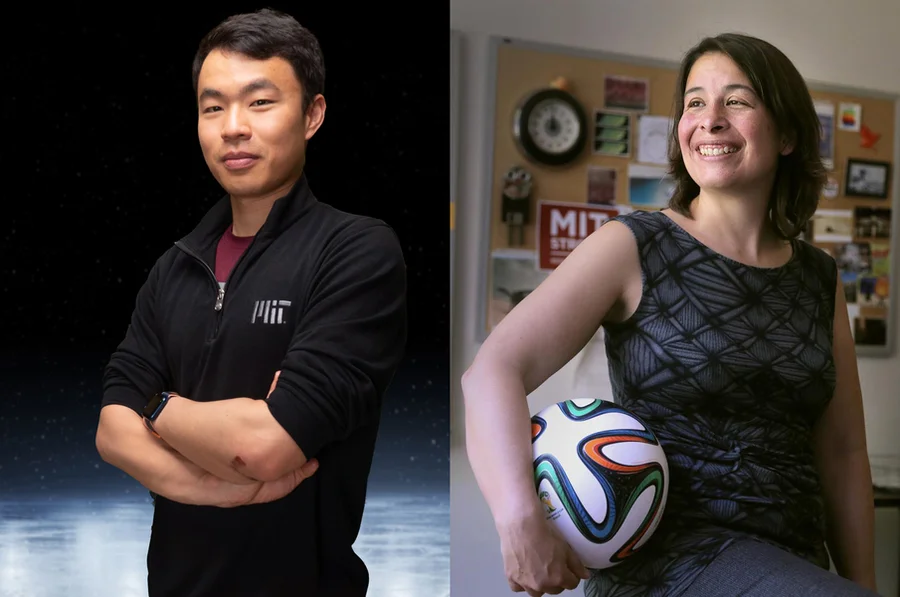
Jerry Lu, a former researcher at the MIT Sports Lab, has developed an AI-driven optical tracking system called OOFSkate that analyzes video of a skater’s jumps and breaks them down into measurable components. According to MIT, the system extracts physical metrics such as jump height, rotation speed and landing quality, then compares them against benchmarks drawn from elite and former elite skaters. The result is a data-driven way to see what separates a clean triple from a shaky quad, and where marginal gains might still exist.
“Skaters can always keep pushing, higher, faster, stronger. OOFSkate is all about helping skaters figure out a way to rotate a little bit faster in their jumps or jump a little bit higher,” Lu told MIT News. “The system helps skaters catch things that perhaps could pass an eye test, but that might allow them to target some high-value areas of opportunity. The artistic side of skating is much harder to evaluate than the technical elements because it’s subjective.”
The technology is built to work with ordinary video, including footage captured on a phone, Lu said. From a single clip, the system can estimate how many rotations a skater can physically support and how a given jump might score under international judging standards. The emphasis is on the technical side of skating, where objective measures exist and small improvements can translate into significant competitive advantage.
That technical focus is deliberate. While AI pose-estimation tools have advanced quickly, they still struggle with depth perception when athletes move toward or away from the camera. Figure skating, however, turns out to be a rare case where that limitation matters less. Jump height, rotation count and landing stability can all be inferred reliably without precise depth data, making skating unusually well suited to current AI techniques, Lu noted.
“This has down-the-line impacts for AI research and companies that are developing AI models,” Lu pointed out. “By gaining a deeper understanding of how current state-of-the-art AI models work with these sports, and how you need to do training and fine-tuning of these models to make them work for specific sports, it helps you understand how AI needs to advance.”
At the same time, researchers at MIT are exploring whether AI can ever meaningfully engage with the sport’s aesthetic side. Anette “Peko” Hosoi, co-founder and faculty director of the MIT Sports Lab, is leading new work examining how AI systems evaluate artistic performance. The question is not whether a model can generate a plausible opinion, but whether it reasons about beauty and expression in ways that resemble human judgment — or simply imitates patterns it has seen before.
Figure skating offers a unique testing ground because its artistic elements are formally scored. Unlike painting or music, skating provides numerical evaluations that can be compared across experts, novices and machines. Researchers are studying whether AI aligns more closely with expert judges, casual viewers or neither — and what that reveals about how these systems actually “understand” performance.
“We’re trying to understand differences between reactions from experts, novices and AI,” Hosoi told MIT News. “Do these reactions have some common ground in where they are coming from, or is the AI coming from a different place than both the expert and the novice?”
During the 2026 Milan–Cortina Winter Games, Lu will be working with NBC Sports to bring this data-driven perspective to television coverage of figure skating, skiing and snowboarding, according to MIT.
“The goal is to make these sports more relatable,” Lu said. “Skating looks slow on television, but it’s not. Everything is supposed to look effortless. If it looks hard, you are probably going to get penalized.”
As for the long-standing question of whether a skater will land a quintuple jump, the answer is shifting from speculation to inevitability, Hosoi said.
“I am now totally convinced it’s possible,” Hosoi noted. “We will see one in our lifetime, if not relatively soon. Not in this Olympics, but soon.”
Six, she suspects, may be where biology finally draws the line.
For now, AI is helping skaters and viewers alike better understand just how close athletes are to that edge — and how much work is hidden inside something that looks effortless.
Image credit: MIT News