Insider Brief
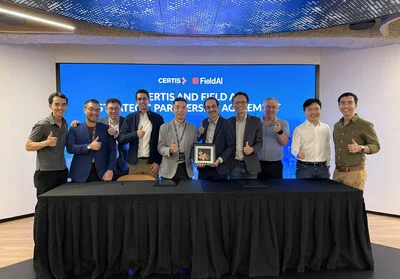
- Certis Group has partnered with FieldAI to deploy general-purpose autonomous robots in complex security operations, combining FieldAI’s autonomy stack with Certis’ Mozart orchestration platform to coordinate robots, human teams and workflows at scale.
- The collaboration targets multi-site deployments across transport hubs, commercial facilities and hazardous environments, aiming to automate routine patrol and monitoring tasks while improving efficiency in a labor-constrained global security market.
- FieldAI has opened a Singapore office to support the effort, with both companies planning to expand into adjacent use cases such as inspection and facilities monitoring as they develop safety, training and operational standards for large-scale autonomous security.
Certis Group is moving deeper into autonomous security, announcing a partnership with U.S.-based FieldAI aimed at scaling autonomous robots across complex, real-world operations.
The Singapore security and operations provider said the collaboration will combine FieldAI’s autonomy software with Certis’ Mozart orchestration platform, which coordinates robots, human teams and workflows in live environments. The objective is to enable multi-site deployments where robots operate alongside security personnel rather than as standalone systems.
According to Certis and FieldAI, the initial focus will be on routine security functions such as patrols, monitoring and incident detection across indoor and outdoor environments, including transport hubs, commercial facilities and remote or hazardous locations. The companies said the systems are intended to automate repetitive work while shifting human staff toward higher-value analysis and response roles.
The global security sector employs more than 30 million people and is operating in environments that are growing more complex and labor-constrained, further making reliability, safety and accountability essential, President and Group CEO, Certis Ng Tian Beng said in the announcement.
“For robotics to be viable at scale, they must integrate seamlessly with human teams, operational workflows and command systems,” Ng said. “This partnership with FieldAI reflects our approach of working with leading technology companies to deploy solutions that can perform consistently in live, mission-critical environments.”
At the core of the effort is the California-based FieldAI’s Field Foundation Models, a general-purpose autonomy stack designed to allow robots to function in dynamic environments without relying on pre-mapped routes or fixed infrastructure, the companies said. Performance improvements are shared across the fleet as systems encounter new operating conditions.
“Because the FieldAI brain doesn’t need prior maps or pre-planned routes, customers can deploy these systems quickly and scale them across new sites with minimal cost and setup,” noted Ali Agha, Chief Executive Officer of FieldAI. “Certis operates some of the most complex security environments globally, and integrating our autonomy technology with Certis’ orchestration and operational platforms allows us to advance these capabilities where it matters most: in live operations at scale.”
Certis said it plans to integrate the technology into its command-and-control and fleet management workflows, with both companies emphasizing reliability, safety validation and human-robot coordination as prerequisites for large-scale deployment. Initial efforts will focus on security applications, with potential expansion into inspection, facilities monitoring and broader field operations over time.
FieldAI has opened a Singapore office to support the partnership, and the companies said they will jointly develop training frameworks and operational standards as they work toward wider commercial deployment.
Image credit: FieldAI/Certis