Insider Brief
- Intrinsic has joined Google, transitioning from an Alphabet “Other Bet” into a distinct group within Google to accelerate deployment of physical AI in manufacturing and logistics.
- The company will leverage Google’s Gemini models, Cloud infrastructure and collaboration with Google DeepMind to move robotics AI from research into production-grade industrial systems.
- Intrinsic’s platform, including its Flowstate development environment, is designed to simplify building and deploying AI-enabled robotic applications across diverse hardware configurations, reducing integration complexity for manufacturers.
Intrinsic announced it has joined Google, marking a structural shift for the Alphabet-owned robotics software company as it seeks to make physical AI more widely available for industrial manufacturing and logistics.
Founded in 2021 as an Alphabet “Other Bet,” Intrinsic has built a software platform designed to simplify the development and operation of AI-enabled industrial robotics applications. By moving under Google, the company said it will operate as a distinct group while leveraging Google’s Gemini models, Cloud infrastructure and collaboration with Google DeepMind.
“The Intrinsic team has been working for years to enable access to intelligent robotics through a democratized platform, so more people can build and benefit from robotics applications,” Intrinsic CEO Wendy Tan White said in a blog post. “Combined with Google’s incredible AI and infrastructure, we’re going to unlock the promise of physical AI for a much broader set of manufacturing businesses and developers. This will fundamentally shift production, from its economics to operations, and enable truly advanced manufacturing.”
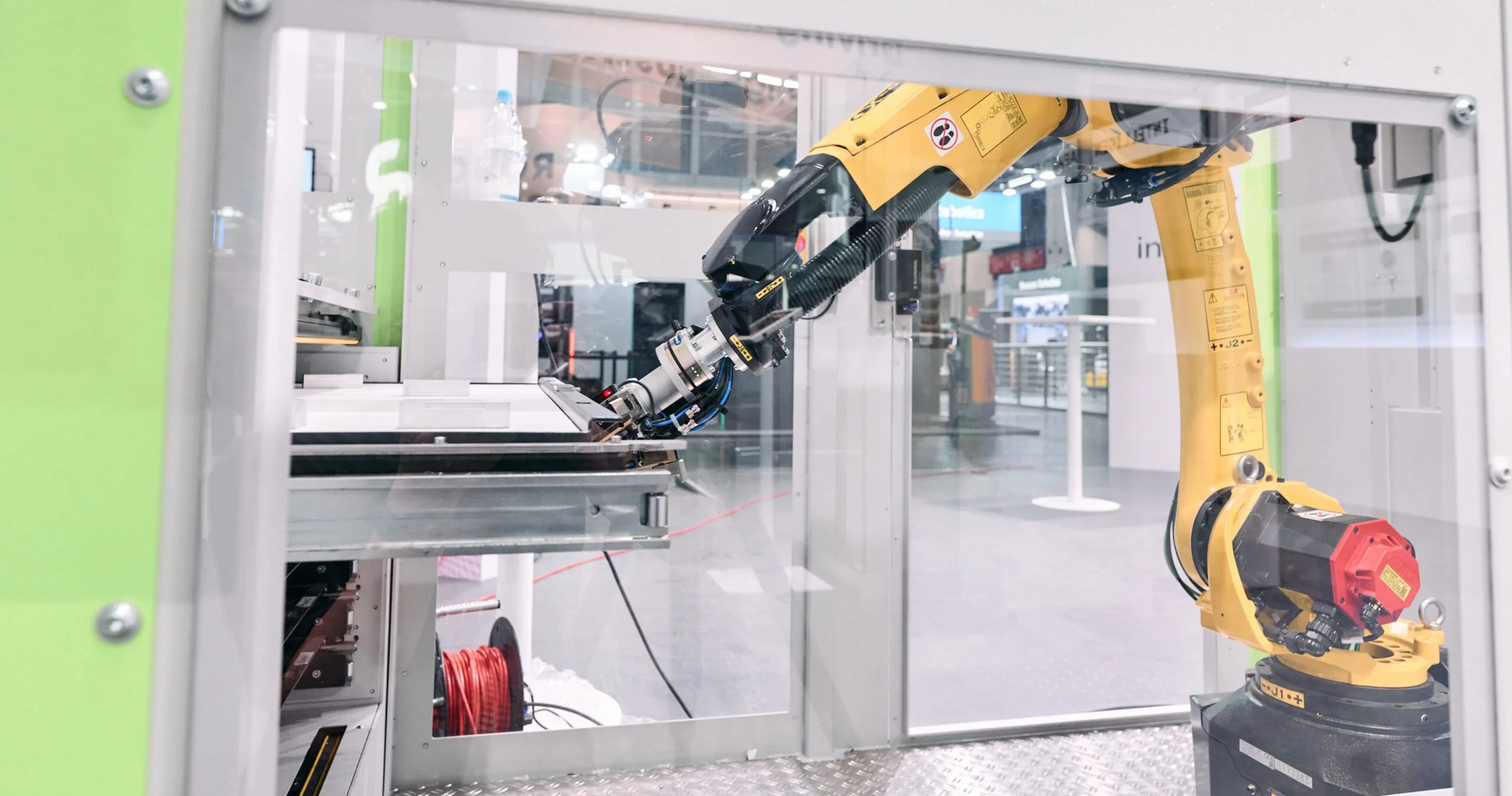
According to Intrinsic, the integration is intended to speed the transition of frontier AI research into production-grade robotics systems used in real-world industrial environments. The company has positioned its platform as a unifying software layer that works across different robot arms, sensors, cameras and hardware configurations. This allows developers to focus on applications rather than system integration, the company said.
Intrinsic’s core offering includes Flowstate, a web-based development and simulation environment that enables users to assemble robotic workflows using modular “skills.” These skills can be manually programmed or AI-enabled, reducing the engineering time typically required to deploy industrial automation. The company said customers range from small manufacturers to global firms including Foxconn.
In the last quarter of 2025, Foxconn and Intrinsic launched a joint venture aimed at advancing AI-enabled robotics in electronics manufacturing and building what they described as the intelligent factory of the future. The partnership targets high-growth segments such as AI servers, GPUs and data center hardware, where production still relies on a mix of rigid automation and manual processes despite surging demand.
Previously, Instrinsic acquired Robots-as-a-Service company Vicarious and several for-profit subsidiaries of Open Robotics in 2022.
The broader strategy reflects growing momentum around “physical AI,” where machine learning models are embedded directly into machines that perform real-world tasks such as assembly, inspection and materials handling. Intrinsic said that aligning more closely with Google will allow it to industrialize AI-driven robotics at scale, bringing research advances into production environments more quickly and with lower integration barriers.
“At Google, we see the immense opportunity in bridging the gap between the digital and physical world — that is also true for intelligent robotics in industries like manufacturing and logistics,” Hiroshi Lockheimer, Chief Product Officer of the Other Bets, noted. “We’re excited to welcome the Intrinsic team to Google, so we can bring breakthrough AI to more businesses and industries, at scale.”
Image credit: Intrinsic