Insider Brief
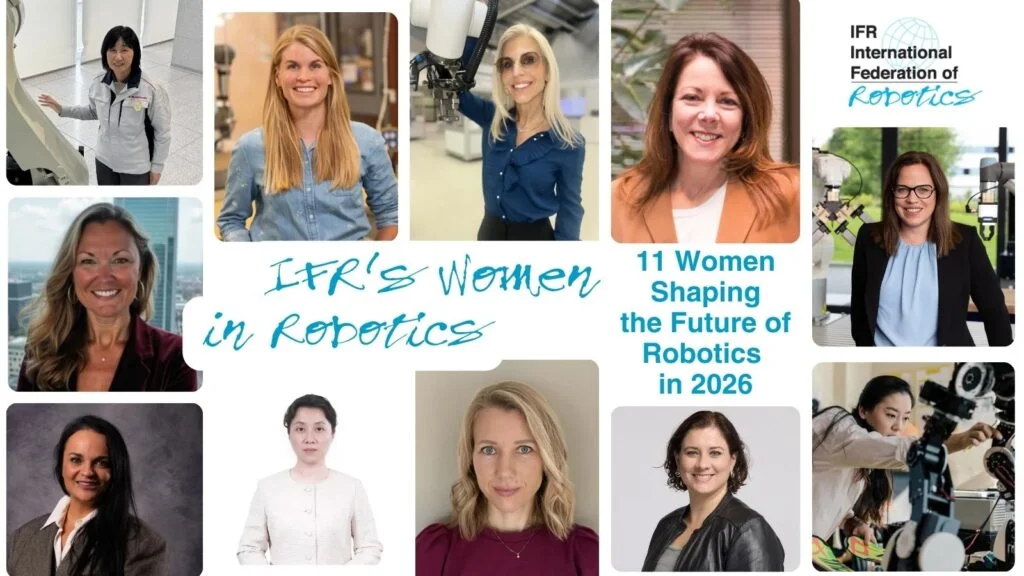
- The International Federation of Robotics named 11 leaders to its Women Shaping the Future of Robotics 2026 list, recognizing contributors advancing next-generation robotics systems across industry and academia.
- The organization highlighted the role diverse teams play in developing AI-driven robotics as global industrial robot installations are projected to surpass 700,000 units annually by 2028.
- IFR noted that while women represent more than 40% of the global workforce, they remain underrepresented in manufacturing and STEM fields, where participation remains below 35% and 30% respectively.
The International Federation of Robotics has named 11 leaders to its “Women Shaping the Future of Robotics 2026” list, highlighting contributors advancing next-generation robotics systems across industry and academia.
The organization said the recognition is intended to increase visibility for women working in robotics as automation expands into new sectors. According to the IFR, companies investing in automation are increasingly emphasizing workforce diversity as part of their strategy to remain competitive in a rapidly evolving technology landscape.
“Women are critical contributors in the fast‑growing field of robotics,” IFR Gneral Secretary Dr. Susanne Bieller, General Secretary said in the announcement. “This is clearly illustrated by diverse teams developing unbiased AI technology and next-generation robotics systems. These projects aim to open up new sectors for automation, not only in traditional manufacturing settings, but also in healthcare and elderly care, or in consumer markets.”
IFR’s 11 Women Shaping the Future of Robotics in 2026
- Younseal Eum — AeiROBOT, South Korea
- Stefania Ferrero — Comau, Italy
- Christina Jørgensen — Universal Robots, Denmark
- Allison Krumpe — HealthTech Partners Global, USA
- Henrike Neulen — Intrinsic, Germany
- Asami Sasao — Kawasaki Heavy Industries, Japan
- Kristina Schunk — Schunk, Germany
- Mikell Taylor — General Motors, USA
- Susanne Timsjö — ABB Robotics, Sweden
- Dana Whalls — Association for Advancing Automation (A3), USA
- Prof. Rong Xiong — IPLUSMOBOT / Zhejiang University, China
The IFR notes that despite gains in workforce participation, women remain underrepresented in manufacturing and technology fields. The organization cited the World Economic Forum’s Global Gender Gap Report 2025 found women now make up more than 40% of the global workforce, but account for less than 35% of workers in manufacturing and under 30% of professionals in science, technology, engineering and mathematics.
Image credit: IFR