Insider Brief
- China-based XGSynBot unveiled its Z1 wheeled humanoid robot designed for industrial environments, featuring modular tooling and real-time AI control to allow a single system to perform multiple manufacturing tasks across different workstations.
- The company said the robot uses a quick-change end-effector system that swaps tools such as grippers, welders and suction devices in about six seconds, along with integrated high-performance joint modules and a dual-system AI architecture that combines task planning with high-frequency motion control.
- XGSynBot also launched its STARFIRE ecosystem initiative to expand industrial partnerships, open hardware interfaces to third-party developers and gradually release datasets and software tools to accelerate embodied AI development across manufacturing sectors.
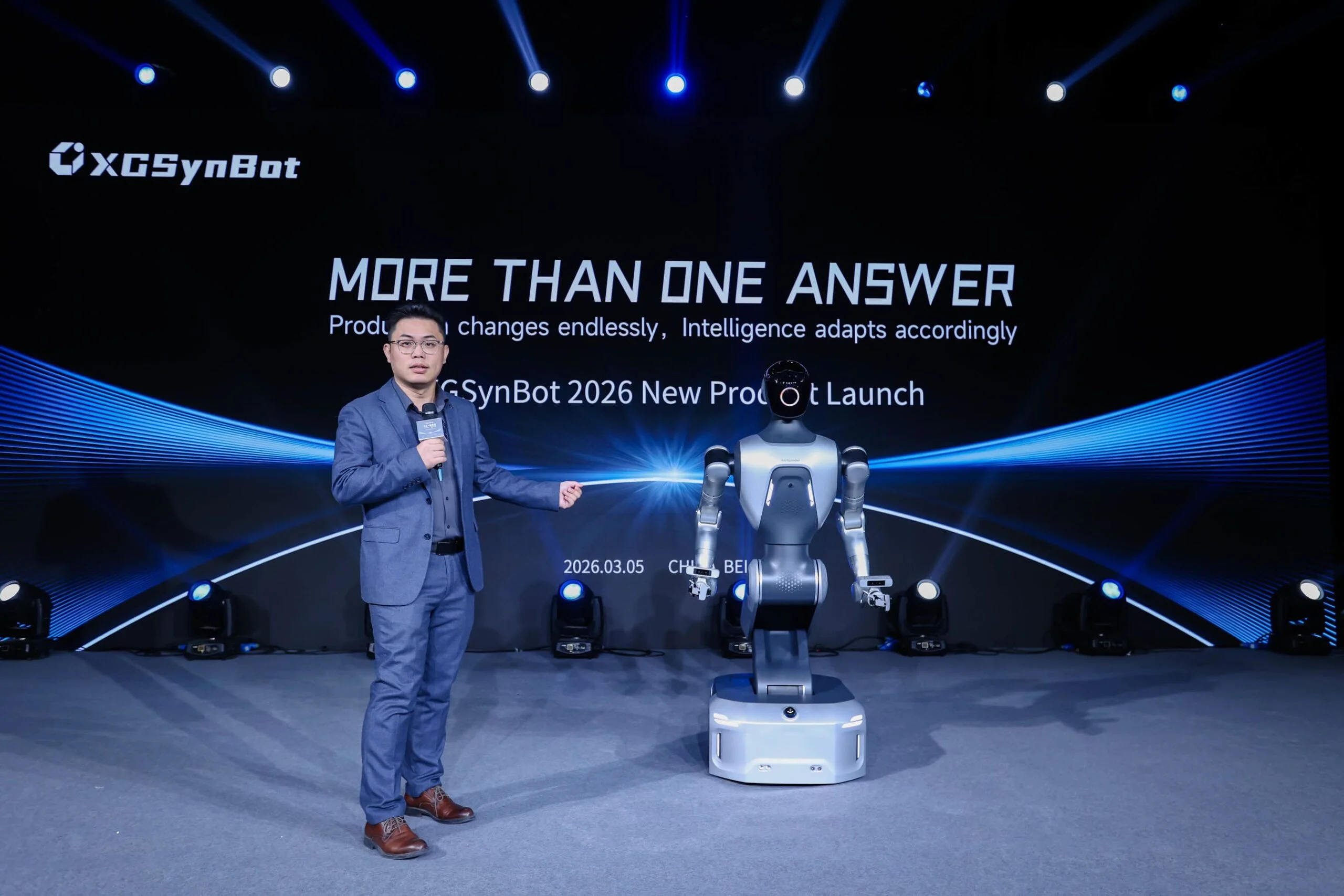
China-based XGSynBot has unveiled its Z1 wheeled humanoid robot designed with a system intended to handle multiple factory tasks through modular tooling and real-time AI control.
According to the company, the robot was introduced during product launch events held in Silicon Valley and Beijing last week, where the company presented the Z1 as a platform designed for continuous operation in demanding production environments. XGSynBot said the system is built to operate in conditions typical of manufacturing floors, including high workloads, variable layouts and precision assembly requirements.
How Does Z1 Work?
At the core of the Z1 platform is a modular quick-change end-effector system that allows the robot to switch between tools such as grippers, welders and suction devices in about six seconds. According to XGSynBot, the approach allows a single robot to perform multiple tasks across different workstations, reducing the need for specialized single-purpose robots.
The robot also incorporates the company’s XG high-performance joint modules, which integrate motors, sensors and reducers into a single unit. XGSynBot said this design improves precision and mechanical stability while reducing signal delays and interference that can occur in more complex distributed robotic systems.
Z1 is powered by a dual-system control architecture designed to balance high-level reasoning with fast motion control. According to the company, one processing layer handles planning and natural-language task instructions, while a second system running at high frequency manages real-time motor control and tactile feedback.
XGSynBot said the platform is designed to support continuous operation in manufacturing settings where robots must adapt to changing tasks, materials and production workflows. The company said the system’s modular architecture allows manufacturers to reconfigure robots quickly for different applications without extensive reprogramming.
STARFIRE: Embodied AI Cooperation Ecosystem
Alongside the product launch, XGSynBot said it plans to expand collaboration with industry partners through its STARFIRE ecosystem initiative, which includes:
- Scenario Co-Innovation: Deploy large-scale embodied AI solutions across 3C electronics, automotive and renewable energy sectors with global industry partners.
- Product Synergy: Open hardware interfaces to third-party tool and component manufacturers to support a plug-and-play industrial robotics ecosystem.
- Open-Sourcing: Gradually release proprietary datasets, scenario models and software development kits in phases to collaborate with academic and industry developers working on embodied AI.
The company noted the launch comes as global investment in embodied AI accelerates, with companies working to move intelligent robots from research labs into real-world workplaces. Despite rapid advances in AI models, large-scale commercial deployment remains a major challenge, and XGSynBot said its focus on durability, modular design and ecosystem development reflects a push toward robots built to operate reliably in demanding manufacturing environments.