Insider Brief
- Vitestro raised $70 million in an oversubscribed Series B round backed by Labcorp Venture Fund, Mayo Clinic and Sutter Health, alongside investors including InterVest, MGFO, PGGM, Puma Venture Capital and ROM Utrecht, with participation from existing backers such as Invest-NL, the EIC Fund, Fred Moll, NYBC Ventures and Sonder Capital.
- The Dutch medical robotics company said the funding will support development of the next generation of its Aletta autonomous robotic blood-draw system, as well as manufacturing scale-up, expanded clinical programs and commercial infrastructure ahead of broader market deployment.
- Vitestro said part of the funding will also support its U.S. FDA De Novo regulatory pathway while expanding clinical adoption in Europe, where the Aletta system is already CE-marked and being used in clinical and pre-commercial settings.
Vitestro has raised $70 million in an oversubscribed Series B round to expand development and commercialization of its autonomous blood-draw robot.
According to the Dutch startup, the financing included strategic investment from Labcorp Venture Fund, Mayo Clinic and Sutter Health, along with new financial investors InterVest, MGFO, PGGM, Puma Venture Capital and ROM Utrecht. Existing investors Invest-NL, the European Innovation Council Fund, Fred Moll, NYBC Ventures and Sonder Capital also participated in the round, Vitestro said.
How Will Vitestro Use the Funding?
Vitestro said the funding will support development of the next generation of its Aletta autonomous robotic phlebotomy system and prepare the technology for broader clinical deployment. The company plans to use the proceeds to scale manufacturing, expand clinical programs and build commercial infrastructure as it prepares to bring the system to additional healthcare markets.
“Closing our Series B financing reflects strong conviction in our mission to establish a new standard in autonomous robotic venous access and diagnostic blood collection,” CEO and co-founder Toon Overbeekesaid in the announcement. “Our technology has evolved from a novel vision into a clinically validated reality, and we are grateful for the support of this distinguished syndicate of strategic, healthcare and life science investors as we move toward broad clinical adoption. Diagnostic blood collection remains the highest-volume invasive medical procedure globally, with billions of procedures performed annually.”
Part of the funding will also support the company’s regulatory efforts in the United States, where Vitestro is pursuing clearance through the U.S. Food and Drug Administration’s De Novo pathway. The company said it plans to expand adoption first in Europe, where its system already carries CE marking, before pursuing broader commercialization in the U.S.
How Does it Work?
Vitestro’s Aletta system is designed to automate diagnostic blood collection, one of the most common medical procedures performed worldwide. The platform combines robotics, imaging technology and artificial intelligence to identify suitable veins, guide needle placement and collect blood samples with minimal human intervention.
The company said the technology is intended to support hospital and outpatient phlebotomy departments by performing routine blood draws, helping address staffing shortages and improving consistency in sample collection.
Vitestro said the system is currently deployed in clinical and pre-commercial environments in Europe The company plans to conduct additional clinical studies and pilot programs with healthcare providers to validate performance in real-world settings.
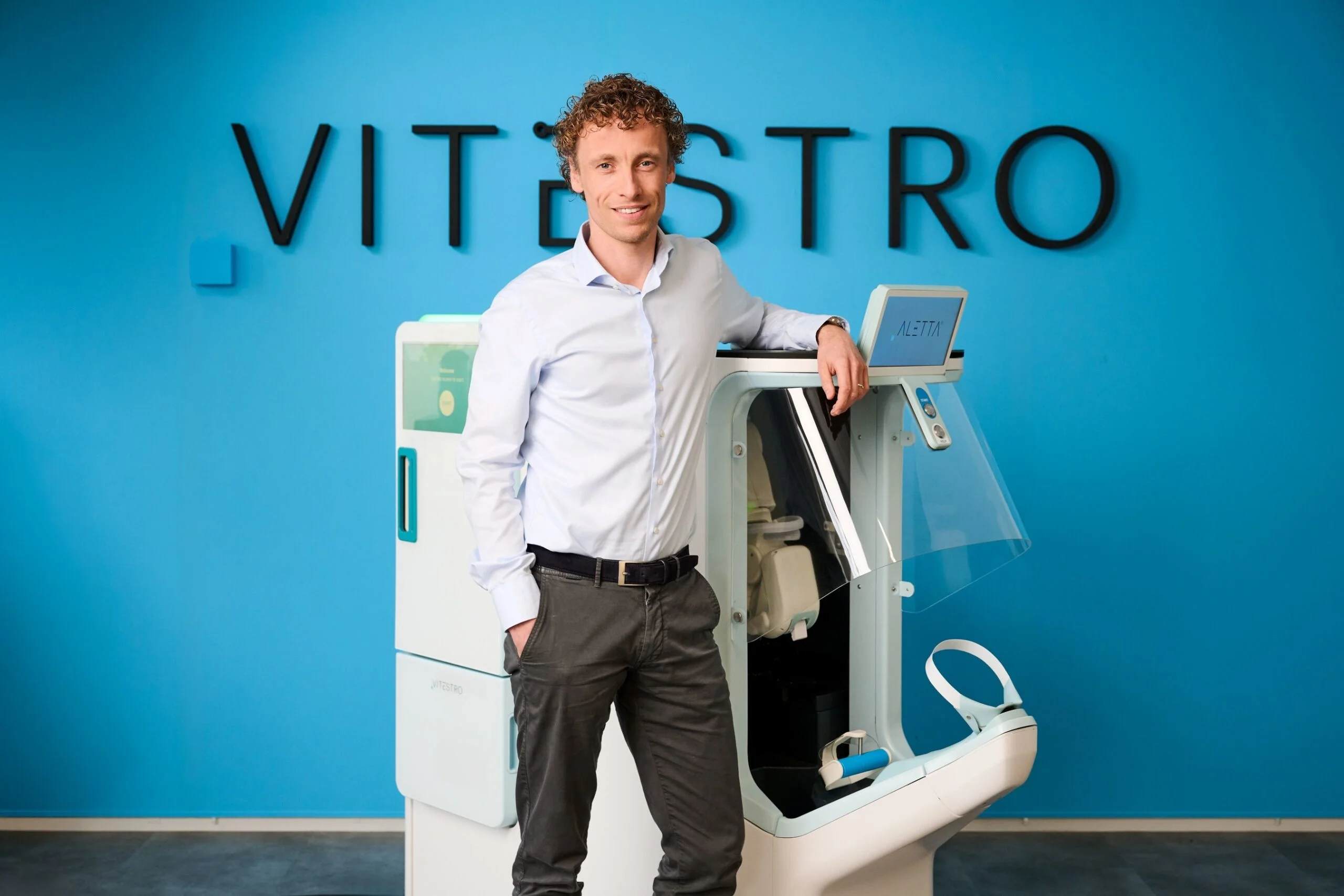
Image: Toon Overbeeke with Aletta, Vitestro’s device for autonomous blood draws (Credit: Vitestro)