Insider Brief
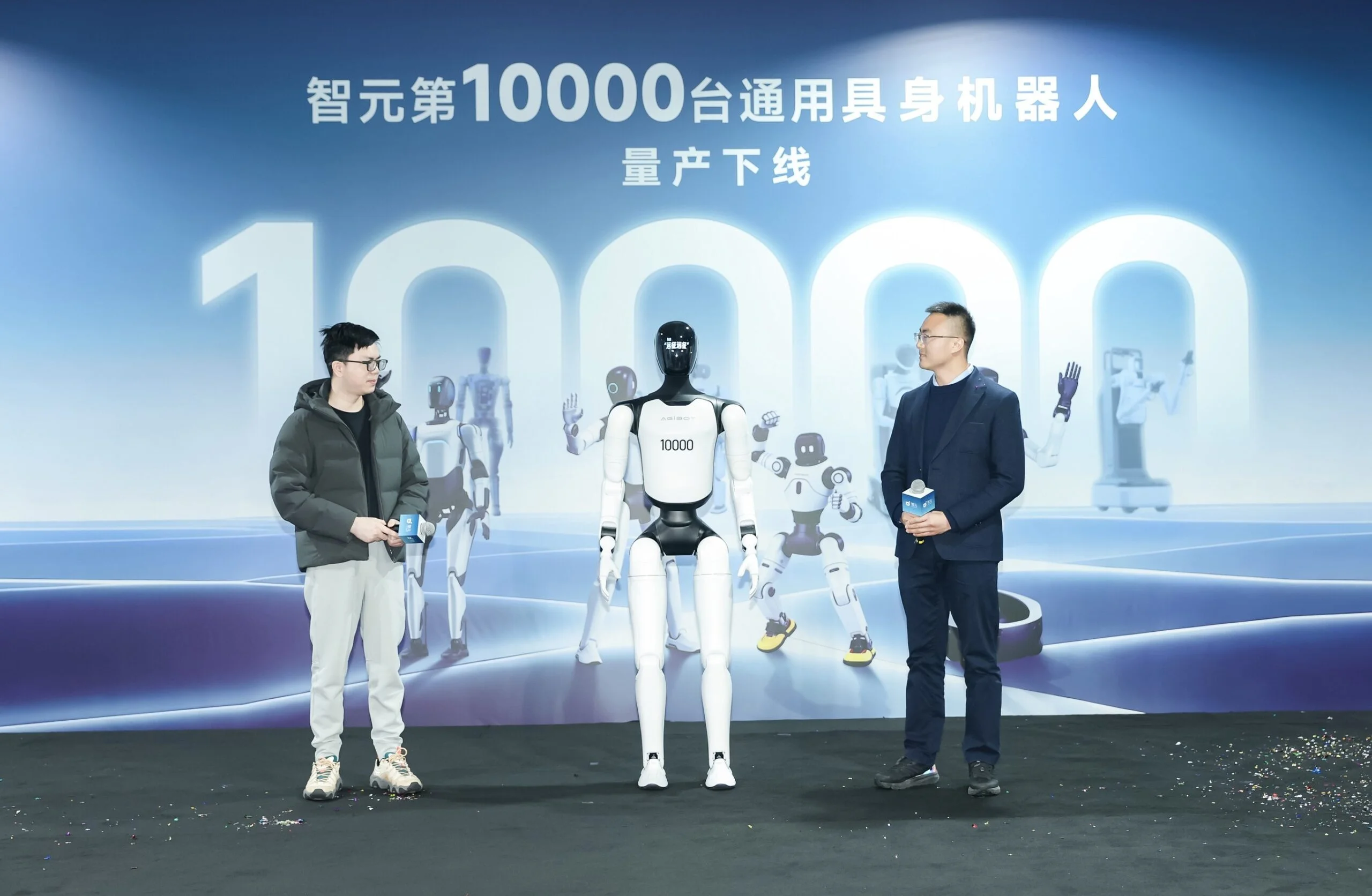
- Agibot said it has produced its 10,000th humanoid robot, marking a shift from early-stage validation to scaled deployment as production accelerated from 1,000 units over nearly two years to 5,000 in about a year and then doubled to 10,000 in three months.
- The company attributed the ramp to a maturing supply chain and manufacturing efficiency gains, with robots now deployed across logistics, retail, hospitality, education and early industrial workflows, moving beyond pilot programs into repeatable commercial use.
- Agibot said global demand is expanding deployments across Europe, North America and Asia, with performance improvements increasingly driven by real-world usage data and coordinated advances across hardware, software and production systems.
Agibot announced it has produced its 10,000th humanoid robot. The Chinese company said the pace of production has accelerated sharply, with output doubling from 5,000 to 10,000 units in three months after taking years to reach its first 1,000.
“Reaching 10,000 units is not simply about producing more robots, it reflects a fundamental shift in our ability to scale,” CTO Peng Zhihui said in the announcement. “As our supply chain matures and manufacturing standardizes, we are seeing a pivot from small-scale, niche applications to robust, large-scale commercial demand. The widespread deployment of AGIBOT’s robots is no longer about seeking technical viability, but about delivering scalable value and driving the adoption of embodied AI.”.
The robots are already in use across logistics, retail, hospitality, education and early-stage industrial workflows, reflecting a move beyond pilot programs into repeatable commercial deployments, according to Agibot. The company also pointed to growing international demand, with systems deployed across Europe, North America and parts of Asia and the Middle East.
Agibot said scaling production is now tied to improvements across its supply chain, manufacturing and software systems, allowing performance and deployment to advance in parallel. Agibot said progress is now less about individual breakthroughs and more about continuous system refinement driven by real-world usage data.
In January, Agibot said it was entering the U.S. market at CES with more than 5,000 humanoid robots shipped, AI Insider reported at the time. The company, founded in 2023, outlined a unified embodied AI architecture and a broad portfolio spanning humanoids, quadrupeds and industrial systems, with deployments across commercial and research settings and a partner model built on a standardized platform.
Image credit: Agibot