Insider Brief
- HII and GrayMatter Robotics signed an MOU to explore integrating physical AI into shipbuilding operations to increase throughput, support the workforce and accelerate U.S. Navy production.
- The partnership will focus on autonomous surface preparation, coating and inspection, along with broader efforts in automation, workforce training and scaling unmanned system production.
- The collaboration aligns with HII’s push to boost shipbuilding output and leverage AI-driven robotics to improve efficiency, consistency and delivery timelines in complex naval manufacturing.
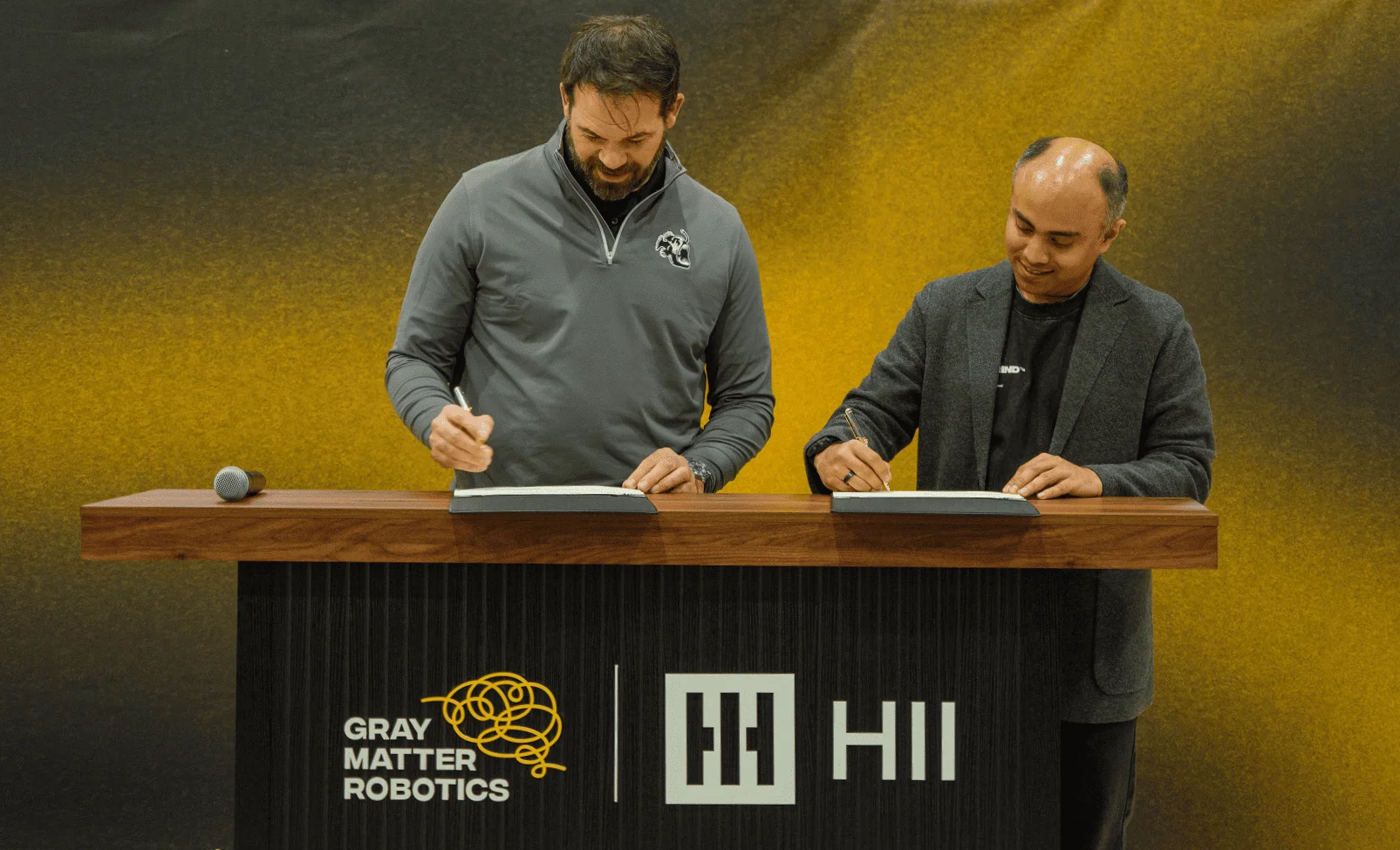
PRESS RELEASE — HII (NYSE: HII) and GrayMatter Robotics (GMR) signed a memorandum of understanding (MOU) to explore the integration of GMR’s Physical AI into shipbuilding operations that could accelerate throughput, strengthen the maritime industrial base, and augment the shipbuilding workforce. This will include bringing autonomous surface preparation, coating, and inspection technologies into shipbuilding. The MOU signing ceremony took place at GrayMatter Robotics’ headquarters and was attended by Eric Chewning, HII’s executive vice president of maritime systems and corporate strategy, and Ariyan Kabir, GrayMatter Robotics CEO and co-founder.
“We are in the midst of an American shipbuilding renaissance and we are extremely excited to partner with GrayMatter Robotics to explore incorporating their state-of-the-art physical AI models into our shipbuilding operations,” Chewning said. “Our shipbuilding throughput was up 14% in 2025 and we are looking for an additional 15% increase in 2026. By working with new partners like GMR we can further augment our workforce and speed up U.S. Navy shipbuilding production. I look forward to jointly developing autonomous AI-based manufacturing solutions and integrating them into our High-Yield Production Robotics (HYPR) initiative that leverages physical AI technologies to our shipbuilding processes. Navigating this transformational partnership has the potential to increase our throughput efficiency without sacrificing quality.”
HII and GrayMatter Robotics will work to identify and potentially pursue future opportunities in four areas that include autonomous shipbuilding capability development, integration of GMR technologies with other shipbuilding technology initiatives, workforce training to extend automation, and acceleration and scaling of unmanned system production. Together with other innovative shipbuilding technologies, GMR would augment the shipbuilding workforce, automate structural production, and accelerate throughput to advance national security objectives.
“GrayMatter Robotics is proud to be leading the charge to bring Factory SuperIntelligence to bolster our national security in this partnership with HII,” Kabir said. “We are partnering with HII to solve difficult problems. We will push to drive down delivery time, build our arsenal, build the essential components for our war fighters, and we have to do this very, very quickly. Bridging that gap between demand and capacity is of utmost importance — right after making sure we are delivering the right quality and consistency, and eliminating the scrap, repair, and rework.”
Following the MOU signing ceremony, attendees from HII, local dignitaries and GMR stakeholders walked the GrayMatter Robotics’ Physical AI experience center and observed demonstrations. The demonstrations showcased how GMR’s AI-driven robotic systems are applicable to naval fabrication work, ranging from sanding, grinding and blasting to coating and inspecting. The demonstrations exhibit how GMR’s AI systems can adapt to the high-mix and high-variability of shipyard production, while maintaining high standards at speed, and with the efficient use of materials.
Currently, HII shipbuilders are combining advanced digital tools, modernized facilities and time‑honored craftsmanship to build the Navy’s most complex ships. While welding automation and other AI technologies continue to advance, much of the work remains hands‑on and highly skilled, with tasks such as sandblasting, grinding, and coating that must follow strict adherence to requirements. AI‑driven technologies offer promising opportunities to support these critical processes by reducing repetitive work and improving consistency to help accelerate delivery timelines and meet the U.S. Navy’s growing demand.
Image credit: GrayMatter Robotics