Insider Brief
- Fujitsu and Carnegie Mellon University have launched a joint Physical AI Research Center to develop technologies for deploying AI in real-world environments across industries including manufacturing, logistics and healthcare.
- The center will bring together interdisciplinary teams to focus on areas such as perception, learning, multi-robot coordination and human-robot collaboration, leveraging CMU’s Robotics Innovation Center to bridge research and real-world deployment.
- Technologies developed through the partnership will feed into Fujitsu’s Kozuchi Physical OS platform starting in fiscal 2026, supporting scalable, mission-critical physical AI systems across cloud-to-edge environments.
Fujitsu Limited and Carnegie Mellon University have launched a joint Physical AI research center to advance core technologies for real-world robotics.
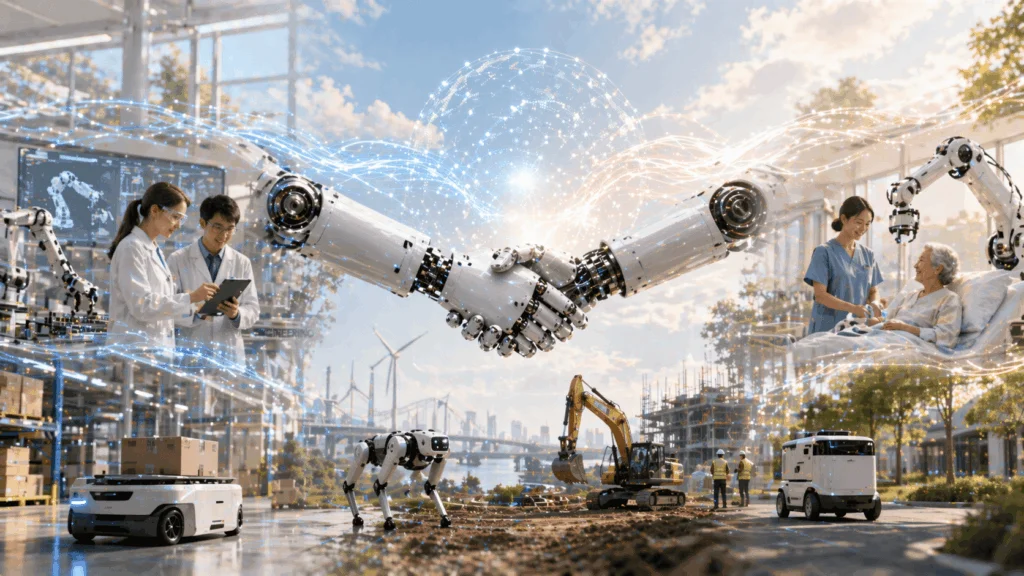
The Fujitsu–Carnegie Mellon Physical AI Research Center will focus on developing scalable systems that enable AI to operate in physical environments, addressing use cases across manufacturing, logistics, construction, infrastructure and healthcare. The initiative reflects growing industry demand for “physical AI” systems capable of interacting with dynamic, real-world conditions rather than controlled digital environments, according to Fujitsu.
“At this research center, Fujitsu will create new value through the convergence of AI, computing, networking, and robotics, and accelerate the societal implementation of reliable physical AI,” said Vivek Mahajan, Corporate Executive Officer, Corporate Vice President, CTO, in charge of System Platform, Fujitsu Limited. “Furthermore, to realize a society where humans and robots coexist and collaborate, we will expand our research scope to areas that underpin the social infrastructure and contribute to the building of a sustainable society.”
What is The Fujitsu–Carnegie Mellon Physical AI Research Center
Fujitsu noted the center will leverage Carnegie Mellon’s Robotics Innovation Center in Pittsburgh, a 14,000-square-meter facility designed to bridge fundamental research with commercial deployment. The site provides infrastructure for testing robotics and AI systems in realistic operating environments.
The center will bring together interdisciplinary teams spanning robotics, machine learning, language technologies, human-computer interaction and engineering, combining academic research with industry deployment. Researchers from Carnegie Mellon will work alongside Fujitsu engineers to develop systems that can move from lab environments into real-world operations.
“The Fujitsu-Carnegie Mellon Physical AI Research Center builds on CMU’s focus on developing AI and robotics systems to tackle real-world problems and the university’s collaboration with industry to put those innovations into practice and inspire what’s next,” noted Martial Hebert, Dean and University Professor of Robotics, School of Computer Science. “Physical AI will fuel the machines of tomorrow, allowing for competent decision-making, enhanced efficiency, greater safety, and, perhaps most importantly, trust to work alongside humans in critical fields.”
What Will the Research Include?
Key research areas include action generation and learning, spatial perception, multi-robot coordination, human-robot collaboration and integration between simulation and real-world environments. The goal is to address persistent challenges in physical AI, including adaptability, scalability and safe interaction with humans.
Participating researchers include:
- Yonatan Bisk, Assistant Professor, Language Technologies
- Fernando De La Torre, Research Professor, Robotics
- Tim Dettmers, Assistant Professor, Machine Learning
- Laszlo Jeni, Assistant Research Professor, Robotics
- Kris Kitani, Associate Research Professor, Robotics
- David Lindlbauer, Assistant Professor, Human-Computer Interaction
- Yorie Nakahira, Assistant Professor, Electrical and Computer Engineering
- Graham Neubig, Associate Professor, Language Technologies
- Jean Oh, Associate Research Professor, Robotics
- Sean Qian, Professor, Civil and Environmental Engineering
- Sebastian Scherer, Associate Research Professor, Robotics
- Peter Spirtes, Department Head and Professor, Philosophy
- Kun Zhang, Professor, Philosophy
The technologies developed through the collaboration will be integrated into Fujitsu’s broader physical AI platform, including the Fujitsu Kozuchi Physical OS. The platform is designed to coordinate robots, sensors and systems across physical environments. Combining task-level intelligence with spatial awareness to support complex operations, the company said the platform is a foundation for mission-critical applications that emphasizes real-time performance, reliability and safety across cloud-to-edge environments. Initial integration of research outputs into the platform is expected to begin in fiscal year 2026.