Insider Brief
- JuliaHub launched Dyad 3.0 and raised $65 million in Series B funding led by Dorilton Capital to expand its AI-driven engineering platform for industrial system design and simulation.
- Dyad combines autonomous AI agents with physics simulations, controls engineering and digital twins to help companies design and test industrial systems such as heat pumps, satellites, semiconductors and water infrastructure more quickly, with JuliaHub positioning the platform as “AI-first” engineering for physical systems.
- The company said Fortune 100 firms in sectors including aerospace, automotive, HVAC and utilities are already using Dyad and Julia, while partnerships with companies such as Synopsys and Binnies are applying the technology to hybrid digital twins, predictive maintenance and industrial control systems.
PRESS RELEASE — JuliaHub announces the launch of Dyad 3.0 and a $65M series B funding round led by Dorilton Capital, with participation from General Catalyst, AE Ventures, and technology investor and former Snowflake CEO Bob Muglia. Dyad marks a fundamental shift in how physical systems are designed and built, bringing autonomous AI agents into the digital design and testing of industrial machines. From heat pumps to satellites to semiconductors, engineering teams can compress cycles of design, testing, and building from months to minutes. Several Fortune 100 companies are already leveraging Dyad and Julia across several industrial sectors such as aerospace, government, automotive, HVAC, and utilities.
Daniel Freeman, who led the Series B round for Dorilton Capital, commented: “Systems modeling is one of the most strategically important layers of the AI-native engineering stack, because it is where physics, control logic, and AI converge. JuliaHub has built something extraordinary with Dyad: a platform that doesn’t just model systems, but compiles them, taking engineers from concept to production control code in a single environment. We believe JuliaHub has the potential to become one of the defining companies in Physical AI, and we’re proud to back the team as they accelerate Dyad’s path to market.”
‘The hard problem’ of hardware innovation
Physical engineering represents one of the largest sectors yet to fully benefit from the AI revolution. While tools like Claude Code, Codex, and Gemini have transformed software development, industrial engineers have remained constrained by legacy tools. McKinsey estimates that a cumulative $106 trillion in investment will be necessary through 2040 to meet the need for new and updated infrastructure. The engineers planning and building these updates need a solution that allows them to move at the pace of AI-enhanced software. That’s where Dyad comes in.
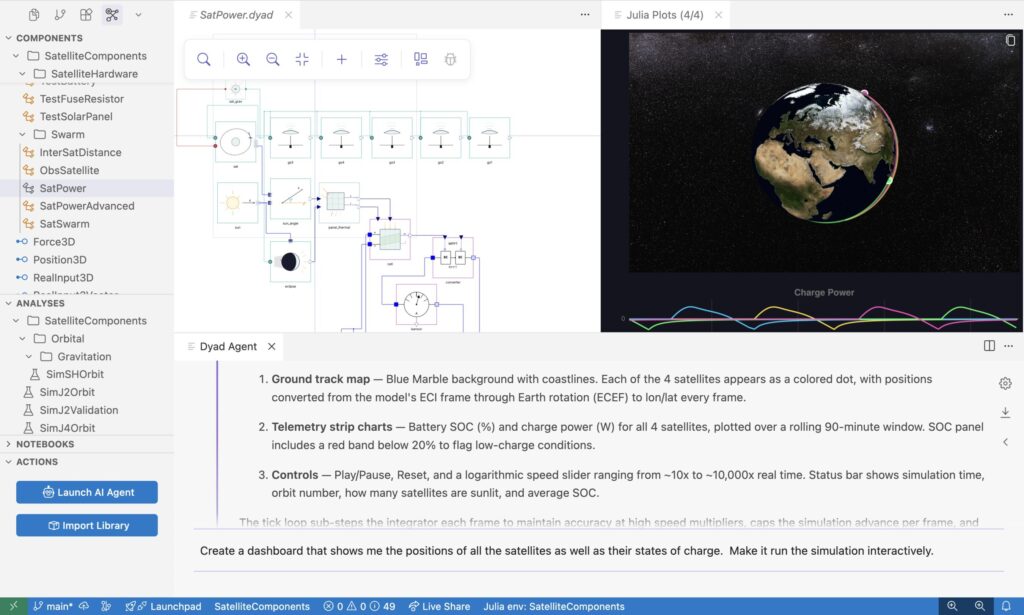
Dyad gives engineering teams an AI-first environment to model, test and validate industrial systems: think Claude Code for the physical world. Dyad 3.0 launches today and builds on Dyad 1.0, which launched in June 2025, and Dyad 2.0, which launched in December 2025. Dyad connects autonomous agents with scalable physics simulations, rigorous controls, safety analysis, and the ability to generate code for embedded systems to bridge the gap between software and the real world. Whether it’s a wastewater facility or an automobile, a scientific PhD is no longer required to develop highly detailed digital twins, tweak controllers for specialized deployment scenarios, and iterate on hardware designs to build the most efficient machine right the first time.
“It’s not about helping engineers complete one small task at a time. It’s agentic engineering at scale, where teams can feed a full specification to Dyad and have it design the complete system. Spec in. Design out,” said Viral Shah, CEO of JuliaHub.
Digital Twins with Scientific Machine Learning
Dyad’s cloud-based agents are designed to continuously scan through the world’s scientific knowledge to constantly improve models. AI-automated lab testing is growing to ensure models match physical reality. Streaming data mixed with Scientific Machine Learning (SciML) makes it possible for models to automatically grow as the system learns from the real world. Dyad’s simulation ecosystem and language offer a foundation on which all of these learnings are relayed back to engineers to check the processes, determine whether assumptions match customer requirements, and be the human in the loop that ensures the safety of the final product. Dyad’s design means engineers do not have to write every line of code in order to try millions of designs while giving engineers the right tools to make sure planes stay in the sky.
Prith Banerjee, Senior Vice President of Innovation at Synopsys commenting on the partnership with JuliaHub says, “Dyad is transforming system-level engineering by combining scientific AI, agentic modeling, and a powerful compilation pipeline into a unified workflow. Integrated with Synopsys simulation software Ansys TwinAI™, it enables high fidelity hybrid digital twins by integrating physics-based simulation with data-driven models. What once required extensive manual effort can now be done far more efficiently, accelerating the entire digital engineering lifecycle and redefining how intelligent, software-defined systems are designed and validated.”
Dyad to implement AI for Science in the real world
General-purpose AI cannot guarantee that a model obeys the laws of physics. In physical engineering, an error is not a bug to be patched; it’s a bridge collapse or a battery fire. This has been the barrier blocking AI from playing a meaningful role in hardware engineering, until now. In recent agentic benchmarking for chemical process modeling, general LLM systems such as Codex, Claude Code (Opus), and Gemini barely completed the initial setup. Dyad almost entirely automated the whole process of creating model-predictive controllers to optimize yields of a chemical plant, a task that would typically take weeks.
“There is a disruptive transition occurring in engineering system design software, and Dyad is on the cutting edge. Previous generations of tools do not provide the promised productivity, or integration to unlock the value of AI. With Dyad, you can model the physics, develop control algorithms with auto code generation, and create accurate digital twins and surrogates for rapid development of deep learning inference models, all enabled by AI. Dyad operates where physics meets analytics, and customers and shareholders win!” said David Joyce, former CEO of GE Aviation and Vice Chair of GE.
Dyad’s modeling language is purpose-built to be easy for AI agents to understand. Its foundational logic is grounded in the laws of physics, allowing its agents to reason about how fluids move through machines, how wind speed and temperature affect components, and how fundamental forces like gravity shape design. This produces physically valid models that engineers can trust. For instance, in partnership with Binnies, a company with a 100-year heritage in water management, and Williams Grand Prix Technologies, JuliaHub developed a SciML–powered digital twin that uses just four sensor inputs to predict pump faults in water distribution systems with over 90% accuracy.
“Dyad represents a step-change for the water industry, enabling a move from reactive operations to predictive, system-level decision making,” said Tom Ray, Director of Digital Products & Services (Digital Twins & AI) at Binnies. “It has the potential to transform how companies model real-world complexity, predict failure, and optimize performance every day.”
Join us for the Dyad 3.0 Launch event
Dyad 3.0 will be officially unveiled at a live event next month on May 19. Join us to see live product demonstrations and hear from our customers on how they use Dyad across industries ranging from Aerospace to HVAC to utilities to Robotics.
Image credit: JuliaHub