
Insider Brief
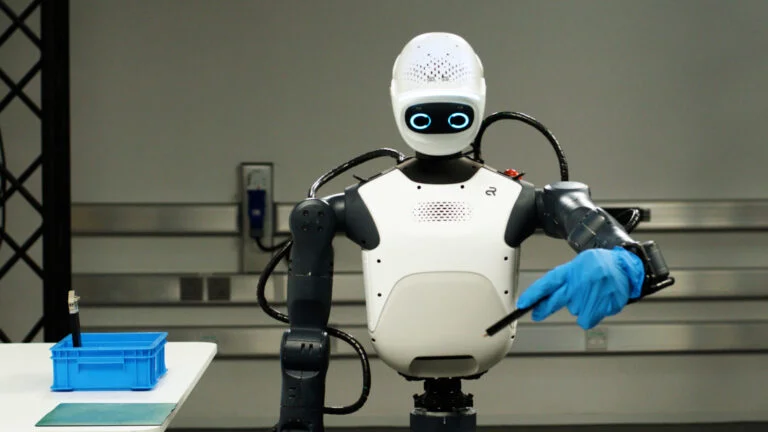
- SAP and robotics software company Cyberwave deployed fully autonomous AI-powered robots inside an active SAP logistics warehouse in St. Leon-Rot, Germany.
- According to Cyberwave, the robots are autonomously handling box folding, packaging and shipping fulfillment tasks through integration with SAP Logistics Management and SAP’s Embodied AI Service.
- Cyberwave said its platform combines Vision-Language-Action models and reinforcement learning to allow warehouse robots to adapt to changing objects, layouts and workflows while reducing robot training timelines from weeks to hours.
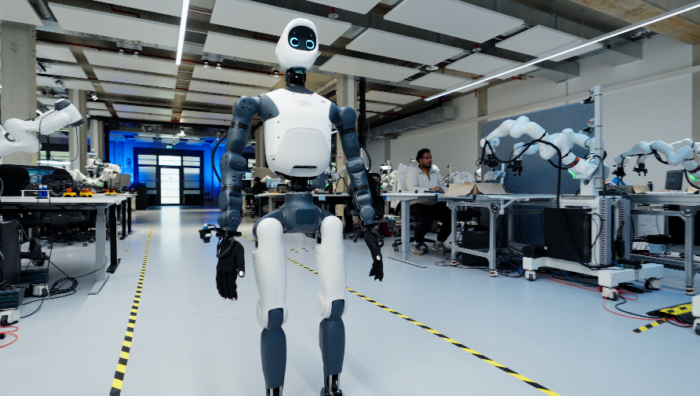
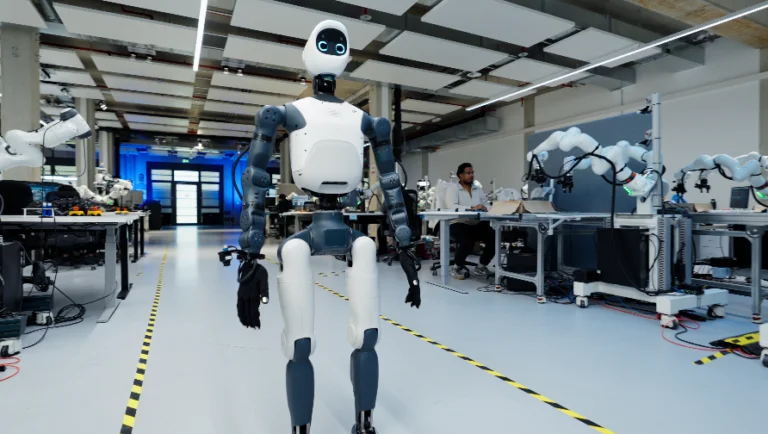
SAP and robotics software company Cyberwave have deployed fully autonomous AI-powered robots inside an active SAP logistics warehouse in Germany.
According to Cyberwave, the deployment is operating at SAP’s warehouse in St. Leon-Rot using SAP Logistics Management, the company’s cloud-native logistics execution platform. The robots are handling box folding, packaging and shipping fulfillment tasks autonomously inside live warehouse operations.
“By integrating AI-powered robotics directly into our live warehouse operations, we are proving that Physical AI is no longer a concept — it’s delivering real value today,” SAP’s head of warehouse and shipping Tim Kuebler said in the announcement. “At our St. Leon-Rot warehouse, SAP LGM provides the digital backbone that allows robots to be deployed quickly, operate reliably, and scale with our processes. This is a decisive step toward more resilient and efficient logistics operations.”
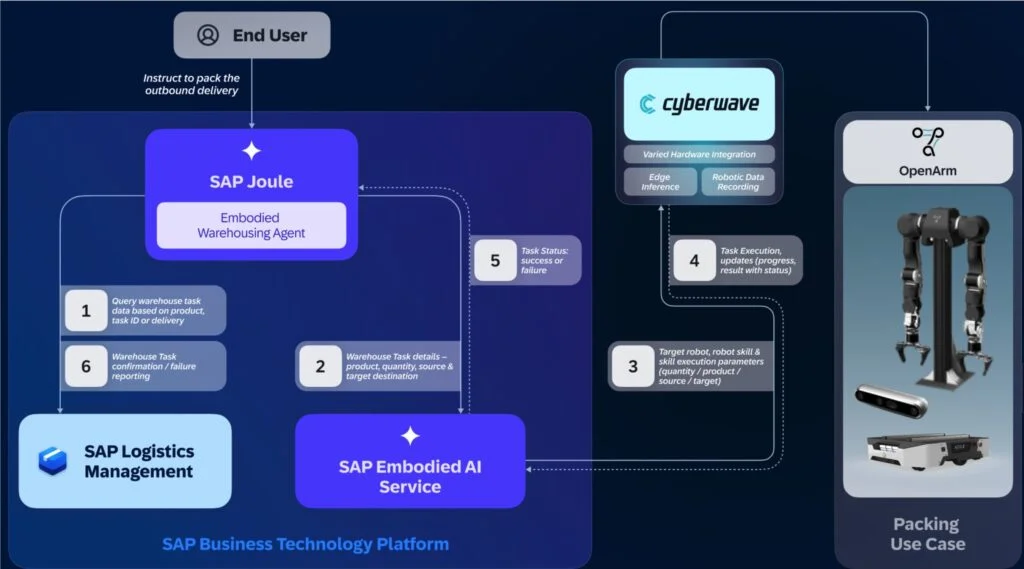
The integration relies on SAP’s API-based logistics architecture and SAP’s Embodied AI Service, which translates warehouse tasks into robot commands through SAP Business Technology Platform and the Cyberwave robotics platform.
Cyberwave indicated the project reflects a broader shift in warehouse robotics from highly scripted automation toward AI systems capable of adapting to changing conditions, object types and workflows in real time.
“Robots no longer need to be painstakingly programmed for every object or scenario-they learn, adapt, and keep improving,” Cyberware co-founder and CEO Simone Di Somma. “That’s the shift we’ve been building toward.”
Cyberwave said its platform is designed to reduce that complexity of warehouse automation by allowing operators to train robots through demonstrations rather than extensive hand-coding. The system combines Vision-Language-Action models and reinforcement learning techniques intended to help robots generalize across different warehouse scenarios rather than memorize fixed motions.
According to the company, the approach reduces robot training timelines from weeks to hours and allows non-expert warehouse operators to teach robots new tasks while continuously refining performance through real-time operational feedback.
In late April, Accenture announced it had deployed humanoid robots in pilot with Vodafone Procure & Connect at a SAP warehouse in Duisburg, Germany, to test how physical AI can improve logistics efficiency, safety and operational decision-making.
Image credit: Cyberware