
Insider Brief
- Researchers at the University of Leeds and University College London have developed an AI system that allows four-legged robots to autonomously switch gaits and adapt in real time to unfamiliar terrain, eliminating the need for prior surface exposure or preprogrammed commands.
- Funded by the Royal Society and the UK’s Advanced Research and Invention Agency, the study used deep reinforcement learning to simulate animal-inspired motion strategies, resulting in robots that instinctively adjust stride using only internal sensors.
- The system, validated in real-world tests on rough terrain, marks a major advance for robotics applications in hazardous environments and could reduce reliance on animal testing in biomechanics research.
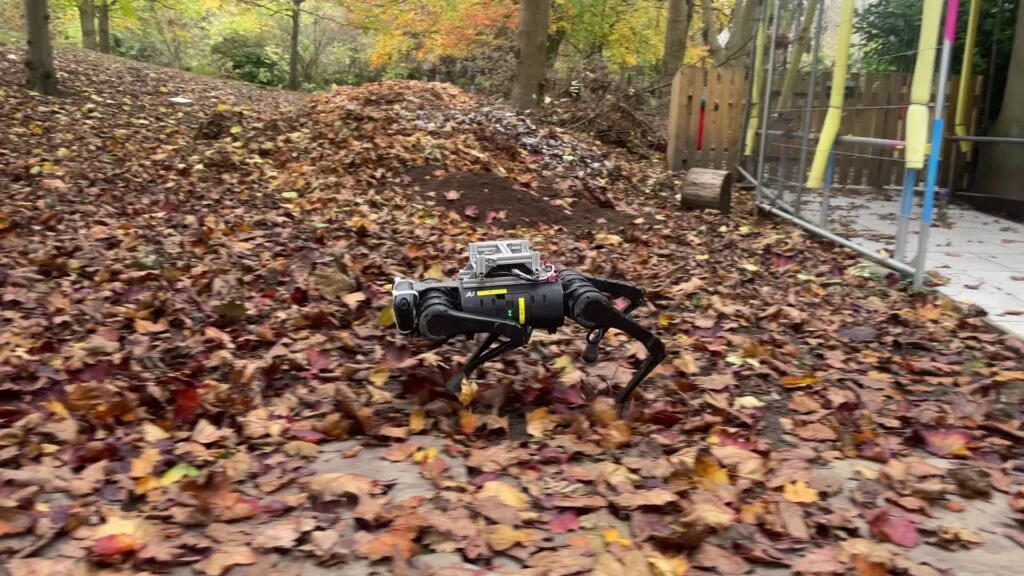
Researchers at the University of Leeds and University College London have developed an AI system that enables four-legged robots to switch gaits autonomously in response to unfamiliar terrain. According to the University of Leeds, the system allows robots to adapt their movement in real time without prior exposure to new surfaces, a significant advance for deploying legged robots in high-risk environments such as disaster zones or industrial inspection sites.
The study, part-funded by the Royal Society and the UK’s Advanced Research and Invention Agency and published in Nature Machine Intelligence, demonstrates that the robot learned to choose and modify gaits—such as trotting, running, or bounding—using animal-inspired strategies developed entirely in simulation. The team used deep reinforcement learning to replicate how animals intuitively adjust stride to maintain balance and efficiency. Unlike earlier systems that rely on preprogrammed commands or require visual sensors, this framework gave the robot the capacity to generalize from virtual experience and navigate rugged terrain using only internal motion sensing.
“We then tested the robot in the real-world, on surfaces it had never experienced before, and it successfully navigated them all. It was really rewarding to watch it adapt to all the challenges we set and seeing how the animal behaviour we had studied had become almost second nature for it,” explained lead author author Joseph Humphreys, postgraduate researcher in the School of Mechanical Engineering at Leeds.
In real-world testing, the robot succeeded across woodchips, uneven timber, and rocky paths, and recovered from physical disturbances like leg strikes without prior training on those surfaces, researchers noted. The core advancement lies in the integration of three behavioral components seen in animals: gait transition strategies, procedural memory, and adaptive motion adjustment. These enabled the robot to make stride decisions instinctively, as animals do, rather than waiting for human instructions.
This ability to adapt instinctively opens new use cases for legged robots, from nuclear cleanup to planetary exploration, where terrain is unpredictable and human intervention is limited. It also offers a potential alternative to using live animals in biomechanics research, enabling ethical testing of motion theories in robotics instead.
While the current system was tested only on one dog-sized robot, the researchers said the framework is transferable to other quadruped robots with similar body plans. Their future work will explore higher-level mobility skills, such as jumping, climbing, and navigating steep or vertical terrain, expanding the system’s applicability in complex real-world scenarios.
“Our long-term vision is to develop embodied AI systems — including humanoid robots — that move, adapt, and interact with the same fluidity and resilience as animals and humans,” Chengxu Zhou, senior author of the study from UCL Computer Science, said