
Insider Brief
- Mantic has emerged from stealth with $4 million in pre-seed funding and a team from Google DeepMind, Citadel, and leading universities, aiming to automate human-level forecasting across geopolitics, business, and technology.
- The company’s AI system won the Q1 2025 Metaculus AI Benchmark Tournament and set a new state of the art in backtested forecasts, using backtesting and reinforcement learning to compress feedback loops from months into milliseconds.
- By scaling forecasts across thousands of questions and updating them continuously, Mantic seeks to provide decision-makers with a “radar” of global risks, moving judgmental forecasting from niche contests into mainstream strategy.
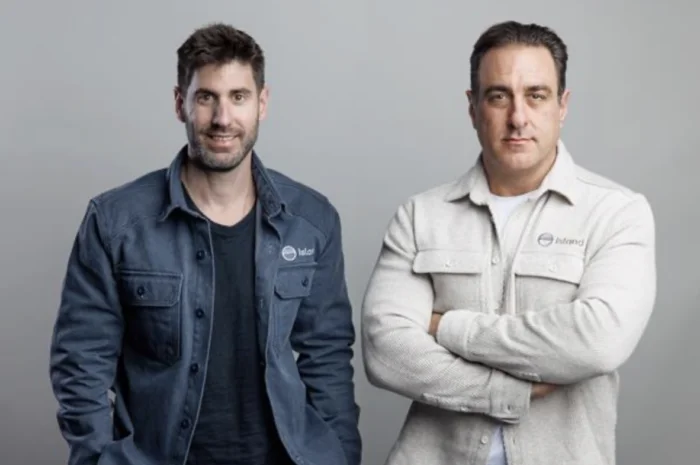
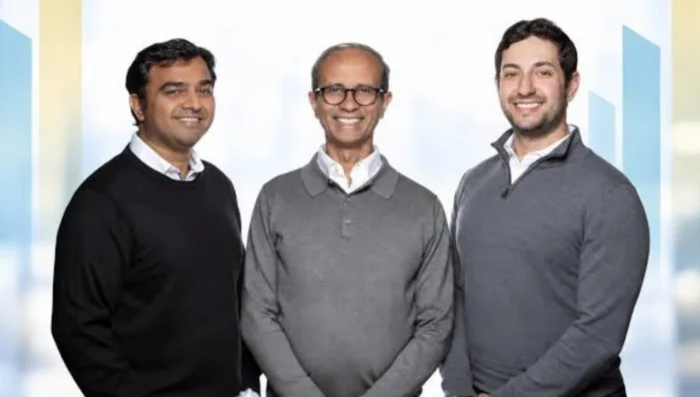
Mantic, a new artificial intelligence startup, has emerged from stealth with a $4 million pre-seed round and a claim that its system can deliver predictions about global events with accuracy rivaling top human forecasters, Tech EU reported. The London-based company, backed by Episode 1 Ventures, DRW, and prominent researchers from Anthropic and Google DeepMind, says its approach could transform decision-making in government, business and beyond.
“… Mantic is coming out of stealth,” the team writes “We’ve assembled a world class team of AI technical staff, coming from Google DeepMind, Citadel, universities of Cambridge and Oxford, and other AI startups. We raised $4m in our pre-seed round led by Episode 1 with backing from DRW and various top AI researchers at Anthropic and Google DeepMind.”
Mantic’s system has won the top prize in the Q1 2025 Metaculus AI Benchmark Tournament, a leading forecasting competition, and its backtested performance on 348 questions from Q2 set a new state of the art.
In a company blog post, the team describes the process of forecasting the future as an expensive — and often inaccurate — endeavor. Governments missed early warnings about the coronavirus pandemic, underestimated the risks of Russian aggression in Ukraine and were unprepared for the speed of advances in generative AI. Businesses struggle to anticipate supply chain shocks or leadership turnover. Decision-making suffers because the ability to forecast accurately is still limited.
One of the best-known approaches is “superforecasting,” a method developed in academic forecasting tournaments and adopted by the U.S. intelligence community, according to the post. In these contests, carefully selected individuals demonstrated a remarkable ability to assign probabilities to future events, often outperforming domain experts. Superforecasters, however, are rare, and their forecasts are slow to produce and limited in number.
Prediction Markets
Prediction markets, such as Polymarket and Kalshi, offer another model, letting people bet on outcomes from elections to economic indicators. Like financial markets, they provide incentives for information gathering. But volumes are small — most markets attract less than $100,000 — and questions often skew toward sports, crypto, and other popular themes. The forecasts themselves usually lack the detailed explanations needed by decision-makers.
The contrast with weather forecasting is stark. In the 1950s, meteorologists working with early computers could barely project the next day’s weather. By the mid-1980s, one-day forecasts were about as accurate as today’s five-day forecasts, a steady gain sometimes called the “one day per decade” rule. Weather forecasting is now integrated into agriculture, energy, aviation, construction, and military planning. By comparison, judgmental forecasting — predicting the messy, one-off events of geopolitics, business, and culture — remains a niche pursuit.
“We believe automation will radically transform judgmental forecasting, like it did weather forecasting,” the Mantic team writes. “It’s now becoming possible to build an AI forecasting system that can rival strong human forecasters. Our system is competitive in the ongoing Metaculus Cup, the premier tournament. From now on, technical and commercial progress in judgmental forecasting will look qualitatively different, thanks to the natural advantages of automated systems.”
Two ‘Unlocks’
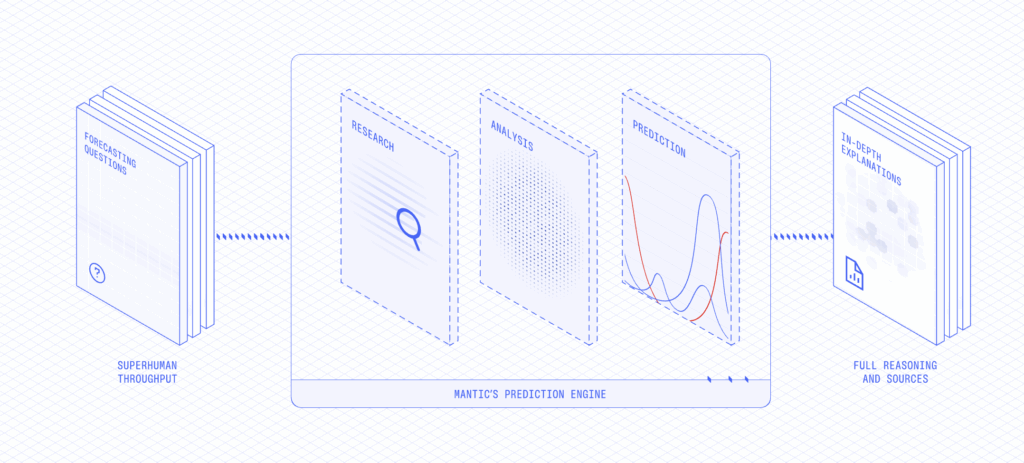
Mantic’s work is an attempt to change that trajectory. The company is focused on what it calls two key “unlocks”: faster feedback through backtesting, and scalability through automation.
The first unlock addresses the problem of slow learning. Human forecasters may take months or years to discover whether a prediction was correct, making it difficult to refine their techniques. Mantic instead backtests its AI, restricting the system to information available at a given date in the past and comparing its predictions against the known outcomes. This allows the system to “replay” history, compressing feedback loops from months into milliseconds. The company has assembled a dataset of more than 10,000 high-quality forecasting questions from 2024 and 2025, giving it material for reinforcement learning and rapid iteration.
The second unlock is scale. Even the best superforecasters are few in number, and prediction markets are narrow in focus. Mantic argues its system can deliver forecasts across thousands of questions in parallel, updating them daily if needed. In the Metaculus Cup, for instance, the system tracked how much photovoltaic capacity China would install in July 2025. It refreshed its forecasts each day as new information became available and surfaced evidence of a likely drop in installations before the community consensus shifted in the same direction.
Scaling Leads to Different Forecasting Product
Scaling up allows Mantic to build a different kind of forecasting product, according to the post. Instead of a single probability estimate, the system can function as a “radar,” producing rolling forecasts across wide domains. The company has demonstrated simulations of the likelihood of U.S. military strikes across the Middle East, updating monthly, and CEO turnover probabilities across all 40 companies in Germany’s DAX index. Such forecasts can provide not just a snapshot, but a moving picture of risk and change.
The ambition is to go deeper as well as broader, according to the team, adding that if the system predicts that a CEO will resign, it can generate follow-on forecasts of who might replace them and when. Mantic says this kind of layered reasoning, scaled to thousands of scenarios, could deliver a far richer picture of the future than human forecasters or small markets can provide.
The company’s founders point to parallels with other areas where AI has already altered the pace of research. AlphaFold, developed by Google DeepMind, condensed years of protein-structure analysis into minutes. Mantic hopes to do the same for judgmental forecasting, compressing what would otherwise be years of human experience into automated predictions.
The effort comes with challenges. Forecasting the world of human affairs is inherently uncertain, with outcomes shaped by politics, strategy, and culture as much as by data. Statistical models have struggled in areas where the past provides little guidance. such as whether Iran will close the Strait of Hormuz, an event that has never happened before. Human reasoning remains critical, but it is also hard to scale.
Mantic’s bet is that AI can combine both reasoning and scale. By backtesting on vast numbers of questions, its system can accumulate more forecasting “experience” than any individual human. By updating continuously, it can deliver forecasts as fast as events develop. And by covering thousands of scenarios, it can scan across domains, surfacing patterns that decision-makers may otherwise miss.