Insider Brief
- ChatGPT has reached 700 million weekly active users worldwide, with more than 2.5 billion daily messages exchanged, according to new research by OpenAI and academic collaborators.
- The majority of usage is consumer-driven, with over 70% of interactions unrelated to work and most conversations falling into Practical Guidance, Seeking Information, or Writing.
- At work, Writing dominates professional use while programming remains a small share, and overall usage is converging on decision support and information tasks across industries.
- Photo by Andrew Neel
When OpenAI launched ChatGPT in late 2022, few could have predicted that within less than three years the chatbot would reach nearly 700 million weekly active users, roughly 10 percent of the world’s adult population. According to a new economic research report written by OpenAI researchers in collaboration with academics from Duke and Harvard, users now send more than 2.5 billion messages each day — about 29,000 per second.
The report provides the clearest picture to date of how people are actually using ChatGPT and where the economic value lies. The researchers analyzed more than a year of consumer usage data, classifying millions of de-identified messages with privacy-preserving machine learning tools. Their findings challenge common assumptions about AI’s role at work, reveal the dominance of consumer-driven use cases, and point toward the sectors where business adoption may accelerate.
Consumers Drive the Majority of Use
The most striking finding is that non-work-related use of ChatGPT has grown much faster than work-related use. In mid-2024, about 53 percent of messages were classified as non-work. By mid-2025, that figure had climbed to 73 percent.
That means most of the daily billions of interactions involve personal advice, entertainment, learning, and general information rather than tasks tied directly to employment. While enterprise analysts often frame generative AI in terms of productivity and automation, the report suggested its consumer footprint is at least as significant, if not larger.
The decline in work share is not because new users are less work-oriented. Instead, cohorts that originally used ChatGPT for professional tasks have shifted toward more personal applications over time. Researchers link this to both improvements in model capabilities and the gradual discovery of new use cases by existing users.
Three Categories Dominate: Guidance, Search, and Writing
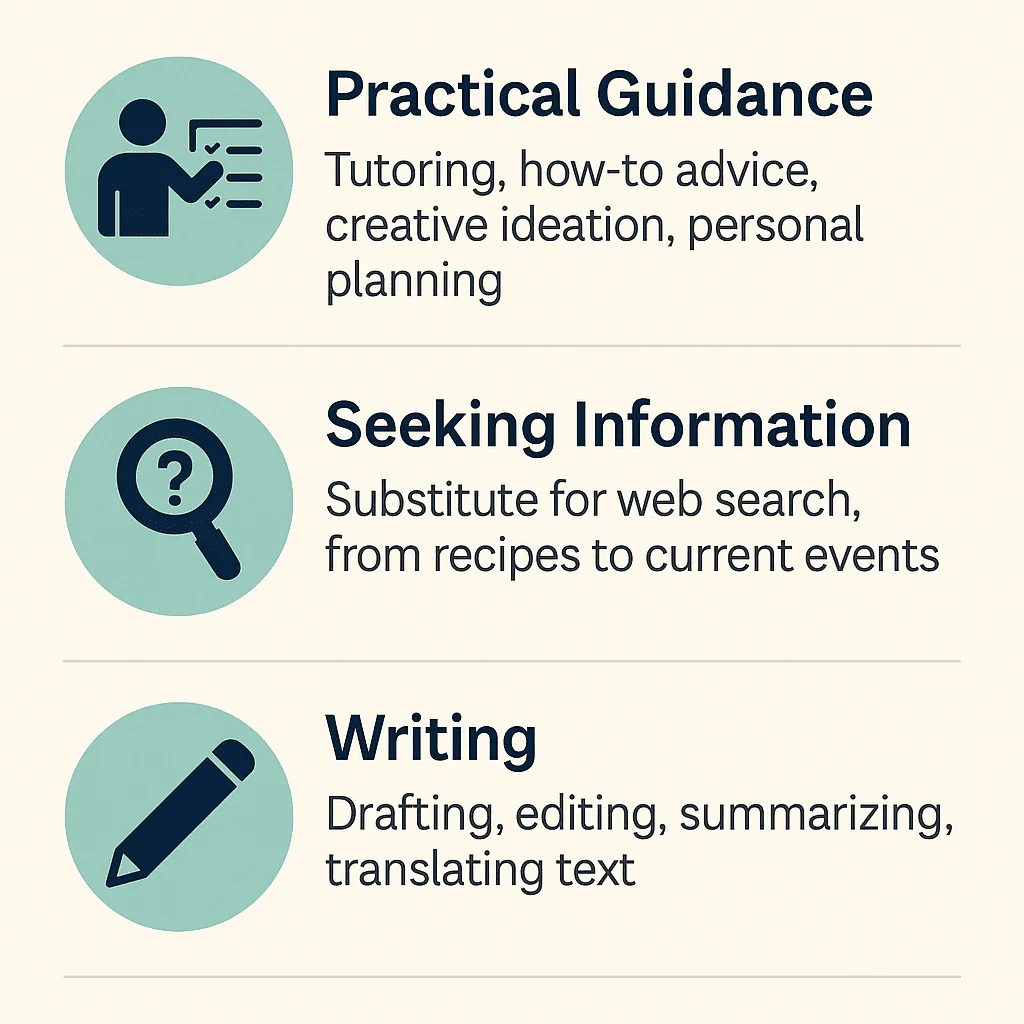
According to the report, most ChatGPT interactions fall into three categories that together make up nearly 80 percent of usage: Practical Guidance, Seeking Information, and Writing. Practical Guidance encompasses tutoring, how-to advice, creative ideation, and personal planning. Seeking Information functions much like a web search, covering everything from recipes to current events. Writing includes drafting, editing, summarizing, and translating text.
In professional settings, Writing is the most prominent use case. Roughly 40 percent of work-related queries involve generating or editing text, and about two-thirds of those are requests to improve material the user has already written rather than to produce original content. In practice, professionals are more likely to ask the model to revise a draft, translate a document, or summarize material for a specific audience than to author a report from scratch.
Technical help, often assumed to be a leading use, turned out to play a much smaller role. Programming requests accounted for only 4.2 percent of all messages. By contrast, a recent study of Claude conversations suggested coding made up a third of work-related interactions.
The discrepancy highlights a broader point. For businesses that have positioned generative AI primarily as a coding assistant, expectations may need to be adjusted. The evidence suggests that communication, decision-making, and knowledge management remain the dominant uses of the technology in workplace settings.
Asking vs. Doing: A Shift Toward Decision Support
To classify user intent, the researchers introduced a framework of Asking, Doing, and Expressing.
Asking refers to situations where the user is seeking information, clarification, or advice to make a decision. These queries range from straightforward factual checks — such as asking who succeeded Abraham Lincoln or what the inflation rate was last year — to more practical guidance, like how to budget for a quarter or what to look for in a health plan during open enrollment. In workplace contexts, Asking often takes the form of requesting explanations, comparisons, or recommendations that help the user make better-informed choices.
Doing, by contrast, covers task execution in which the model is asked to generate an output that can be plugged directly into a process. Examples include drafting an email, rewriting a report in more formal language, producing a project timeline in tabular form, or extracting structured data from text. In professional use, Doing is most visible in requests for written communication and, to a lesser extent, technical tasks such as coding or formatting spreadsheets. These are situations where the AI is not simply advising the user but completing part of the work on their behalf.
The third category, Expressing, captures conversations where the primary purpose is not information or output but conversational or emotional expression. This can take the form of casual greetings or small talk, like wishing the model good morning or asking for a joke. It also includes more personal exchanges, such as a user describing anxiety about an upcoming presentation or reflecting on life choices. Some users employ ChatGPT in imaginative or role-playing scenarios, pretending to converse with a historical figure, a friend, or even a version of themselves at a different age. Although this category represents a smaller fraction of overall use, the researchers noted that it underscores the ways in which people incorporate AI into daily routines that go beyond work tasks or fact-finding.
Across all messages, Asking accounted for 49 percent, Doing for 40 percent, and Expressing for 11 percent. Crucially, Asking grew faster than Doing over the past year, and these messages were consistently rated higher quality both by automated classifiers and direct user feedback.
This distinction matters for business adoption. It suggests that the real economic value lies less in replacing human labor through task execution and more in augmenting it through decision support. Knowledge workers in particular appear to rely on ChatGPT as a co-pilot, a pattern the researchers say is consistent with models of productivity that emphasize better decision-making in high-skill occupations.
Who Uses ChatGPT?
The demographic findings also upend early assumptions about AI adoption.
- Gender gap closes: When ChatGPT launched, users were overwhelmingly male — about 80 percent of active accounts in the first months were tied to typically masculine names. By mid-2025, that number had dropped to 48 percent, with slightly more users associated with feminine names.
- Youthful base: Nearly half of all messages are sent by adults under 26, though usage has broadened across age groups over time.
- Global spread: Growth has been strongest in low- and middle-income countries, particularly those with GDP per capita between $10,000 and $40,000. The researchers note that in these markets, ChatGPT is rapidly becoming a default digital tool, leapfrogging other forms of search and productivity software.
Educational and occupational patterns also shape use. Users with bachelor’s or graduate degrees are significantly more likely to use ChatGPT for work tasks. Among occupations, computer-related roles are the heaviest professional users, but writing dominates among business and management roles. In non-professional categories like education and healthcare, writing again makes up about half of work-related use.
What People Actually Do at Work with ChatGPT
BThe researchers found a striking similarity across industries in how ChatGPT is being used at work. Regardless of occupation, the bulk of professional queries fall into two broad functions: obtaining, documenting, and interpreting information; and making decisions, giving advice, solving problems, and thinking creatively.
The patterns hold across very different job categories. Management professionals primarily turn to the tool for writing and decision support. Computer specialists make heavier use of technical help, but “making decisions and solving problems” still ranks among their most common tasks. In fields such as education and healthcare, documenting information and producing written outputs are among the dominant uses.
The report suggested this convergence points to a broader shift: rather than serving only niche technical needs, generative AI is being woven into the core cognitive functions of knowledge work itself.
Interaction Quality and User Satisfaction
The report also tracked user satisfaction by analyzing follow-up responses in conversations. Positive interactions have grown much faster than negative ones, and by mid-2025, “good” responses outnumbered “bad” responses by a factor of four.
Interestingly, satisfaction rates were highest in categories such as Self-Expression, while Multimedia and Technical Help scored lowest. Asking queries were more likely to be rated positively than Doing or Expressing, reinforcing the finding that users view ChatGPT as especially valuable for decision support.
What It Means for Businesses
For an AI business audience, several implications stand out:
- Consumerization of AI: The majority of usage is now consumer-driven. This challenges the assumption that enterprise adoption will lead growth. Instead, the data suggest generative AI is following the trajectory of search and social media — scaling first as a consumer platform and only later consolidating in enterprise workflows.
- Communication as the killer app: Writing and editing dominate workplace use. Startups and incumbents that can integrate AI writing assistants into email, CRM, and project management systems are best positioned to capture value.
- Decision support over automation: The growth of Asking queries points to AI’s role as an advisor, not just an executor. Businesses should design AI strategies that emphasize better-informed employees rather than pure task replacement.
- Emerging markets as growth hubs: Rapid adoption in lower-income countries suggests a global market for AI-native services — from education to small business support — that may bypass legacy software entirely.
- Generational shift: Nearly half of all usage comes from under-26-year-olds. As these users enter the workforce, they will carry AI-native habits into professional settings, accelerating organizational adoption.
The Broader Picture
The report ultimately argues that ChatGPT’s economic value lies in its role as a decision-support system in knowledge-intensive jobs, where better decisions translate directly into productivity. But it also highlights the underestimated impact of generative AI outside work, particularly in education, health,and daily life.
For business leaders, the message is clear: AI is not just a back-office tool. It is fast becoming a mass-market consumer platform with significant spillover effects into the workplace. Companies that recognize this dual role — part productivity software, part consumer internet service — will be better placed to adapt.
As the researchers conclude, ChatGPT’s trajectory shows that generative AI is reshaping both work and life simultaneously. The economic stakes are not confined to office productivity; they extend into how billions of people make decisions, communicate, and learn in their daily lives.