
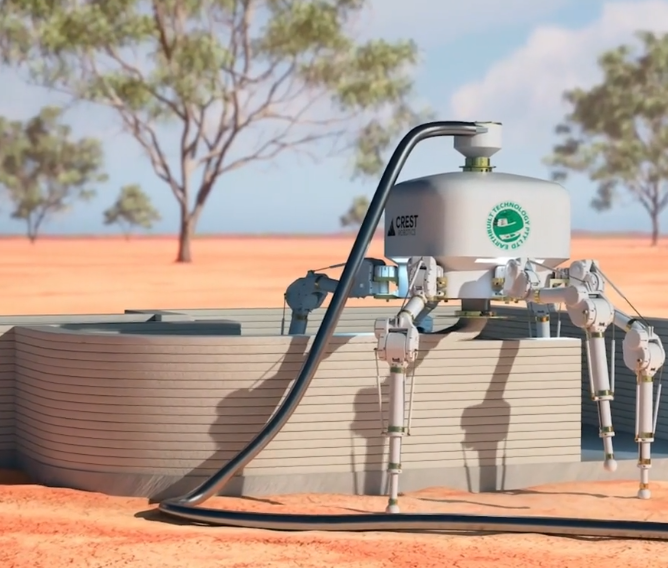
- Crest Robotics and Earthbuilt unveiled “Charlotte,” a semi-autonomous, spider-like 3D-printing robot to build houses on Earth within a few years and eventually basic lunar shelters, showcased in prototype at IAC Sydney.
- The mobile system straddles and moves along walls to deposit material, collapsing multiple steps into one workflow to cut labor and time, with developers claiming eventual throughput comparable to more than 100 bricklayers.
- Charlotte remains in R&D with NSW Space+ support; scaling will require real-world pilots, validated cost/productivity data, and meeting materials and code-compliance hurdles, with lunar use aligned to NASA’s Artemis goals.
A spider-like construction robot named Charlotte is being pitched as a way to 3D-print houses on Earth within a few years—and, eventually, to build basic shelters on the Moon. The semi-autonomous system, shown in scaled-down form at the International Astronautical Congress in Sydney, combines mobile robotics with large-format 3D printing to turn raw materials directly into walls and structural elements, its developers said, according to the Australian Broadcasting Corporation.
Charlotte is a joint project of Crest Robotics and Earthbuilt Technology, which say the machine is designed to “straddle” and move along partially built walls, laying down layers of material where needed. The companies describe the approach as the “smallest possible” mobile platform that can complete house-scale prints by repositioning itself rather than relying on a gantry or fixed printer frame. By folding robotic motion and on-site material deposition into one workflow, the developers aim to cut labor, shorten build times, and eliminate carbon-intensive steps common in traditional construction, Crest Robotics founding director Clyde Webster said in the ABC report.
Earthbuilt co-founder Jan Golembiewski said the concept collapses many manufacturing and logistics steps into a single machine that ingests available inputs and outputs finished wall sections on site, ABC reported. The team contends that, once matured, the system could work at a pace comparable to scores of human bricklayers and do so with more consistent quality. While those performance claims will need to be proven at full scale, the direction reflects a broader push in construction toward automation that can operate in variable, outdoor environments rather than controlled factories.
Developers frame the project as a response to two pressures: labor shortages and productivity stagnation on job sites. Webster said robotics could be central to easing Australia’s housing shortfall and lifting output per worker, which has been flat in construction for decades, according to the ABC account. Independent researchers echo the need for new tools. Neda Mohammadi, who studies project management and infrastructure at the University of Sydney, told ABC that automating repetitive and higher-risk tasks can act as a “force multiplier,” allowing smaller crews to deliver more work and reduce delays tied to scarce skilled labor.
Charlotte remains in research and development. The prototype shown at the space congress is a technology demonstrator, not a commercial unit. Moving from a conference floor to active job sites will require proving the robot can handle uneven terrain, tight footprints, weather, and inspection and code-compliance requirements that vary by jurisdiction. The material science also matters: printing mixes must cure quickly, bond reliably between layers, and meet structural and fire codes. Those are solvable but nontrivial hurdles that have slowed adoption of construction 3D printing more broadly.
Even so, the team is already looking past Earth. Crest and Earthbuilt say the architecture could help build lunar infrastructure using local regolith, aligning with NASA’s Artemis program to return astronauts to the Moon; Webster cited a 2027 target for Artemis III in remarks reported by ABC. The appeal is straightforward: moving materials is expensive in space, and an agile printer that can work with what’s on hand could reduce mass and cost. Demonstrating reliability in harsh, remote environments, the team argues, would also feed back into more robust systems for terrestrial use.
The effort has received support from New South Wales’ Space+ program, and the developers are seeking additional partnerships and funding around the International Astronautical Congress, which draws more than 6,000 participants from academia and industry each year, ABC reported. If Charlotte advances, it would join a growing list of attempts to bring factory-style precision to the messiness of construction sites. The next milestones are predictable: larger pilots on real jobs, validated productivity and cost data, and a path through certification.
Photo Credit: Crest Robotics