
Insider Brief
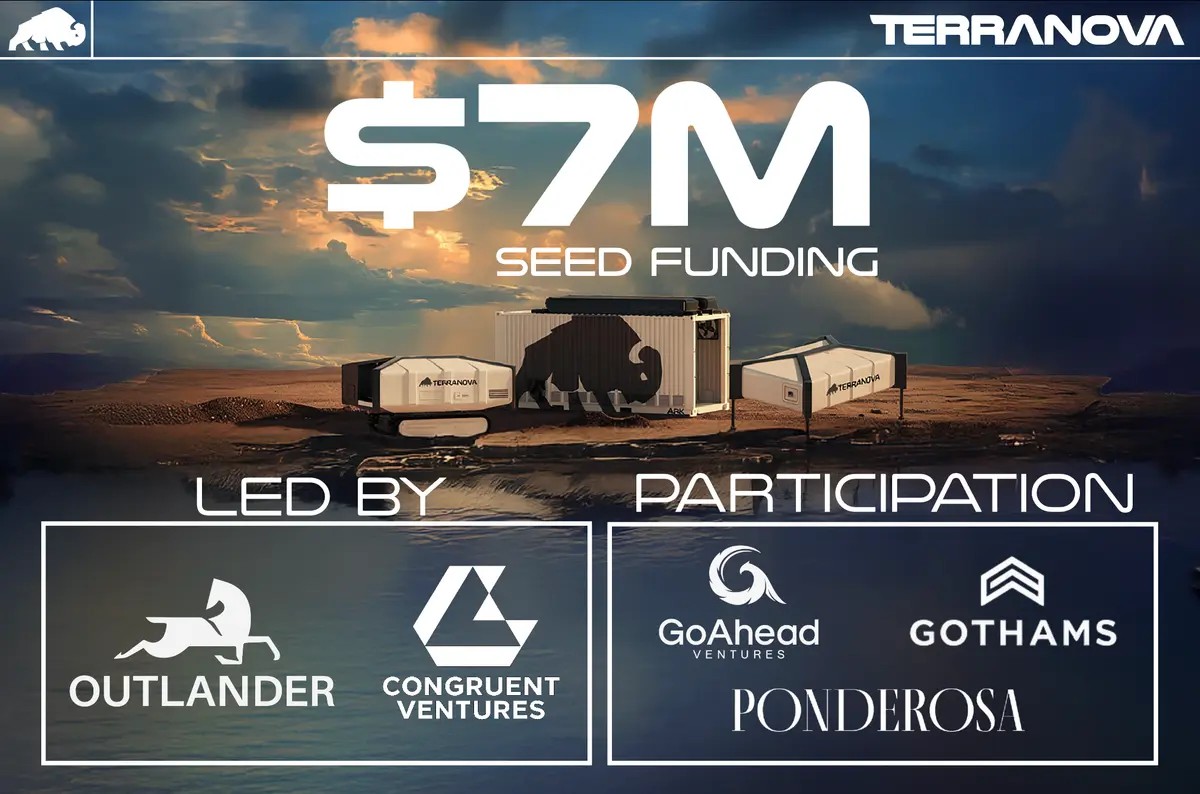
- Terranova, a California startup developing autonomous robots that lift and stabilize flood-prone land, has emerged from stealth with a $7 million seed round led by Outlander and Congruent Ventures, joined by GoAhead Ventures, Gothams, and Ponderosa, a Galvanize Climate fund.
- The company’s car-sized robots inject a wood-based slurry underground to raise terrain by up to a foot per acre per day, creating protective elevation without surface disruption and offering a low-cost alternative to levees and seawalls.
- The funding will support Terranova’s first field projects and robotic production as it applies its AI-driven “subsurface terraforming” system to help coastal and inland communities combat flooding and land subsidence.
A California startup is betting that the solution to flooding won’t come from higher seawalls or larger pumps, but from reshaping the ground itself.
Terranova, a terraforming robotics company developing autonomous systems to lift and stabilize flood-prone terrain, has emerged from stealth with a $7 million seed round that closed three times oversubscribed, according to the company. The round was led by Outlander and Congruent Ventures, with participation from GoAhead Ventures, Gothams, and Ponderosa, a fund within Galvanize Climate Solutions.
The company’s technology targets two compounding global problems — flooding and land subsidence — that Terranova indicated cost the U.S. economy an estimated $180 billion annually. Traditional flood infrastructure, such as levees and drainage systems, struggles to keep pace with sea-level rise, groundwater depletion, and severe weather. Terranova’s approach is to offer a mechanical alternative. Rather than protecting terrain, it raises it.
“We’ve solved the challenges related to flooding, that’s the headline” Laurence Allen, CEO of Terranova, noted in the funding announcement this week. “We’re combining heavy robotics and geotechnical innovation to literally reshape the world. Terranova’s mission is nothing less than to terraform the earth and usher in a new era of resilience and societal abundance.”
The company said its robots, each roughly the size of a car, inject a wood-based slurry deep underground to elevate land without disturbing the surface. The process can raise terrain by a foot per acre each day, creating protective elevation around infrastructure, homes, and wetlands. A single “mothership” coordinates three autonomous injection rovers, which are guided by artificial intelligence models that analyze soil composition, flood risk, and target elevation.
Terranova’s system combines robotics, geotechnical engineering, and AI control to automate what has long been a labor-intensive process of earthmoving. The company touts its robots perform injections with precision, adjusting pressure and placement in real time to achieve a desired surface profile. The company describes this as a “subsurface terraforming” process — turning the adaptation challenge of rising seas into a solvable engineering problem.
The new capital will fund Terranova’s first field projects and expand production of its robotic fleet, along with growing its engineering and field operations teams, according. Early deployments will focus on low-lying coastal and inland communities, where repetitive flooding and soil subsidence have made traditional mitigation projects prohibitively expensive.
The company positions its approach as both a climate adaptation and mitigation technology. The slurry used in injections is derived from waste biomass, creating a durable carbon sink while reducing the need for traditional fill material. Terranova estimates that, at scale, its process could cost an order of magnitude less than conventional flood defenses such as levees or seawalls.
“Terranova represents a new category at the intersection of robotics, climate resilience, and American industrial renewal,” Jordan Kretchmer, Senior Partner at Outlander VC, pointed out. “Laurence and his team are tackling one of the hardest and most important challenges of our time – protecting land itself.”
Image Credit: Terranova