
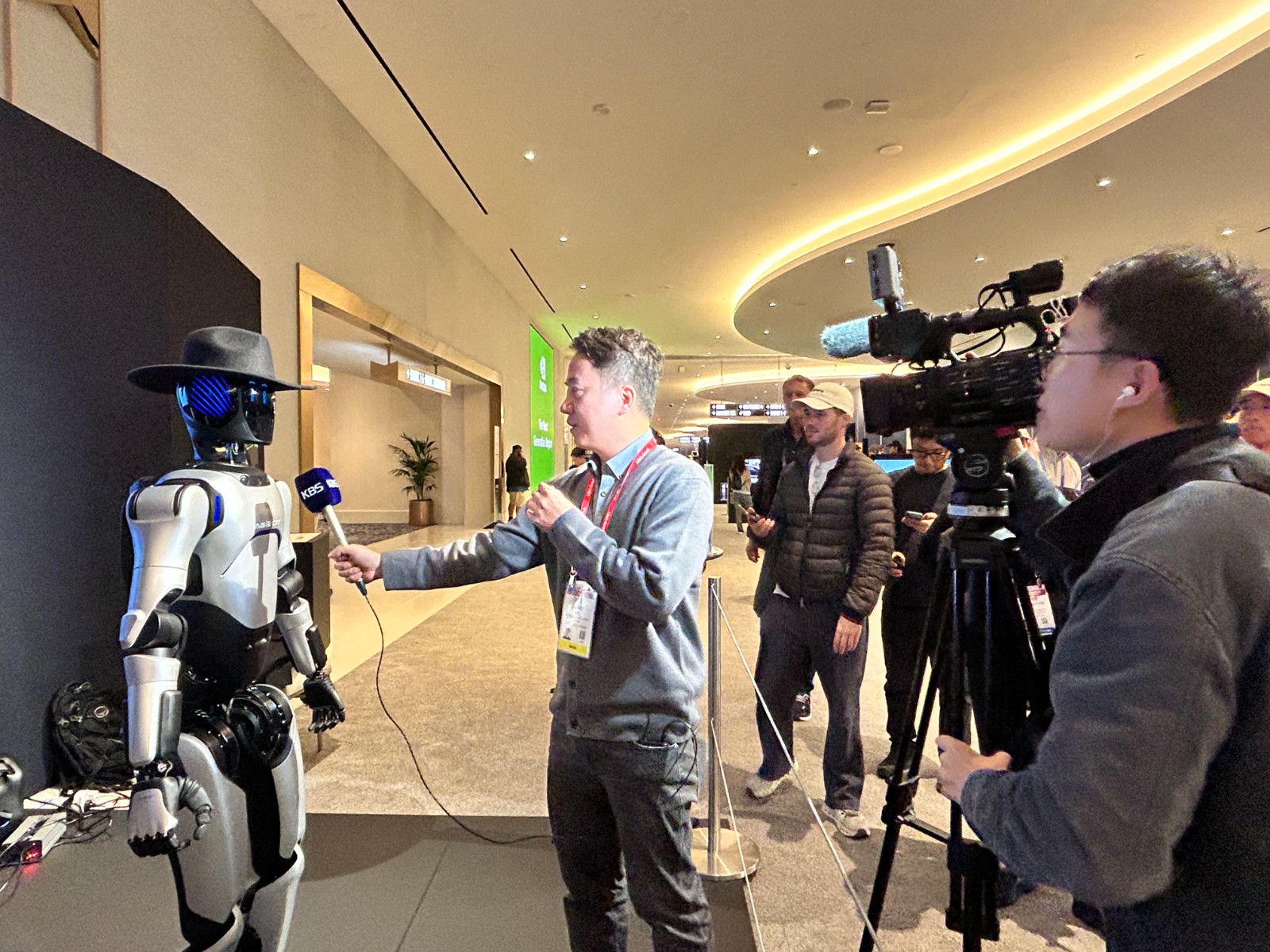
Insider Brief
- Agibot is entering the U.S. market at CES with claims of manufacturing scale, saying it has shipped more than 5,000 humanoid robots and moved beyond prototypes into mass production and real-world deployment.
- Founded in 2023, the company is focused on embodied intelligence through a unified architecture that integrates locomotion, manipulation, and interaction, positioning its humanoid and legged robots for sustained operation across commercial, industrial, and institutional environments.
- Agibot’s portfolio spans full-size and compact humanoids, industrial systems, quadrupeds, and a dexterous manipulation platform, with deployments across hospitality, manufacturing, logistics, security, data collection, and research, alongside a partner model aimed at enabling customization on a standardized robotics platform.
Chinese robotics company Agibot is making its formal entry into the U.S. market with a claim that sets it apart from many of its peers: scale. The company said it has shipped more than 5,000 humanoid robots to date, emphasizing it is one of the few humanoid developers to move beyond prototypes and pilots into mass production and live deployment.
“Bringing our full robotics portfolio to CES marks a defining moment for Agibot,” Dr. Yao Maoqing, Partner at AGIBOT, Senior Vice President, and President of the Embodied Business Unit, said in the announcement. “It demonstrates how we are able to build an ecosystem of humanoid robots, not for a single task or setting, but for a future where embodied intelligence can serve people across industries, environments, and everyday life.”
Founded in 2023, Agibot is focused on what it describes as embodied intelligence — robots designed to integrate movement, interaction, and task execution within a single platform. At CES, the company is presenting a full portfolio of humanoid and legged robots that it says are already operating across commercial, industrial, and institutional environments, rather than confined to demonstration labs.
Central to Agibot’s approach is what it calls a “one robotic body, three intelligences” architecture. The framework integrates locomotion, manipulation, and interaction capabilities at the system level, with the aim of enabling robots to adapt quickly to different environments and use cases. Agibot argues this unified design allows its machines to transition more easily from controlled demonstrations to sustained, real-world operation.
The company’s lineup includes:
A2 Series: Full-size humanoid robots designed for guided interaction and autonomous navigation in public-facing environments such as showrooms and presentation spaces.
X2 Series: Compact humanoids aimed at education, research, and entertainment, with an emphasis on expressive movement and humanlike walking.
G2 Series: Industrial-focused humanoids combining interactive intelligence with force-controlled manipulation for manufacturing and logistics tasks.
D1 Series: Quadruped robots built for inspection, patrol, and operations in complex or constrained environments.
OmniHand: A dexterous manipulation system designed to enable fine motor control and support precision tasks across Agibot’s robotic platforms.
Agibot said its robots are already deployed across eight application areas, including hospitality and reception, entertainment, industrial manufacturing, logistics sorting, security and inspection, data collection, and research and education. The company frames this breadth as evidence of operational maturity rather than experimentation.
Building on its manufacturing base, Agibot is also promoting what it calls a “Powered by Agibot” model, allowing partners to customize hardware, software, appearance, and algorithms on top of a standardized platform. The company says this approach is intended to lower barriers for organizations that want to deploy humanoid robots without building full systems from scratch.
Image credit: Agibot