Insider Brief
- LimX Dynamics raised about $200 million in a Series B round as investors continue to back embodied intelligence platforms moving from demonstrations toward commercial deployment.
- The financing included institutional investors and strategic industry backers, with existing shareholders increasing their stakes as LimX focuses on scaling real-world humanoid robotics applications.
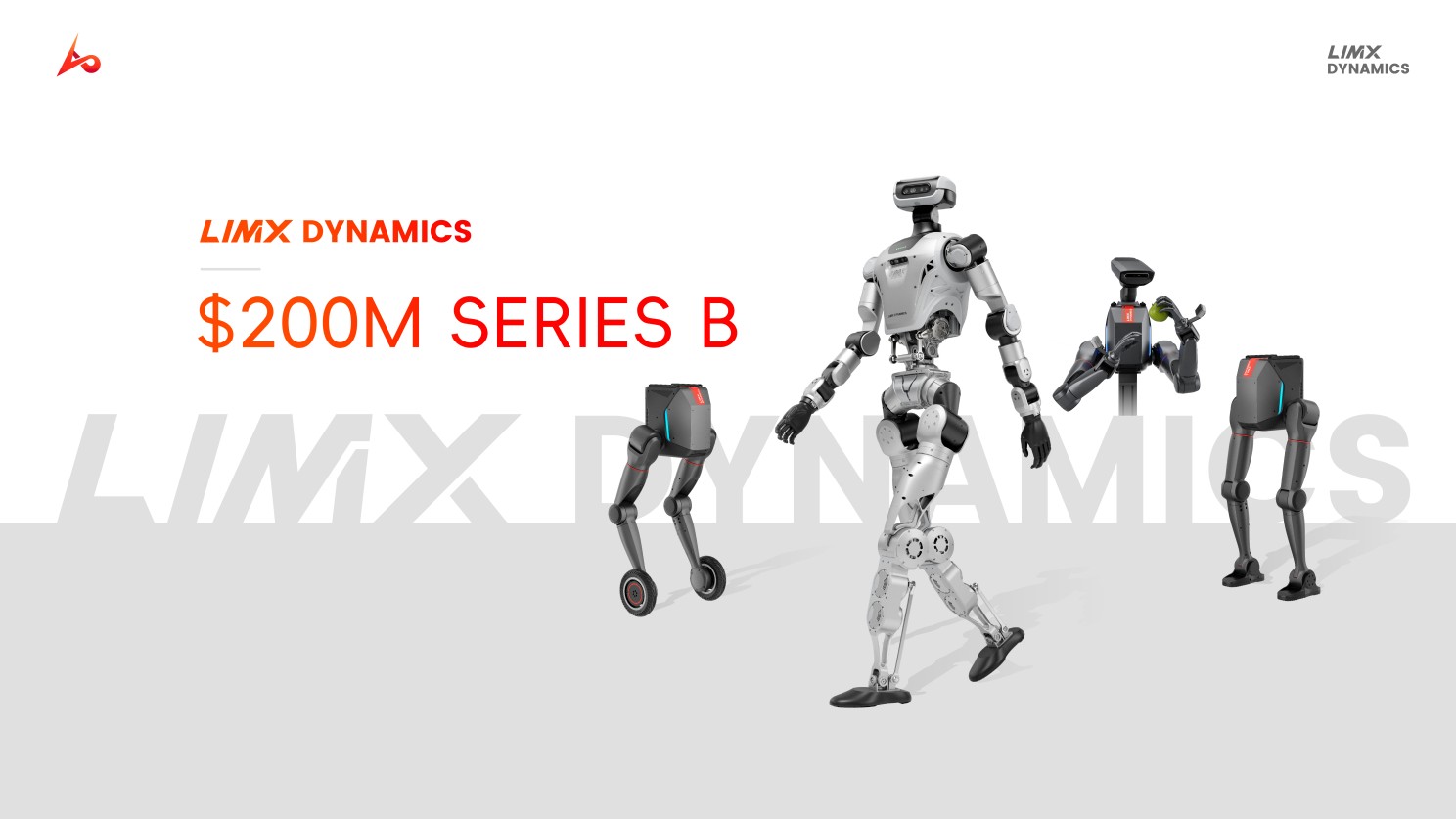
- LimX is positioning its modular Tron 2 hardware platform and Cosa operating system as a lower-cost, general-purpose approach to reduce customization, shorten development cycles and improve reliability in industrial environments.
Chinese humanoid robotics company LimX Dynamics has raised about $200 million in a Series B funding round, bringing in a mix of institutional and strategic investors as capital continues to flow into embodied robotics.
The round included Stone Venture, JD, Oriental Fortune Capital, CoStone Capital, Shangqi Capital (backed by SAIC Motor), NIO Capital, Future Capital and several existing shareholders increased their stakes, according to the company.
According to LimX Dynamics, the funding will be used to advance three core technology areas: humanoid robot hardware design and manufacturing, motion-control foundation models and a proprietary agentic operating system designed for physical-world operation. The company is positioning this full-stack approach as a way to improve reliability and reduce the cost and complexity of deploying robots outside controlled environments.
In recent months, LimX introduced two products aimed at real-world validation. TRON 2 is a modular robotic platform designed to be reconfigured across multiple physical forms, allowing developers and enterprise users to adapt a single system to different tasks without redesigning hardware. The company said the platform is intended to serve as a standardized base for testing and deployment as applications evolve.
LimX also unveiled COSA, its in-house operating system, which it says coordinates perception, planning, and whole-body motion control. The system is designed to support more flexible task execution in changing environments, addressing a longstanding gap between robotic cognition and physical action.
Image credit: LimX Dynamics