

Insider Brief
- A new white paper from AUVSI’s Partnership for Robotics Competitiveness warns that the U.S. is at a drone-sector–style inflection point in robotics and physical AI, where delayed and fragmented policy could allow Chinese state-backed firms to dominate global supply chains and erode U.S. manufacturing capacity.
- According to the paper, robotics is rapidly becoming foundational infrastructure across manufacturing, logistics, agriculture, public safety, and defense, making the economic and national-security consequences of market capture far more severe and durable than in drones.
- To avoid long-term dependency, the partnership calls for early, coordinated action — anchored by a National Robotics Strategy, tougher trade and procurement enforcement and supply-chain and workforce investment — before market dominance hardens and becomes difficult to reverse.
The United States is approaching a decisive moment in advanced robotics and physical AI, a class of technologies that combine software, sensing, compute and machines operating in the physical world. According to a new white paper from the Association for Uncrewed Vehicle Systems International’s new industry colation Partnership for Robotics Competitiveness, the competitive dynamics now unfolding closely resemble the early trajectory of the commercial drone market — where delayed and fragmented policy responses allowed Chinese state-backed firms to dominate global supply chains and erode U.S. manufacturing capacity .
This time, the stakes are higher, the industry coalition reports. Robotics systems are not niche technologies. They are becoming foundational infrastructure across manufacturing, logistics, agriculture, public safety, and defense. Allowing similar market capture in robotics, the paper argues, would create dependencies far broader and more durable than those seen in drones, with economic and national-security consequences that would be difficult to reverse.
“The age of autonomy and advanced robotics is here, and dominance in this industry will determine who leads the next industrial revolution,” Michael Robbins, President & CEO of AUVSI, said in announcing the new initiative and release of the white paper. “That’s why America must get Robot Ready with a National Robotics Strategy to strengthen our industrial base, secure our supply chains, and accelerate innovation, ensuring the robotics industry delivers good jobs, higher productivity, enhanced safety, and lasting prosperity for the American people.”
The Central Argument
At its core, the partnership’s analysis advances a simple but urgent claim: robotics is entering a rapid scaling phase just as China has mobilized a whole-of-nation strategy to dominate the sector. Without early, coordinated intervention, U.S. firms risk being outcompeted not on technical merit, but through state-backed pricing, supply-chain leverage and asymmetric legal and regulatory regimes.
Why the partnership believes robotics policy is urgent:
- Robotics and physical AI are scaling from pilot projects into core economic and defense infrastructure.
- China is deploying a state-backed industrial strategy that compresses development timelines and distorts global markets.
- Delayed U.S. policy risks repeating the drone sector’s outcome: market capture followed by long-term dependency, rather than fair competition.
The analysis stresses that early, targeted action is materially more effective than reactive restrictions imposed after market dominance has already hardened.
Robotics as Strategic Infrastructure
Modern robotics has evolved well beyond rigid, pre-programmed machines operating behind safety cages. Advances in machine learning, sensing, and compute are enabling robots to perceive complex environments, adapt in real time and operate autonomously in unstructured settings such as warehouses, farms, city streets, and disaster zones.
The paper characterizes this shift as a transition from task-specific automation to generalizable embodied intelligence. Robots are no longer simply executing scripts; they are learning from data and interacting directly with people and infrastructure.
What distinguishes modern robotics from prior automation waves:
- Operation in unstructured, real-world environments, not fixed industrial settings.
- Reliance on learning-based autonomy, rather than static programming.
- Platforms that are dual-use by design, spanning commercial and military applications.
- Strategic importance tied to standards, interoperability, and supply-chain control.
Because of these characteristics, the analysis places robotics alongside semiconductors and aerospace as a domain where economic competitiveness and national security converge .
Economic Competitiveness Across the Industrial Base
The white paper grounds its strategic claims in sector-level realities already shaping the U.S. economy. In manufacturing and warehousing, autonomous mobile robots have become central to flexible automation, with the global AMR market estimated at $4.74 billion in 2025 as demand grows for internal logistics and fulfillment efficiency. These systems help offset labor shortages, boost throughput, and support surge capacity for defense-relevant production.
Similar dynamics are playing out across logistics, agriculture, and public safety. Autonomous forklifts, yard automation, and delivery robots are reducing dwell time and error while hardening domestic supply chains. In agriculture, precision robotics are improving yields, addressing labor shortages, and strengthening food security, an issue the analysis treats as inseparable from national security. Public safety deployments, from search-and-rescue to hazardous-material handling, extend responder reach and reduce risk, while highlighting the dangers of relying on foreign adversary–linked systems in critical operations.
Robotics and the Workforce: Augmentation, Not Displacement
The partnership’s analysis pushes back against the idea that robotics adoption is primarily about replacing workers. Instead, it frames robotics as a response to persistent labor shortages, demographic headwinds, and rising productivity demands that cannot be met through workforce supply alone.
How the analysis characterizes robotics’ labor impact:
- Robotics adoption is primarily labor-augmenting, not labor-replacing.
- Systems take on repetitive and hazardous tasks.
- Workers shift toward oversight, maintenance, and integration roles.
- Safety gains support longer working lives and improved retention.
The paper emphasizes that these benefits depend on workforce readiness, training pathways, and trust—making skills development a central pillar of robotics policy rather than an afterthought .
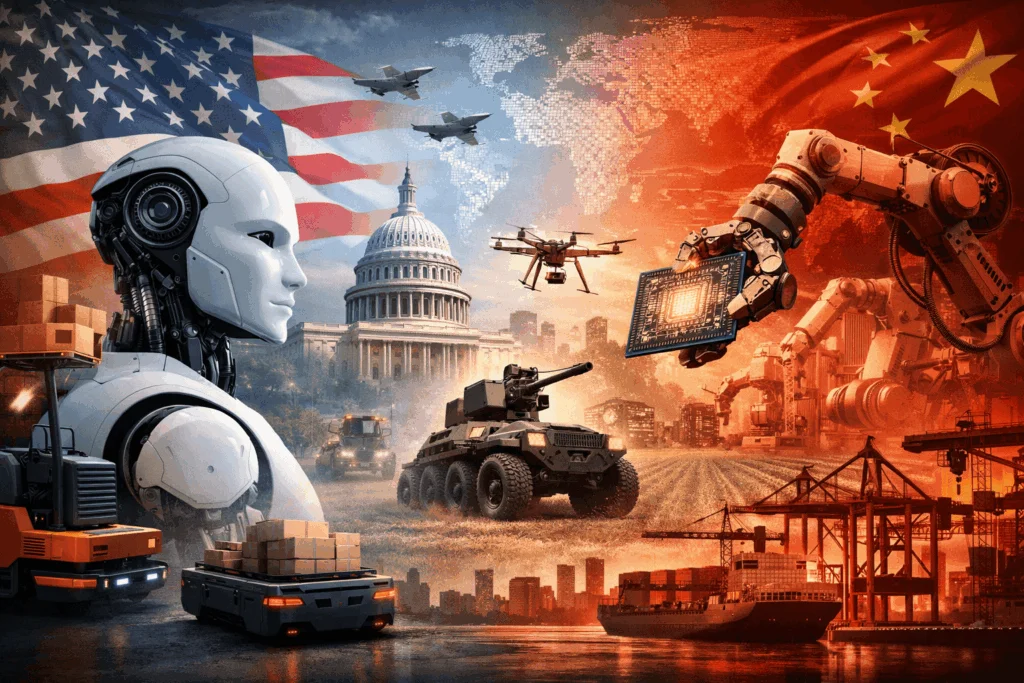
National Security and the Modern Battlefield
On the defense side, the white paper argues that robotics and autonomy are no longer experimental technologies. Autonomous systems for logistics, resupply, reconnaissance, and force protection are becoming foundational to modern military operations, particularly in contested environments.
China has moved beyond experimentation, integrating uncrewed ground systems into military exercises and combined-arms scenarios. Recent demonstrations of LiDAR-equipped robotic platforms in amphibious assault exercises underscore Beijing’s emphasis on autonomy for reconnaissance and perimeter security. The war in Ukraine has further reinforced the military value of adaptable, attritable autonomous systems — lessons that U.S. competitors are actively studying, the analysis notes .
Cyber-Physical Risk and Structural Exposure
Modern robotics systems are networked cyber-physical platforms that blend software, communications, and machines capable of real-world action. As a result, vulnerabilities extend beyond data breaches to physical disruption.
Key cyber-physical risks identified in the analysis:
- Exposure of facility layouts, production patterns, and operational data.
- Remote disruption or manipulation of physical robotic systems.
- Dependence on foreign-controlled firmware, cloud services, or updates.
- Legal asymmetries compelling Chinese firms to provide state access to data and systems.
Crucially, the paper reports that these risks are structural and jurisdictional, not merely technical, and cannot be mitigated through cybersecurity best practices alone .
China’s Whole-of-Nation Robotics Strategy
The white paper situates these risks within a broader examination of China’s industrial policy. Robotics has been elevated alongside artificial intelligence, semiconductors, and electric vehicles as a strategic priority under frameworks such as Made in China 2025 and successive Five-Year Plans.
China’s approach combines subsidies, preferential financing, coordinated research and development and military–civil fusion with outbound investment strategies designed to absorb foreign technology and talent. High-profile acquisitions, such as Germany’s Kuka, illustrate how access to advanced manufacturing expertise has been internalized into domestic ecosystems.
The result is a state-backed growth model that allows Chinese firms to compete aggressively on price while consolidating control over critical supply chains, the analysts report.
Strategic Supply-Chain Chokepoints
The paper becomes most concrete in its discussion of component dependencies that constrain robotics manufacturing:
- Rare-earth permanent magnets, particularly neodymium-iron-boron, are essential for high-performance motors, yet the United States has extremely limited domestic capacity.
- Advanced batteries and power electronics are tightly coupled to platform design, with China dominating downstream lithium-ion processing and cell manufacturing.
- Sensors and LiDAR underpin perception and autonomy while generating sensitive spatial data tied to critical infrastructure.
Once integrated, these components are difficult to replace without costly redesign and recertification, locking in long-term dependencies that can be exploited for economic or geopolitical leverage, the analysis warns .
The Policy Path Forward
The partnership calls for a National Robotics Strategy to coordinate federal action, anchored by a National Robotics Council and expert commission to align policy, adoption, and standards-setting. It urges policymakers to counter China’s unfair market practices using existing trade and national-security authorities, while aligning federal procurement to prohibit China-linked robotics and prioritize U.S. and allied platforms that meet clear security and transparency standards.
The analysis also advocates using government market power — through advance market commitments and demand aggregation — to de-risk private investment and accelerate deployment without prescribing specific technologies.
To safeguard the robotics ecosystem, the partnership emphasizes robust use of ICTS risk-based reviews to screen adversary-linked technologies and investment in cyber-physical systems. It also calls for stronger protection of intellectual property through coordinated export controls, deeper integration with trusted allies to diversify robotics supply chains, and targeted action to mitigate strategic chokepoints by expanding domestic production, stockpiling and allied sourcing of critical inputs such as rare earths, batteries, and sensors.
Beyond these core priorities, the partnership highlights several other actions that reinforce long-term competitiveness:
- Adopt industry-led standards and trusted certification to embed security, interoperability, and transparency without slowing innovation.
- Strengthen the U.S. robotics industrial base by extending manufacturing tax credits and investment incentives to capital-intensive robotics production.
- Accelerate adoption through targeted grants, particularly for small and mid-sized firms facing high upfront deployment costs.
- Prepare the workforce for the robotics economy through industry-aligned training, certifications, and workforce development tax credits.
- Expand pilots and public-private partnerships to reduce deployment risk, generate real-world data, and create early markets for U.S.-developed robotics.
Bottom Line
The analysts conclude that robotics and physical AI will shape the next era of industrial competitiveness and national security. The United States retains deep strengths in innovation and engineering, but the window for effective action is narrowing. Applying the lessons of the drone sector early — before market dominance hardens into dependency — offers the best chance to secure long-term leadership in one of the defining technologies of the twenty-first century, the analysis concludes .