
Insider Brief
- Coco Robotics launched Coco 2, a next-generation autonomous delivery robot designed to transition the company from human-assisted operations to full autonomy.
- The new platform expands beyond sidewalks into bike lanes and select roadways where permitted, increases uptime, and cuts delivery times by up to 50% compared with the prior generation.
- Coco 2 runs on upgraded edge computing hardware and is trained on millions of real-world and simulated urban miles, positioning the company to scale broader citywide deployments across restaurants, grocers and retail logistics.
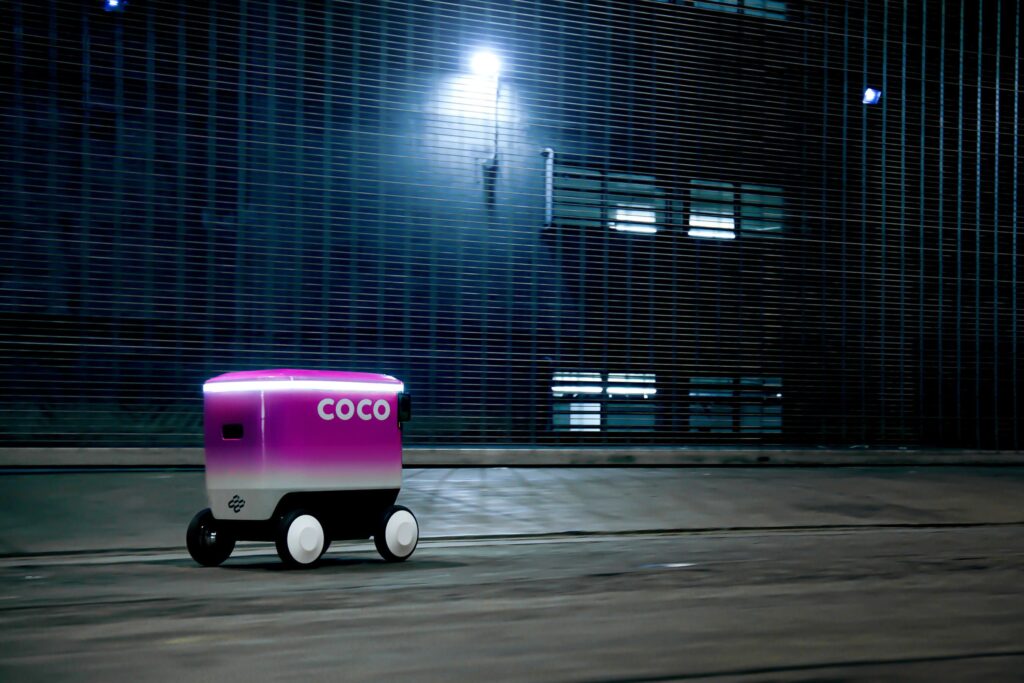
Coco Robotics is rolling out Coco 2, an upgraded autonomous delivery robot aimed at accelerating its shift toward fully autonomous urban logistics.
“Every mile our robots have driven has made the whole fleet smarter,” CEO and Co-Founder Zach Rash said in the announcement. “Human-in-the-loop learnings have helped us improve with every edge case, creating a feedback loop between deployment, data collection, and model advancements. This ongoing process has steadily enhanced our fleet’s intelligence, enabling Coco to operate in new cities with real-time adaptability.”
What’s new about Coco 2?
According to the company, the new platform expands beyond sidewalk-only routes into bike lanes and select roadways where permitted, broadening its operating domain and targeting faster, more flexible urban logistics. Coco said the update reduces delivery times by up to 50% compared with its prior generation.
The new model is also more weather resistant and can increase daily delivery capacity and in turn cost per mile since its uptime is up to three times longer.
Coco 2 is built on a larger and more mature operational dataset drawn from millions of real-world miles across varied environments, including extreme heat, heavy rain, snow and dense urban traffic. The company noted that data is used to continuously refine its navigation and decision-making models, allowing the robot to adapt more quickly when entering new cities.
What Powers Coco 2
Coco 2 runs on NVIDIA Jetson Orin NX for higher-performance edge computing, enabling more processing directly on the robot rather than relying on constant cloud connectivity. In parallel, the company uses NVIDIA Omniverse, Isaac Sim and Isaac Lab to create synthetic training environments that mirror real streets and edge cases before deployment.
Operationally, Coco 2 is designed as a general-purpose urban robotics platform capable of serving not only restaurants, but also grocers, pharmacies and retailers, the company emphasized. The company said the new robot will allow faster expansion into new cities.
Coco, founded in 2020, currently operates autonomous delivery services through Uber Eats, DoorDash and Wolt, serving more than 3,000 merchants ranging from local restaurants to national chains. The company said it plans to expand its fleet to thousands of robots globally by the end of the year.
Image credit: Coco Robotic