
Insider Brief
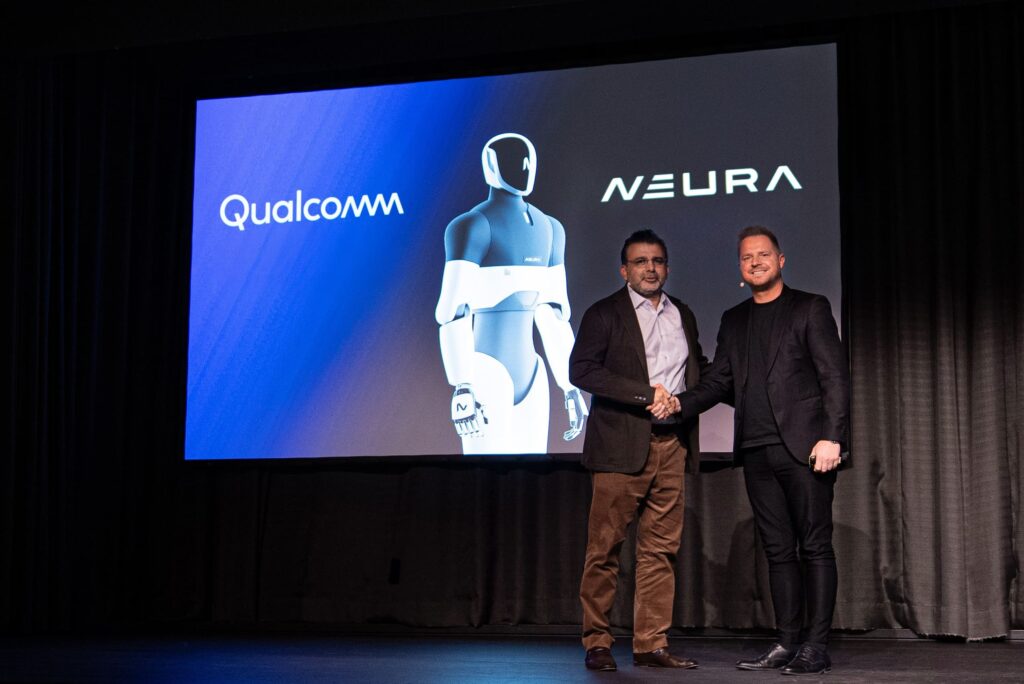
- Neura Robotics has formed a long-term strategic collaboration with Qualcomm Technologies to develop next-generation robotics and physical AI platforms aimed at accelerating real-world deployment.
- The partnership combines Qualcomm’s edge AI processors and connectivity platforms with Neura’s robotic hardware and embodied AI software to support humanoid and general-purpose robots across multiple environments.
- The companies plan to develop standardized architectures and use Neura’s Neuraverse platform to train, simulate and manage fleets of robots connected through a shared intelligence network.
Neura Robotics announced it has formed a long-term strategic collaboration with Qualcomm Technologies to develop next-generation robotics and physical AI platforms designed for real-world deployment.
The partnership combines Qualcomm’s edge AI computing, connectivity and robotics processors with Neura’s robotic hardware systems and embodied AI software to accelerate commercialization of humanoid and general-purpose robotics.
“By bringing together our cognitive robotics platforms and the Neuraverse ecosystem with Qualcomm Technologies’ leadership in edge AI and connectivity, we’re aiming to accelerate a future where cognitive robots operate safely alongside humans across industries and throughout everyday life,” CEO and Founder of Neura Robotics David Reger said in the announcement.
What Does the Collaboration Entail?
The collaboration centers on so-called “brain and nervous system” reference architectures that combine high-level AI functions such as perception, reasoning and planning with real-time robotic control. Qualcomm’s robotics processors, including the Dragonwing IQ10 series and related AI acceleration software stack, will be paired with Neura’s robotics platforms and cognitive software to support scalable deployments across multiple robot form factors.
The companies also plan to develop standardized runtime and deployment interfaces designed to simplify how AI workloads are validated, deployed and updated across robotic systems. The approach is intended to help robotics developers move more quickly from prototype systems to production-scale deployments while maintaining deterministic performance and functional safety.
“Robotics represents one of the most demanding edge AI use cases, where decisions must happen instantly, reliably, and locally, without relying solely on the cloud for safety-critical responses,” said Nakul Duggal, EVP and Group GM, Automotive, Industrial and Embedded IoT and Robotics, Qualcomm Technologies, Inc.
Neura’s Neuraverse platform is expected to serve as a core environment for simulation, training and lifecycle management of physical AI systems built on Qualcomm’s robotics processors. The cloud-based system connects robots into a shared intelligence network designed to allow improvements made by one robot to be distributed across broader fleets.
The partnership also seeks to expand the developer ecosystem for robotics by encouraging third-party software development and enabling a build-once, deploy-across-multiple-platforms model, the companies noted. Neura’s robotics portfolio — including robotic arms, mobile robots, service robots and humanoid platforms — will serve as reference systems for testing and validation.
Image credit: Neura Robotics