
Insider Brief
- Rhoda AI emerged from 18 months of stealth with $450 million in Series A funding and introduced FutureVision, a robotics intelligence platform built on video-predictive control to help robots operate in real-world industrial environments.
- The company said its Direct Video Action architecture pretrains models on hundreds of millions of internet videos to learn motion and physics before fine-tuning with smaller amounts of robot data, allowing systems to adapt to changing conditions in closed-loop control.
- Rhoda AI said the funding will support research, industrial deployments and team expansion as it develops foundation models designed to power robotic manipulation across manufacturing and logistics environments.
Rhoda AI announced it has emerged from stealth with $450 million in Series A funding and introduced a new robotics intelligence platform designed to help machines operate more reliably in real-world industrial environments.
The company is backed by a group of technology investors including Capricorn Investment Group, Khosla Ventures, Leitmotif, Matter Venture Partners, Mayfield, Premji Invest, Prelude Ventures, Temasek and Xora, along with several individual technology investors. Rhoda AI said the new funding round will help accelerate commercial deployments with manufacturing and logistics partners as well as expand development of the platform, called FutureVision.
Rhoda said FutureVision is built on a video-predictive architecture intended to address a persistent limitation in robotics: the difficulty of adapting to dynamic, unpredictable conditions outside controlled laboratory settings. The company said the funding will support research and engineering, expansion of industrial deployments and growth of its technical team.
The company pointed out that newer artificial intelligence approaches, including vision-language-action models, have improved robots’ ability to learn tasks from data but often struggle with variability such as shifting layouts, unfamiliar objects and changing workflows.
“We believe the next era of robotics requires models that understand how the world moves — not just what it looks like or how it’s described in language,” cofounder and CEO Rhoda Jagdeep Singh said in the announcement. “By learning from internet-scale video and operating in closed loop, our systems are designed to adapt to real world variability in ways conventional approaches struggle to achieve. The goal is simple: robots that work in the real world, not just controlled lab settings.”
How Does Rhoda AI’s Platform Work?
Rhoda said its approach focuses on training robotic systems using large-scale video data to build an understanding of motion and physical interaction. The company pre-trains models on hundreds of millions of internet videos to develop a baseline representation of how objects and environments behave, then fine-tunes the models using smaller sets of robot-specific data.
According to the company, the system continuously observes its surroundings, predicts near-term changes in the environment as video frames and converts those predictions into actions. Rhoda said this process repeats in rapid cycles, allowing robots to adjust their behavior in response to changing conditions.
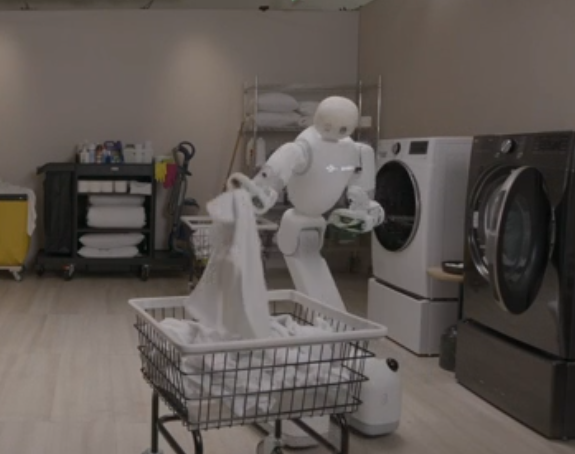
Rhoda AI said its Direct Video Action architecture integrates perception and control in a closed-loop system that allows robots to update actions continuously as conditions change, rather than relying on fixed plans that can fail in dynamic environments. The company said models pretrained on large-scale video data learn underlying motion patterns and physical interactions, enabling robots to acquire new manipulation tasks with relatively small amounts of teleoperation data, in some cases requiring as little as about ten hours of robot training.
FutureVision serves as the company’s core intelligence platform and is expected to function as a foundation model that can be deployed across different robotic systems. Rhoda AI said it plans to license the technology to partners using a range of hardware and software platforms.
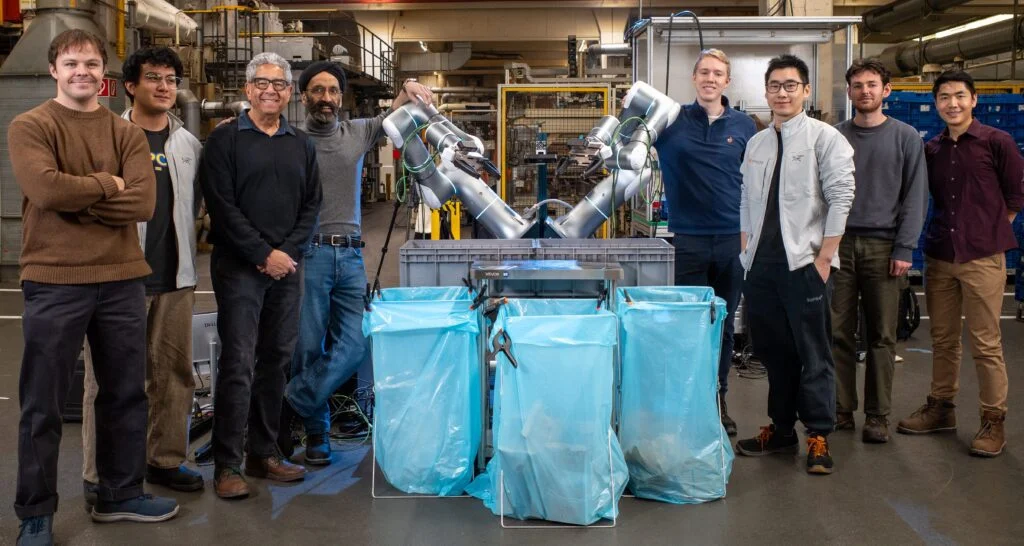
The company said its technology has already been tested in industrial environments where robots must operate under changing conditions. In one manufacturing evaluation, Rhoda reported that its system autonomously completed a component-processing workflow in under two minutes per cycle while meeting production performance benchmarks.
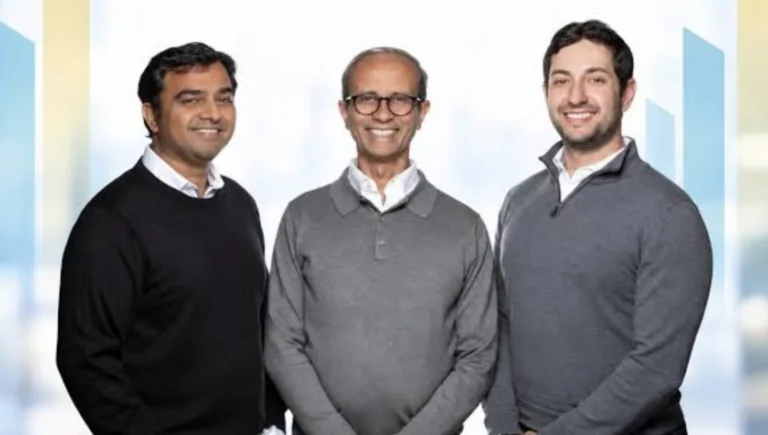
Along with Singh, a technology entrepreneur who has previously founded and scaled multiple deep-technology companies, the leadership team also includes Chief Science Officer Eric Ryan Chan, a researcher in computer vision and generative modeling who previously worked on generative systems at WorldLabs, and Gordon Wetzstein, a Stanford University professor and head of the Computational Imaging Lab.
Image credit: Rhoda AI