Insider Brief
- HDT Robotics deployed its Hunter WOLF unmanned ground vehicles for military training and operational evaluation to demonstrate readiness for field use and integration into real-world missions.
- The multi-mission platform is designed to reduce soldier workload and extend operations, with configurable roles including communications, logistics, casualty evacuation and ISR, supported by commercially available components for easier maintenance.
- Training exercises allow soldiers to operate the system across multiple configurations and test semi-autonomous capabilities, evaluating how robotic systems can augment human teams in demanding environments.
HDT Robotics announced it has deployed its Hunter WOLF unmanned ground vehicles for military training and operational evaluation to demonstrate the platform’s readiness for the field.
According to the company, the deployments are designed to familiarize soldiers with operating, maintaining and configuring the vehicle across multiple mission scenarios under realistic conditions. HDT said the effort is focused on integrating the system into existing operations while testing its performance.
What is Hunter WOLF?
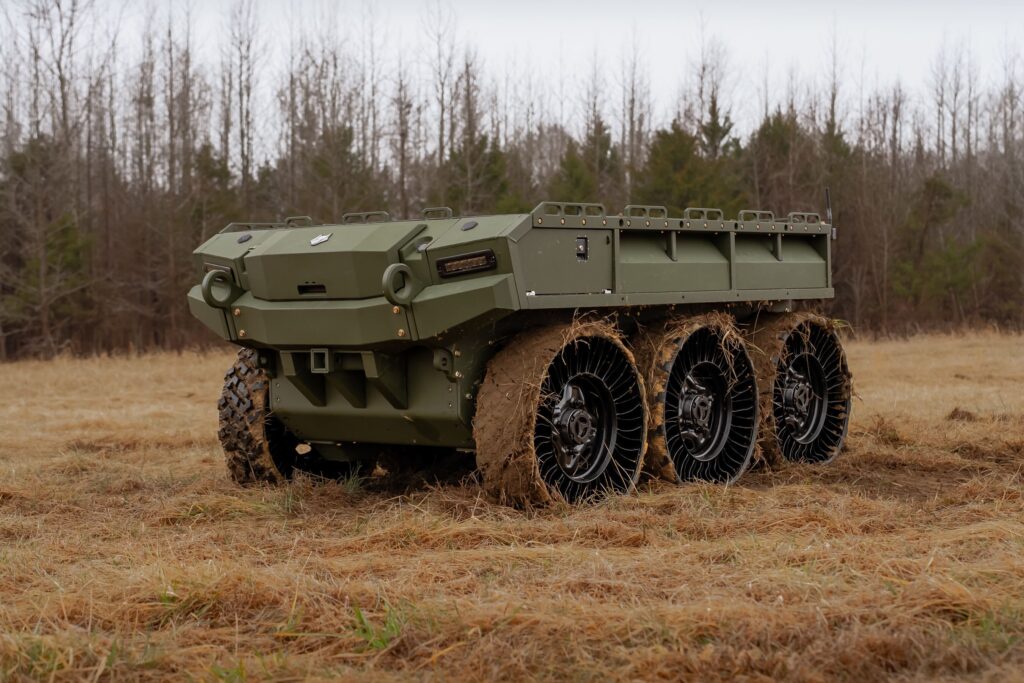
Hunter WOLF is a multi-mission robotic platform developed within HDT’s Advanced Battle Lab and is intended to reduce physical strain on soldiers while extending mission duration. According to HDT, the vehicle can be configured for communications, logistics support, casualty evacuation or intelligence, surveillance and reconnaissance tasks.
The platform uses commercially available components to simplify maintenance and improve reliability in the field, an area that has historically challenged more complex military systems. HDT said this design approach is intended to reduce downtime and enable easier support in austere environments.
How is HDT Robotics Testing Hunter WOLF?
“The training gives soldiers hands-on experience operating and maintaining the platform and will demonstrate the use of autonomy kits and casualty evacuation,” the company said.
During the training exercises, soldiers operate the vehicles in several configurations, including communications relay, sustainment and support roles. These setups incorporate tactical radios, mobile power systems, water purification units and cargo transport capabilities, along with modules for casualty evacuation, the company noted.
The training will allow operators to test assisted or semi-autonomous functions in controlled scenarios. The goal is to assess how robotic systems can complement human teams by handling repetitive or physically demanding tasks, the company noted.
“We’re focused on giving soldiers a capability that helps them do their job while reducing their exposure to risk. The Hunter WOLF has gone through rigorous testing, is battlefield tested, and ready now,” HDT’s robotics sector president Tom Van Doren said in the announcement.
Based in Virginia, HDT develops modular robotic systems designed for hazardous and demanding environments, with applications across defense and industrial sectors. The Hunter WOLF program represents the company’s latest effort to transition robotics from development into field-ready systems.