Insider Brief
- A study from the Norwegian University of Science and Technology found seafarers remain skeptical of autonomous ships, citing concerns about safety, skill degradation and the need for continued human oversight.
- Based on responses from 1,009 captains and mates, researchers identified 12 key challenges including emergency handling, system reliability and the risk of losing critical skills as automation increases.
- The findings suggest adoption will depend on building trust through human involvement, real-world testing and clearer integration of automation.
Researchers in Norway are exploring how seafarers see the rise of autonomous ships and what the industry can take away from their insights.
A new study from the Norwegian University of Science and Technology found that seafarers remain skeptical of autonomous ships, raising concerns about safety, skill degradation and the need for human oversight as the industry moves toward automation, according to the university.
The study, How can maritime automation and autonomy be safely implemented? A mixed-method topic model, analyzed responses from 1,009 captains and mates on Norwegian vessels, making it one of the largest surveys of its kind, the university said. Researchers indicated the findings highlight a tension between rapid advances in autonomous maritime technology and the workforce expected to operate alongside it.
Captains and mates remain responsible for oversight and decision-making on ships, but the maritime industry is facing recruitment challenges as automation expands. Researchers said skepticism among seafarers toward autonomous systems must be addressed to ensure adoption and attract skilled personnel.
“Seafarers feel strongly that people should continue to work on board, maintaining oversight and control so that unforeseen events can be managed properly,” PhD research fellow Asbjørn Lein Aalberg said.
Researchers identified 12 key areas of concern related to safety and operations. These include emergency handling, system reliability, human oversight, and the potential erosion of critical skills among crew members as automation increases. The study suggests that while autonomous systems may improve efficiency, they introduce new risks if not properly integrated with human expertise.
What did Researchers Learn?
A central finding is that trust remains a major barrier to adoption. Many seafarers expressed concern that fully autonomous systems may not be able to handle unpredictable conditions, particularly in challenging environments such as rough seas or emergency situations. The researchers noted that maintaining human involvement, especially in oversight roles, may be critical to ensuring safe operations during the transition period.
The study also pointed out concerns about long-term skill degradation. As automation takes over routine tasks, seafarers said they worried that their ability to respond to critical events could decline. The researchers compare this to other domains, such as medicine, where AI tools can enhance performance but still require human judgment in complex or edge-case scenarios.
“In waves of over 4 metres, I do not want to encounter an autonomous ship that does not use the ‘bad weather route’ like we do” and “Crews are becoming lazy because they expect an alarm on absolutely everything“,” says another.” are two responses researchers highlighted in reporting their findings.
At the same time, the findings indicated that skepticism is not uniform opposition. Many respondents were open to automation if systems are introduced in a way that supports, rather than replaces, human roles. The researchers suggested opportunities to improve trust include clearer communication, hands-on testing and involving seafarers in development and deployment phases.
The researchers concluded that successful adoption of maritime autonomy will depend not only on technological advancement but also on building trust among operators. This includes addressing safety concerns, preserving critical skills and ensuring that human oversight remains central to system design.
The timing of the research is notable as Norway is making deploying autonomous ferries on public routes a priority. This shift reflects broader industry pressures, including labor shortages and the push to improve efficiency through automation, according to researchers.
Methodologically, the study used a survey-based approach with open-ended responses, allowing researchers to capture detailed perspectives from experienced maritime professionals. The analysis applied topic modeling techniques to identify recurring themes and concerns across the dataset, researchers noted.
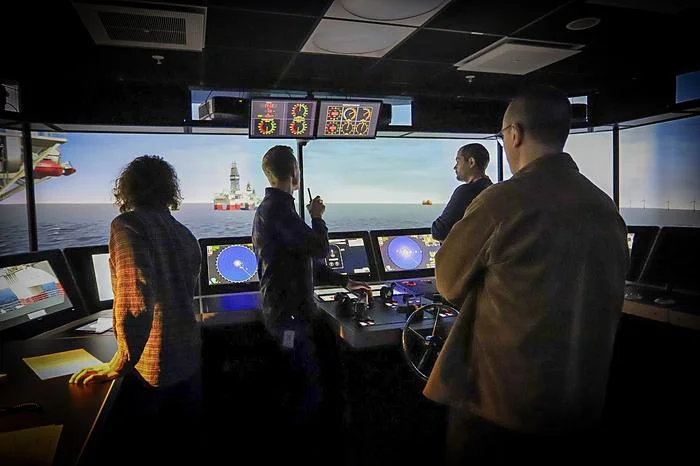
Featured image: The photo was taken during a cybersecurity course in the ship simulator at NTNU in Ålesund. (Credit: Archive photo: Eli Anne Tvergrov, NTNU)