
Insider Brief
- Sodexo Australia and Ottonomy are piloting autonomous delivery robots at Rio Tinto’s Gudai-Darri mining village in Western Australia to bring food and essentials directly to workers in a remote, shift-based environment.
- The Ottobot system uses geofenced navigation and app-based ordering to reduce wait times and improve access to services for fly-in-fly-out workers without increasing staffing requirements.
- The deployment highlights a broader shift toward adapting urban delivery robotics to controlled industrial settings, where defined routes and predictable conditions enable early adoption and operational testing.
Autonomous delivery robots are moving into remote industrial environments, with Sodexo Australia piloting a food and essentials delivery system at a Rio Tinto mining village in Western Australia.
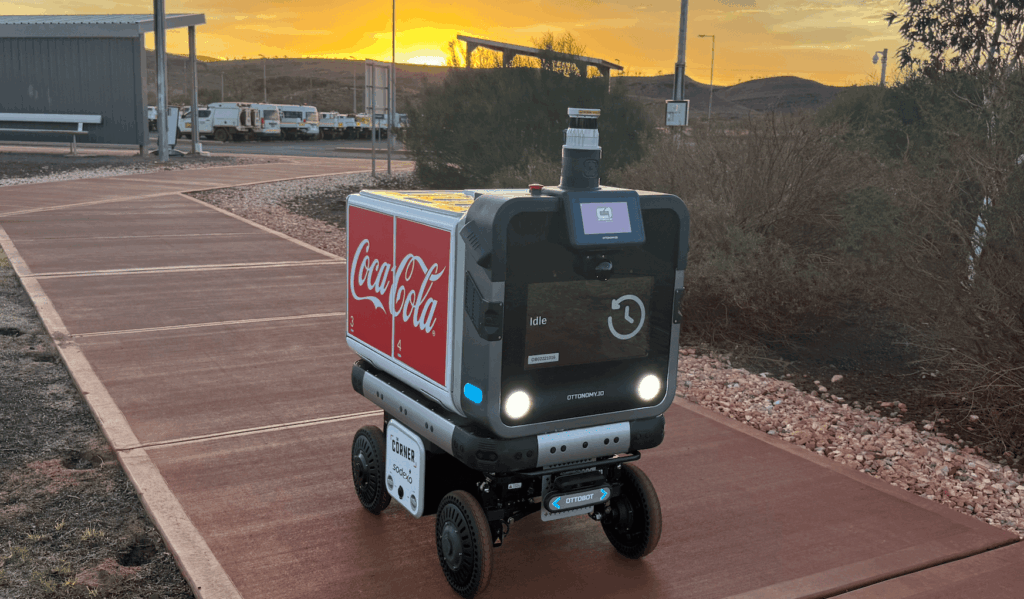
Ottonomy said it is testing its autonomous delivery robot Ottobot at the Gudai-Darri site in the Pilbara region to deliver meals, snacks and other items directly to workers’ accommodations, reducing wait times and extending access to on-site services in a remote setting.
Sodexo, which provides food and beverage services to the mining village, indicated the pilot targets a specific operational challenge in mining camps, where what are called fly-in-fly-out (FIFO) workers operate on long shifts and access to services can be limited by distance and scheduling. By enabling on-demand delivery through a mobile app, the company aims to improve convenience without adding staffing requirements.
The robots navigate pre-mapped, geofenced routes within the village and operate at walking speed, designed to yield the right of way to pedestrians and vehicles. Orders are prepared by staff, loaded into the robot and delivered to users, who unlock the compartment with a PIN code upon arrival.
The deployment reflects a broader trend of adapting autonomous delivery systems, initially developed for urban environments, to controlled industrial settings, according to the company. Mining camps, with defined routes and predictable traffic patterns, provide a testbed for expanding robotics into non-traditional service environments.
Sodexo has been expanding its use of automation at the site, including an autonomous retail store launched in 2025. The robot delivery will be offering the same brand partners that Coca-Cola, Red Bull, Mars and Smiths Chips, with other items from the village menu.
Ottonomy said its platform is designed to operate across both indoor and outdoor environments, with a focus on addressing labor constraints and enabling localized delivery networks. The company’s system combines its robot fleet with an orchestration platform that manages routing and operations.
The pilot also involves consumer brands supplying products for delivery, reflecting how service automation is being integrated into existing supply chains rather than built as a standalone system.
The trial will evaluate how autonomous delivery performs in a remote, high-utilization environment, where reliability and ease of use are critical. If successful, similar systems could be deployed across other mining sites and industrial facilities, Ottonomy said.
Image credit: Ottonomy