

Insider Brief
- Researchers from the Tokyo University of Science have developed a self-powered dye-sensitized solar cell-based synaptic device that mimics human synaptic behavior, enabling efficient time-series data processing for edge AI applications.
- The device, inspired by the eye’s afterimage phenomenon, features light intensity-controllable time constants, allowing it to classify human motions like walking and running with over 90% accuracy while consuming just 1% of the power required by conventional systems.
- This innovation integrates optical input, computation, and power functions at the material level, paving the way for low-cost, energy-efficient edge AI sensors with applications in health monitoring, surveillance, and vehicle-mounted cameras.
PRESS RELEASE — Physical reservoir computing (PRC) utilizing synaptic devices shows significant promise for edge AI. Researchers from the Tokyo University of Science have introduced a novel self-powered dye-sensitized solar cell-based device that mimics human synaptic behavior for efficient edge AI processing, inspired by the eye’s afterimage phenomenon. The device has light intensity-controllable time constants, helping it achieve high performance during time-series data processing and motion recognition tasks. This work is a major step toward multiple time-scale PRC.
Artificial intelligence (AI) is becoming increasingly useful for the prediction of emergency events such as heart attacks, natural disasters, and pipeline failures. This requires state-of-the-art technologies that can rapidly process data. In this regard, reservoir computing, specially designed for time-series data processing with low power consumption, is a promising option. It can be implemented in various frameworks, among which physical reservoir computing (PRC) is the most popular. PRC with optoelectronic artificial synapses (junction structures that permit a nerve cell to transmit an electrical or chemical signal to another cell) that mimic human synaptic elements are expected to have unparalleled recognition and real-time processing
However, PRC based on existing self-powered optoelectronic synaptic devices cannot handle time-series data across multiple timescales, present in signals for monitoring infrastructure, natural environment, and health conditions.
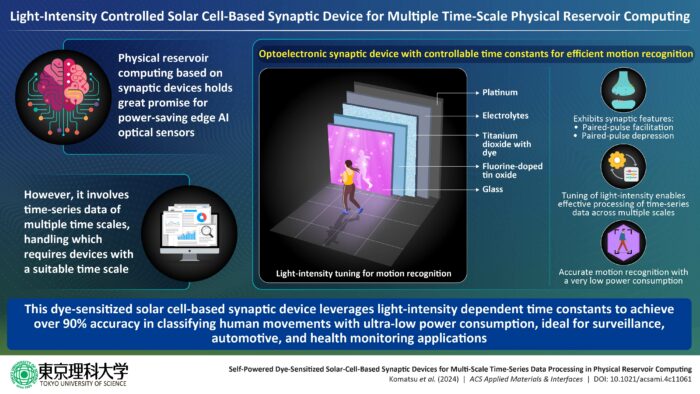 In a recent breakthrough, a team of researchers from the Department of Applied Electronics, Graduate School of Advanced Engineering, Tokyo University of Science (TUS), led by Associate Professor Takashi Ikuno and including Mr. Hiroaki Komatsu, and Ms. Norika Hosoda, has successfully fabricated a self-powered dye-sensitized solar cell-based optoelectronic photopolymeric
 Dr. Ikuno explains the motivation behind their research: “In order to process time-series input optical data with various time scales, it is essential to fabricate devices according to the desired time scale. Inspired by the afterimage phenomenon of the eye, we came up with a novel optoelectronic human synaptic device that can serve as a computational framework for power-saving edge AI optical sensors.”
The solar cell-based device utilizes squarylium derivative-based
Furthermore, when this device was used as the reservoir layer of PRC, it classified human movements such as bending, jumping, running, and walking with more than 90% accuracy. Additionally, the power consumption was just 1% of that required by conventional systems, which would also significantly reduce the associated carbon emissions. “We have demonstrated for the first time in the world that the developed device can operate with very low power consumption and yet identify human motion with a high accuracy rate,” emphasizes Dr. Ikuno.
Notably, the proposed device opens a new path toward the realization of edge AI sensors for various time scales, with applications in surveillance cameras, car cameras, and health monitoring. According to Dr. Ikuno, “This invention can be used as a massively popular edge AI optical sensor that can be attached to any object or person, and can impact the cost involved in power consumption, such as car-mounted cameras and car-mounted computers.” He adds, “This device can function as a sensor that can identify human movement with low power consumption, and thus has the potential to contribute to the improvement of vehicle power consumption. Furthermore, it is expected to be used as a low power consumption optical sensor in stand-alone smartwatches and medical devices, significantly reducing their costs to be comparable or even lower than that of current medical devices.”