
Insider Brief
- Nvidia has unveiled new simulation libraries, AI models, and computing infrastructure at SIGGRAPH to accelerate advanced robotics development
- The company also introduced NuRec rendering for high-accuracy 3D environment reconstruction, open-sourced Isaac Sim 5.0 and Isaac Lab 2.2, and launched Cosmos Reason, a reasoning vision-language model enabling robots to interpret complex commands, use common sense, and adapt to unfamiliar environments.
- Nvidia is supporting these tools with RTX PRO Blackwell Servers, DGX Cloud on Microsoft Azure, and a new OpenUSD curriculum and certification program, aiming to expand industry adoption of simulation-driven AI development in robotics, autonomous vehicles, and manufacturing.
Nvidia is rolling out new simulation libraries, AI models, and computing infrastructure designed to speed the development of advanced robotics. The announcement, made at the SIGGRAPH conference in Vancouver, underscores the company’s push to blend computer graphics and artificial intelligence to make robots and autonomous systems more capable, adaptable, and commercially viable.
The new offerings include Nvidia Omniverse software development kits (SDKs) and libraries for creating physically accurate “digital twins” — virtual replicas of real-world systems — and Nvidia Cosmos world foundation models for generating the synthetic data needed to train physical AI. Together, these tools allow developers to model, test, and refine robots in simulated environments before deploying them in the field, the company noted in the announcement.
“Computer graphics and AI are converging to fundamentally transform robotics,” Rev Lebaredian, vice president of Omniverse and simulation technologies at Nvidia, said in a statement. “By combining AI reasoning with scalable, physically accurate simulation, we’re enabling developers to build tomorrow’s robots and autonomous vehicles that will transform trillions of dollars in industries.”
According to Nvidia, the Omniverse update introduces interoperability between MuJoCo, a widely used physics engine for robot learning, and Universal Scene Description (OpenUSD), a standard for 3D content. This enables more than 250,000 developers to use the same robot designs across platforms without rebuilding them from scratch. A new NuRec rendering library brings “3D Gaussian splatting” — a technique for capturing and reconstructing real-world environments from sensor data — to Omniverse, allowing developers to replicate real spaces in simulation with greater accuracy.
Nvidia said it has also integrated NuRec into CARLA, an open-source simulator used by over 150,000 autonomous vehicle developers, and added support from industry tools such as Voxel51’s FiftyOne, which is used by Ford and Porsche for AI data preparation.
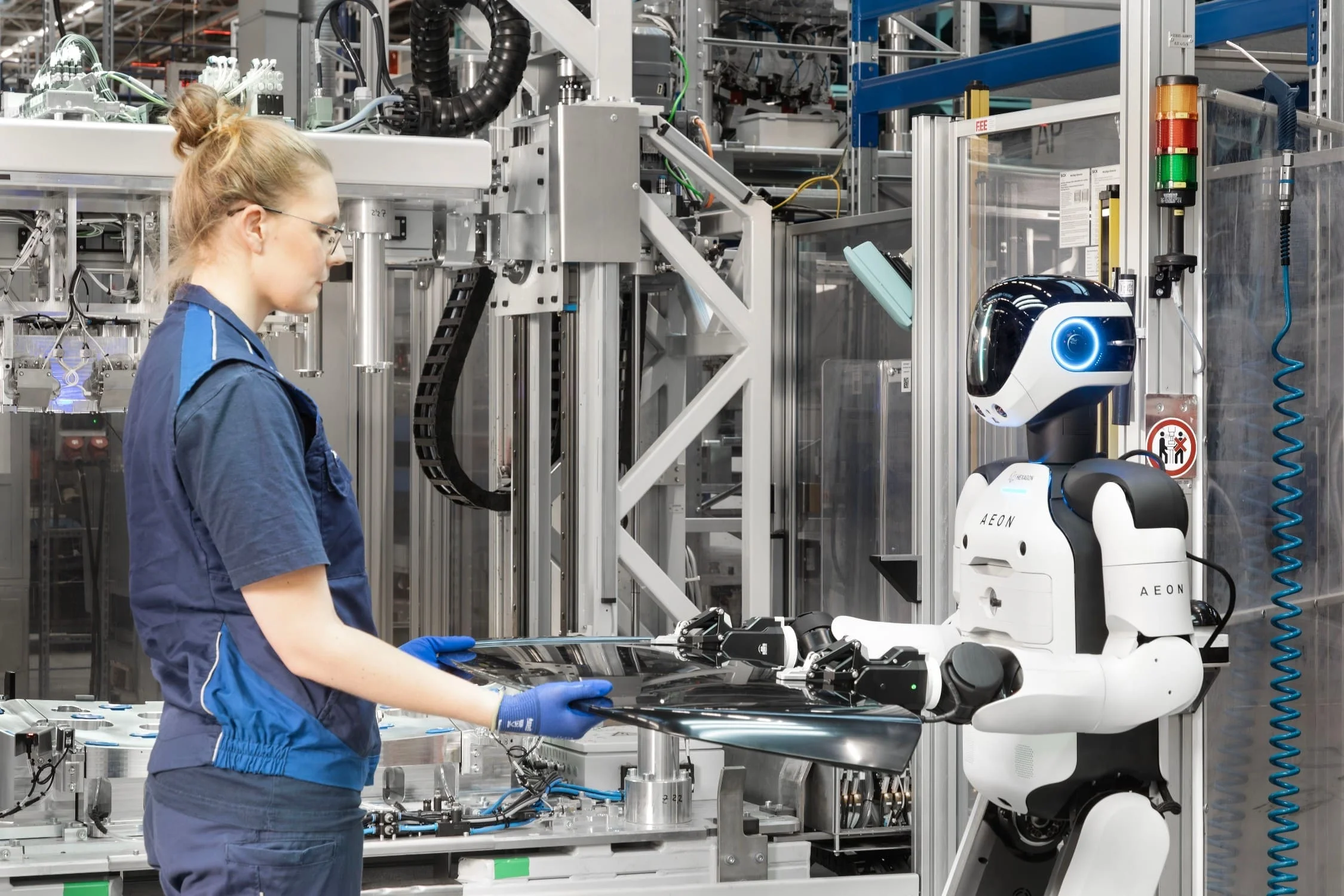
Nvidia Isaac Sim 5.0 and Isaac Lab 2.2, both now open source, provide frameworks for simulating and training robots. Companies including Boston Dynamics, Figure AI, Hexagon, and Skild AI are adopting the tools to accelerate robotics R&D, while Amazon Devices & Services is using them in a new manufacturing solution.
On the AI modeling side, Nvidia is expanding its Cosmos platform with two major updates. Cosmos Transfer-2 improves the speed and control of synthetic data generation from 3D simulation scenes, reducing a complex 70-step process to one. Lightwheel, Moon Surgical, and Skild AI are using Cosmos Transfer to train physical AI systems for robotics in diverse conditions. Cosmos Reason, a new seven-billion-parameter “reasoning” vision-language model, enables robots to break down complex instructions, use common sense, and adapt to unfamiliar environments. It is being used internally by Nvidia’s robotics and DRIVE teams and externally by partners such as Uber and Magna for tasks ranging from autonomous delivery route planning to annotating training data.
Supporting the new software, Nvidia introduced RTX PRO Blackwell Servers, built to handle training, simulation, and data generation workloads on a single architecture. It also extended its DGX Cloud service — now available on Microsoft Azure Marketplace — to make it easier for developers to stream OpenUSD- and RTX-based applications from the cloud without managing their own infrastructure.
The company is also launching an OpenUSD curriculum and certification program, supported by Adobe, Amazon Robotics, Siemens, and other partners, to meet demand for expertise in the format. The company said it is working with Lightwheel on open-source robotics training frameworks to help accelerate the adoption of 3D simulation in robotics development.