
Insider Brief
- European militaries are moving UGVs from trials to field use, with national programs and EU/NATO efforts converging on logistics, reconnaissance, engineering, and cautious armed overwatch—accelerated by lessons from Ukraine and a focus on survivability and tempo.
- France (FURIOUS/AUROCHS), the UK (ATILLA/THESEUS), Germany (cargo-mule trials, InterRoC convoys, ARX Gereon), Italy (RAS spirals), and Poland (KUNA) are advancing deployments alongside industry platforms from Rheinmetall (Mission Master/PATH), Milrem (THeMIS/UK variant), KNDS/Nexter (Ultro/Optio), QinetiQ (Titan), and ARX (Gereon).
- Success hinges on interoperable standards (iMUGS, NATO IOP), rugged autonomy and resilient comms, clear human-in-the-loop rules, and procurement and training that scale mixed man–machine formations from demonstrations to routine NATO exercises.
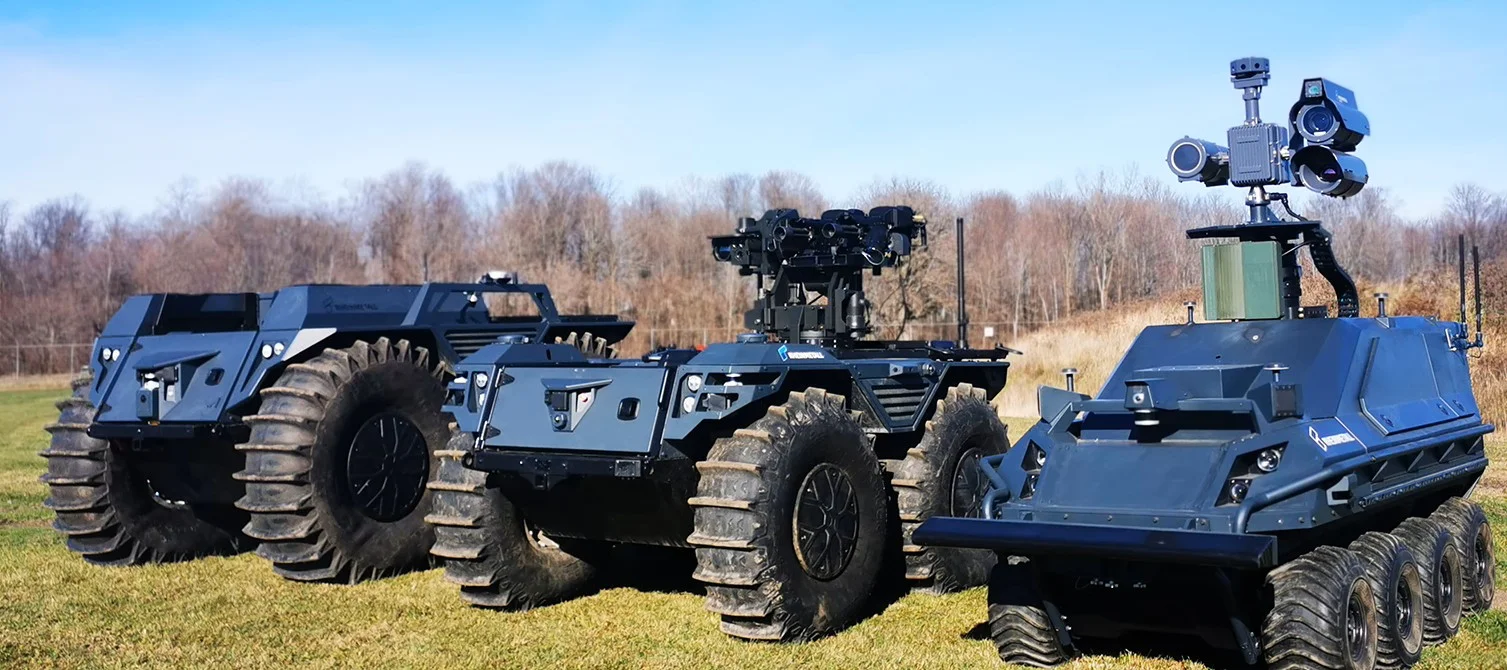
- Image: Rheinmetall
Europe’s armies are moving unmanned ground vehicles (UGVs) from test ranges to the field, with national programs, EU-backed consortia, and contractors converging on logistics, reconnaissance, engineering, and armed support—an effort increasingly shaped by lessons from Ukraine and a premium on survivability and tempo.
Across Europe, defense ministries are accelerating military ground robotics to reduce risk to troops, speed decision cycles, and stretch manpower. The trend is clearest in programs that pair government demand with private-sector platforms (Rheinmetall Mission Master, Milrem THeMIS/Type-X, KNDS Nexter Optio/Ultro) and EU/NATO standardization pushes that aim to make robots interoperable across coalitions. The near-term emphasis: autonomous convoying and last-mile resupply, unmanned route clearance and breaching, persistent ISR, EOD/engineering, and—cautiously—armed overwatch with a human firmly in the loop.
National Programs
France
Paris is formalizing ground-robotics inside the military’s SCORPION modernization stack. The Defense Ministry’s FURIOUS effort develops autonomy for tactical robots, highlighting safety and productivity in high-risk missions (MoD page). In July 2025, the French Defense Innovation Agency flagged AUROCHS as a “polyvalent, robust tactical robot,” signaling official interest in heavier armed UGVs for contested environments.
United Kingdom
The UK moved beyond light EOD platforms to heavy UGVs with Project ATILLA, a live procurement to convert surplus Warrior IFVs into optionally-crewed, autonomous minefield-breaching systems for Royal Engineers—an attritable, modular, heavy-payload UGV pathfinder, according to the government. London also seeded autonomous last-mile resupply under Project THESEUS, with Dstl acquiring the first fleet of autonomous ground vehicles for Army experimentation in 2020.
Germany
Germany is pushing UGVs from trials to field use: the Bundeswehr’s infantry “cargo-mule” evaluations (e.g., Mission Master, Ziesel, PROBOT) judged systems mature enough for procurement; the BAAINBw-backed InterRoC program is proving leader-follower autonomous convoys with HX trucks using Rheinmetall’s PATH kit; late-2024 demos paired an ARX Gereon UGV with a tethered drone for persistent ISR; and Berlin has funded operational deployments—sending KMW/Milrem THeMIS UGVs (CASEVAC/route-clearance) to Ukraine and later adding ARX Gereon units—feeding real-world lessons into doctrine, interoperability, and future buys.
Italy
Rome created a multi-year Robotic & Autonomous Systems (RAS) campaign led by the Army’s Innovation Office, in 2023 completing its first spiral of urban ops experiments and charting doctrine, TTPs, and requirements for mixed manned-unmanned formations. An Italian MoD brief details the RAS framework and the pathway to “logistica distribuita” and manned-unmanned teaming.
Poland (and Eastern flank)
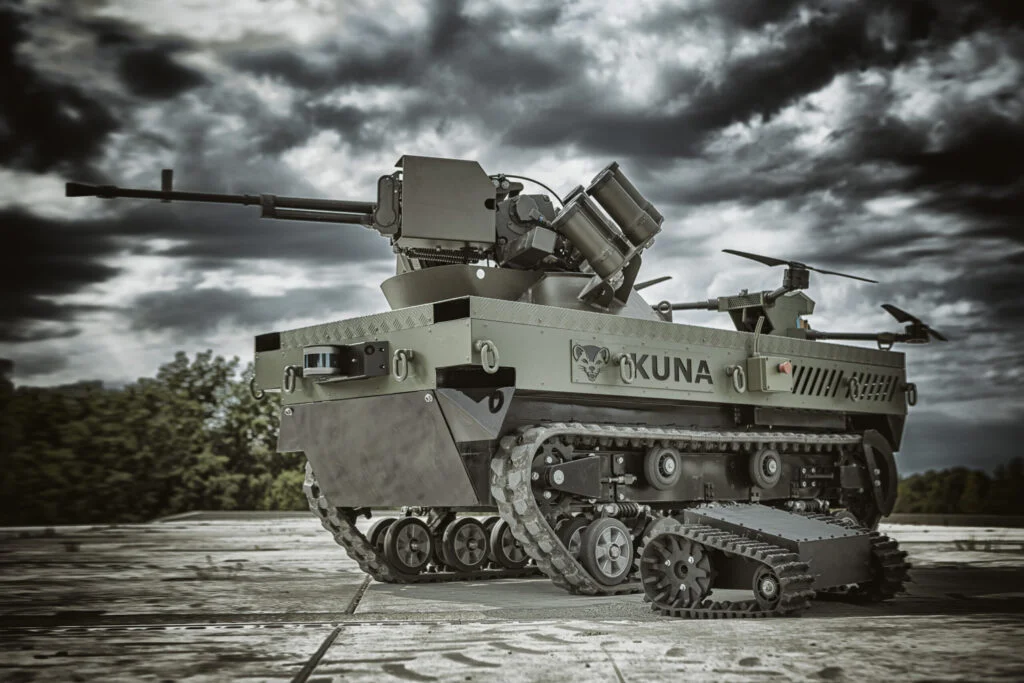
Warsaw stood up a dedicated unmanned branch and began field trials of the domestically developed KUNA UGV—a tracked, modular system paired with a Raven quadcopter for relay/overwatch—at the 19th Mechanized Brigade. State research institute notices and official military media confirm deliveries and a September–October test window focused on tactics and procedures.
EU and NATO: Standardizing the Stack
Europe’s flagship ground-robotics effort began with iMUGS (Integrated Modular Unmanned Ground System) in 2019 under the EU’s EDIDP program, led by Estonia’s Milrem Robotics to deliver a common reference architecture and multi-mission UGV demonstrators. The Commission’s factsheet and program notes outline objectives and early demos (ISR, CASEVAC, last-mile resupply) with THeMIS-based testbeds. A follow-on iMUGS2 consortium €50 bid under the European Defence Fund scales the architecture, manned-unmanned teaming, and plug-and-play payloads.
NATO, in parallel, has been aligning on open interoperability profiles (UGV IOP/JAUS-style interfaces) so a single controller can operate multiple vendors’ robots in coalition ops—an essential step for mixed formations in multinational brigades. A 2021 NATO Science and Technology report explained how a multinational team tested “plug-and-play” rules so ground robots from different countries—and their control consoles—could work together and share information with command systems in real missions. Having proven the basics, the authors recommend moving next to higher-level functions so robots and control systems can coordinate even more complex tasks.
Industry Platforms
Milrem Robotics (Estonia)
The THeMIS is now in 16 countries (8 NATO) in various configurations; Milrem’s releases detail the vehicle’s multi-mission role and the company’s leadership of iMUGS (THeMIS overview). Italy and others have tapped Milrem to support Army experimentation and RAS road-mapping—work that feeds back into EU standardization and national requirements.
Most recently, Milrem Robotics and UK partners Overwatch Aerospace, MSI-Defence Systems, and Pearson Engineering unveiled a UK-specific THeMIS combat UGV at DSEI 2025, pairing the THeMIS platform with MSI’s TERRAHAWK remote weapon station and Overwatch’s APEX UAS, with Pearson leading integration for British requirements. Development, testing, and production will occur in the UK as the program enters trials to deliver a deployable, scalable robotic combat solution for the British Army.
Rheinmetall (Germany)
The company’s PATH A-Kit,, introduced in 2023, turns manned vehicles and UGVs into autonomous platforms (convoys, waypoint nav, follow-me) and anchors the Mission Master family. Rheinmetall press releases and PDFs confirm PATH’s role and the UGV roadmap; at DSEI 2025, Rheinmetall unveiled the Mission Master CXT2 with Skyranger 7.62 for counter-UAS/U-SHORAD on an unmanned ground chassis.
KNDS / Nexter (France–Germany)
KNDS markets the Ultro robotic mule (up to 600 kg payload) and Optio-X20 armed variants; According to the company, in 2022, the Italian Army selected the Ultro-600 for evaluation as part of its RAS workups—an instructive tie-in between OEMs and national doctrine development.
Since 2012, Nexter Robotics has notched early commercial wins with its NERVA micro-UGVs, selling 56 units to France’s DGA under the SCORPION program and several hundred to foreign militaries, the company pointed out. Canada alone ordered 92 NERVA LG reconnaissance robots for evaluation.
QinetiQ (UK)
QinetiQ’s long history in UGVs spans Talon/Dragon Runner (EOD) and Titan (built with Milrem on a THeMIS base) for the British Army’s last-mile resupply experiments—documented in the company’s investor releases and annuals.
QinetiQ and Pratt Miller delivered the first RCV-L hybrid-electric unmanned ground combat vehicle to the U.S. Army’s GVSC on Nov. 5, 2020, the first of four prototypes for a 2022 manned-unmanned teaming soldier experiment, according to the company. Built on Pratt Miller’s EMAV with QinetiQ’s MOSA control system, the payload-agnostic RCV-L met Army speed, mobility, and payload goals and aimed to integrate autonomy plus government systems like a tethered UAS and CROWS-J.
ARX Robotics
Founded in 2021 by former Bundeswehr soldiers—ARX Robotics has built the modular Gereon family of unmanned ground vehicles (Gereon 2, Gereon 3, ATR, and RCS) for civilian and military use. The platforms accept 10+ quick-swap “click-and-go” payloads and cover roles from logistics and casualty evacuation to mobile targetry and reconnaissance, with options like an acoustic gunfire detector that auto-locates shooters; the newest Gereon 3 can even climb stairs for indoor tasks, according to Bundeswehr-Journal.
The Bundeswehr has begun limited fielding: in early 2024, two Gereons supported “robotic breach” training at the Infantry School, gathering sensor data that also helped refine autonomy. By mid-2024, Gereon RCS units were in operational use with German forces on NATO missions in Slovakia, and Berlin subsequently, according to the company, added 30 Gereon RCS for delivery to Ukraine—mirroring earlier THeMIS support—while ARX reported trials or sales with six European militaries.
The Hard Problems: Interoperability, Autonomy, Comms, and Doctrine
- Interoperability & open architectures. EU programs and OEM roadmaps are converging on modular interfaces so controllers, payloads, and vehicles from different vendors can “plug-and-fight.” The iMUGS reference architecture and the EU’s emphasis on standardization are designed to prevent vendor lock-in and speed coalition fielding, according to the European Commission.
- Autonomy on chaotic terrain. Vendors stress that autonomy in convoy/roads is easier than autonomy in rubble, mud, and GPS-denied forests. Hence hybrid modes (teleop + guarded autonomy) and autonomy kits (Rheinmetall PATH) that can be retrofitted across fleets.
- Communications resilience. Tethered drones (like KUNA’s Raven) acting as relays, multi-band radios, and encrypted links are becoming standard, but Electronic Warfare resilience remains a gating factor for meaningful autonomy at distance. Collins Aerospace announced this month the company had won a NATO contract to deliver its Electronic Warfare Planning and Battle Management (EWPBM) software, which builds a Recognized Electromagnetic Picture and Electronic Order of Battle to plan, coordinate, and assess EW operations.
- Doctrine & TTPs. Nations are writing new playbooks: Italy’s RAS spirals, the UK’s THESEUS/ATILLA, and Poland’s KUNA trials are explicitly about building tactics, techniques, and procedures before mass procurement.
Whether UGVs become standard kit or stay stuck in demo mode will hinge on execution: common standards that let allies share robots and control stations, rugged autonomy that works off-road and under jamming, and procurement that buys more than a handful for trials. Europe’s defense ministries say the payoff is clear—fewer troops in harm’s way and tighter logistics loops—but turning that promise into programs of record will require sustained funding, clear rules on human-in-the-loop engagement, and training that makes man–machine teaming second nature at the unit level.
If NATO exercises start fielding mixed formations where robotic mules, breaching vehicles, and armed overwatch UGVs deploy as a matter of course—not just at trade shows—Europe will have moved ground robotics from curiosity to capability. If not, the gap will be filled by rivals who field faster.