

Insider Brief
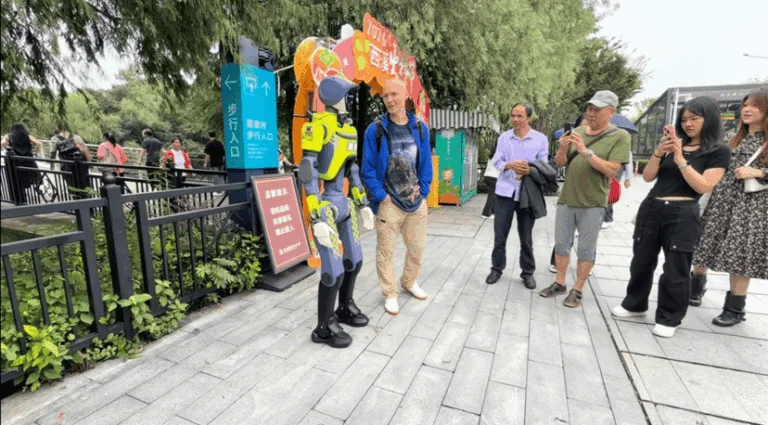
- Deep Robotics unveiled DR02, an industrial-grade humanoid the company bills as the first full-size all-weather model for outdoor patrols and plant work.
- The robot features IP66 dust/water protection and a −20°C to 55°C operating range with human-scale dimensions (~175 cm), 1.5 m/s walking (up to 4 m/s), 20 cm stairs/20° slopes, and 10 kg per arm (20 kg total) payloads, according to the company.
- A modular quick-swap design and a 275-TOPS compute stack with LiDAR, depth, and wide-angle cameras enable mapping and updates as Deep Robotics targets security and factory deployments at scale.
Deep Robotics launched a new humanoid, the DR02, that the Chinese company says is the first full-size model built to operate outdoors in all weather—an attempt to move robots from controlled demos to real-world patrols and plant work.
According to the company, the DR02 is an IP66 protection rating, which Deep Robotics says makes the humanoid robot dust-tight and able to withstand powerful water jets—conditions common on loading docks, rail yards, and open-air campuses. The company adds that the machine is designed to run across a temperature range of -20°C to 55°C (about -4°F to 131°F), letting it move between cold storage, hot workshops, and outdoor sites without special enclosures. Those claims, made in the company’s launch announcement, position DR02 as an “all-weather, all-scenario” platform intended to reduce downtime and expand the hours a robot can work.
The DR02 is built to human-like proportions—about 175 centimeters tall (roughly 5-foot-9) with 68-centimeter arms—to fit existing spaces and tools, according to Deep Robotics. The company says the robot walks at a standard pace of 1.5 meters per second (about 3.4 mph) for routine tasks and can sprint up to 4 m/s (about 8.9 mph) when needed for time-critical jobs. It is rated to climb continuous stairs of 20 centimeters (around 8 inches), handle 20-degree slopes, and maneuver through tight shelf aisles—capabilities aimed at reducing the number of times a site needs to be redesigned just to accommodate a robot.
Load handling is modest but practical. Deep Robotics says each arm is rated for 10 kilograms (about 22 pounds) and the whole robot for 20 kilograms (about 44 pounds), enough for common jobs like carrying spares, swapping small parts, or delivering emergency gear across a site. The trade-off favors mobility and endurance over heavy lifting, a balance that reflects the early tasks most customers ask humanoids to do.
To keep maintenance simple, the DR02 uses a modular, quick-detach design, the company noted. Forearms, full arms, and legs can be swapped, and left and right modules are interchangeable. For operators, that means less time waiting on repairs and more time in service—a key consideration when robots are expected to work around the clock. DEEP Robotics frames this as a way to cut operating costs and shorten outages in industrial settings where uptime is paramount.
On the intelligence side, Deep Robotics says the robot carries a 275-TOPS computing unit (a measure of raw processing throughput) for on-board perception and control. A sensor stack that includes LiDAR, a depth camera, and a wide-angle camera feeds real-time mapping, obstacle avoidance, and path planning. The company emphasizes that this hardware is meant to grow more capable over time through software updates—“getting smarter with use,” as the launch materials put it—so buyers aren’t stuck with a static system in a fast-moving field.
The robot “fills the gap in humanoid robot operations” for complex outdoor tasks such as security patrols and factory operations, according to Deep Robotics. The company further indicated it will scale deployments across more scenarios to drive industrial upgrades and accelerate global adoption of humanoid robotics.