Insider Brief
- BMW Group is deploying humanoid robots at its Leipzig plant in Germany as part of a European pilot to expand its use of Physical AI in vehicle production.
- The effort builds on a 2025 pilot at BMW’s Spartanburg, South Carolina plant, where a humanoid robot supported production of more than 30,000 BMW X3 vehicles over 10 months by performing repetitive sheet metal positioning tasks.
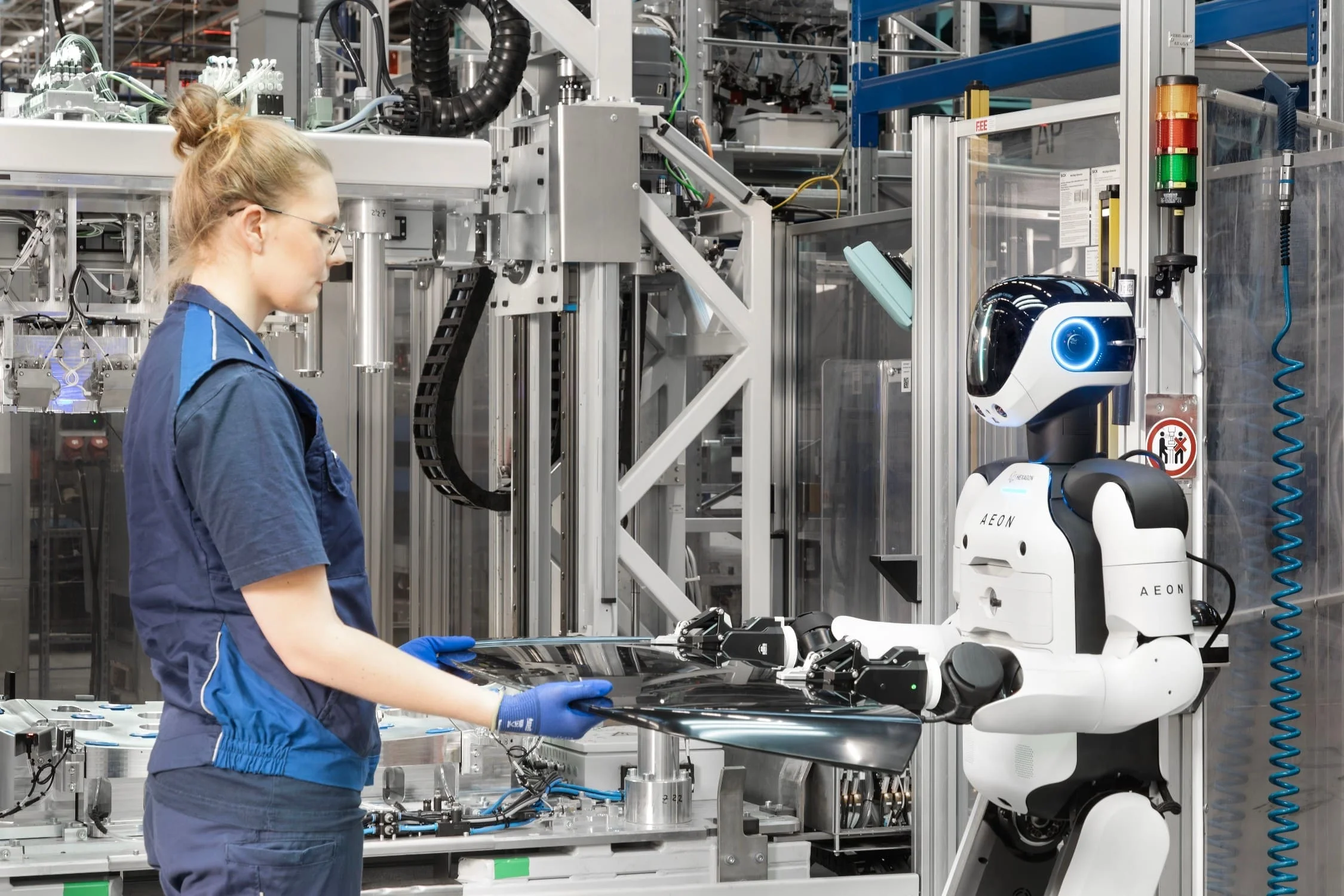
- BMW said the Leipzig program, conducted with Hexagon and its AEON humanoid robot, will test applications in high-voltage battery assembly and component manufacturing, supported by a unified production data platform and a new Center of Competence for Physical AI.
The BMW Group is deploying humanoid robots in Europe as it deepens its push into physical AI.
According to BMW, the company has launched a pilot project at its Leipzig plant to integrate AI-enabled humanoid robots into existing vehicle production, with early use cases focused on high-voltage battery assembly and component manufacturing. The effort builds on a 2025 pilot at BMW’s Spartanburg, South Carolina plant, where a humanoid robot supported production of more than 30,000 BMW X3 vehicles over 10 months, handling repetitive sheet metal positioning tasks in the body shop.
“Digitalization improves the competitiveness of our production — here in Europe and worldwide,” Milan Nedeljković, Member of the Board of Management of BMW AG, Production, said in a statement. “The symbiosis of engineering expertise and artificial intelligence opens up entirely new possibilities in production.”
BMW said artificial intelligence is already embedded across its production system, from digital twins in its virtual factory to AI-driven quality controls and autonomous intralogistics. The company noted unified IT and data platform underpins that system, replacing siloed data structures and allowing AI agents to operate autonomously in complex environments. In combination with robots, those agents form the backbone of Physical AI.
The Leipzig pilot is being conducted with Hexagon through its robotics unit, which introduced its AEON humanoid robot in 2025. After lab validation and initial on-site testing, a broader pilot phase is scheduled to begin in summer 2026.
BMW frames humanoid robotics as a complement to existing automation, particularly for repetitive or ergonomically demanding tasks. The company has also established a Center of Competence for Physical AI in Production to standardize evaluation criteria and scale deployments across its global manufacturing network.
Image credit: BMW