Insider Brief
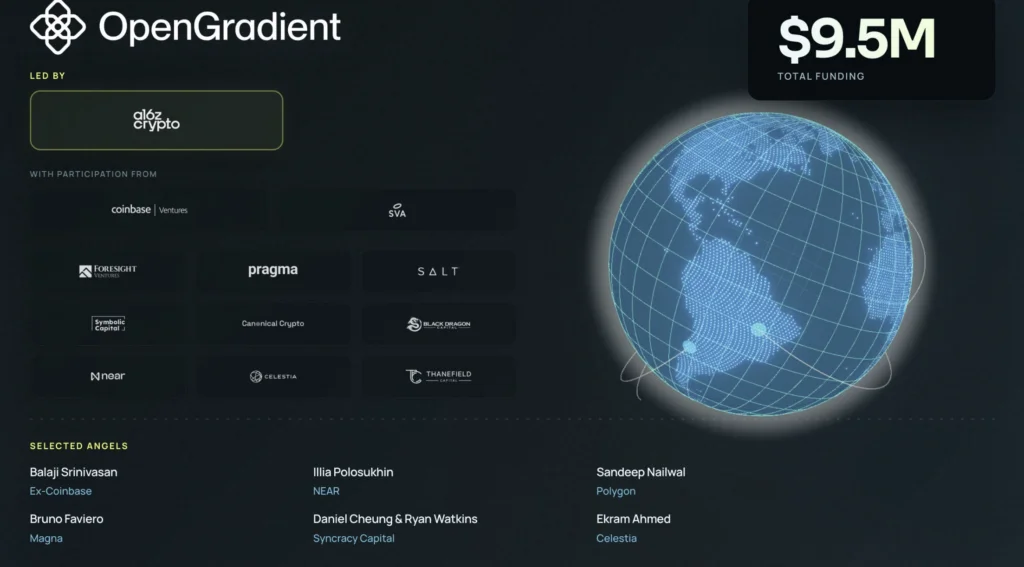
- OpenGradient has raised $9.5 million in funding led by a16z crypto to scale a decentralized infrastructure platform for verifiable AI model execution.
- The platform enables transparent and auditable AI through a network that provides cryptographic proof of model outputs, along with a decentralized model hub and developer tools.
- With strong early traction, OpenGradient aims to address risks from opaque AI systems by offering an open alternative where developers can verify, control, and monetize AI workloads.
PRESS RELEASE — OpenGradient, the compute layer for verifiable AI, announced $9.5 million in total funding raised to scale its network for open, auditable model execution.
Major investors include a16z crypto, with participation from Coinbase Ventures, SV Angel, Foresight Ventures, Pragma, SALT, Symbolic Capital, Canonical Crypto, Black Dragon, NEAR, Celestia, and Thanefield Capital. Angel investors include Balaji Srinivasan (ex-CoinbaseCTO), Illia Polosukhin (co-founder, NEAR), Sandeep Nailwal (co-founder, Polygon), Bruno Faviero (Magna), Daniel Cheung and Ryan Watkins (Syncracy Capital), and Ekram Ahmed (Celestia).
The Problem
AI is becoming the backbone of software, finance, and autonomous agents, but the infrastructure it runs on remains opaque. Developers building AI-native applications today face a choice: trust black-box cloud endpoints, or build costly verification layers from scratch. As AI moves from assistive tooling to autonomous execution (making trades, managing assets, issuing decisions) that opacity becomes a systemic risk.
What OpenGradient Is Building
OpenGradient is the Network for Open Intelligence — a decentralized infrastructure network designed to host, execute, and verify AI models at scale. Rather than functioning as a standalone blockchain, OpenGradient operates as a specialized AI coprocessor. It enables other applications, blockchains, or agents to outsource computationally-heavy tasks to a dedicated network of specialized GPU and Trusted Execution Environment (TEE) nodes for computation. For example, a company can run AI workloads such as sybil detection or content generation on OpenGradient, with clients independently verifying results by querying cryptographic proofs from the network.
The platform consists of three core components:
- Verifiable Inference Network — a dedicated compute layer that executes AI workloads and attaches cryptographic proofs to every inference, enabling downstream applications to verify exactly what model ran, on what input, and what it returned.
- Decentralized Model Hub — the world’s largest on-chain model repository with over 2,000 models, where creators can publish, monetize, and compose open models without intermediaries.
- Developer Tooling — SDKs and APIs that make verifiable inference accessible through familiar interfaces, so builders don’t need to understand proof systems to benefit from them.
“The AI stack is consolidating around a handful of closed providers, and the applications being built on top have no way to audit what’s running underneath,” said Matthew Wang, co-founder and CEO of OpenGradient. “We’re building the open alternative — infrastructure where models are inspectable, execution is provable, and developers own the intelligence their products depend on. This funding lets us scale that vision.”
Traction
OpenGradient has demonstrated significant early traction ahead of its broader ecosystem launch:
- 2M+ users across the network and adjacent products
- 2M+ verifiable inferences processed
- 500K+ cryptographic proofs generated
- 2,000+ models from 100+ developers on the Model Hub
- 6 active revenue streams across the platform
This shift shows a growing demand for AI systems that aren’t just black boxes, but something you can actually program, measure, and build value on.
About OpenGradient
OpenGradient is the Network for Open Intelligence — a decentralized infrastructure network designed to host, execute, and verify AI models at scale. Rather than functioning as a standalone blockchain, OpenGradient operates as a specialized AI coprocessor, enabling applications, blockchains, and agents to outsource computationally-heavy tasks to a dedicated network of specialized GPU and TEE nodes. Its stack includes a verifiable inference network, a decentralized Model Hub with 2,000+ models, and developer tooling that allows applications and agents to use AI with cryptographic guarantees around execution, provenance, and monetization. OpenGradient is backed by a16z crypto, Coinbase Ventures, and leading investors across AI and crypto infrastructure.
Website: opengradient.ai | Docs: docs.opengradient.ai | Model Hub: hub.opengradient.ai
Media Contact
OpenGradient
[email protected]
https://opengradient.ai