Insider Brief
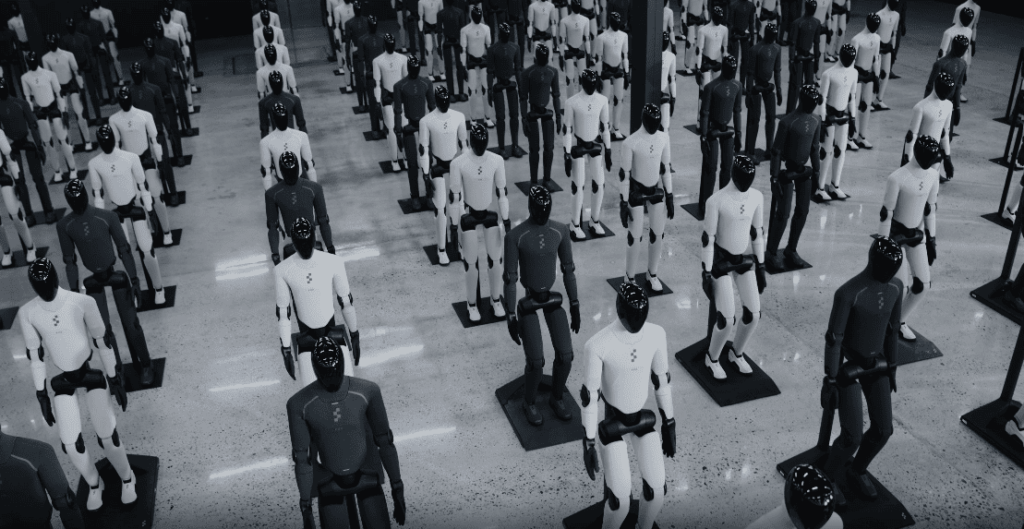
- Figure AI has increased production of its Figure 03 humanoid robot from one unit per day to one per hour in less than four months, producing more than 350 robots through its BotQ manufacturing facility.
- The company said the production ramp was driven by dedicated assembly lines, custom manufacturing software across more than 150 workstations and tighter supplier quality controls, with reported first-pass yields above 80% and more than 9,000 actuators produced across over 10 product variants.
- Figure also introduced a new perception-conditioned whole-body control capability for its System 0 AI model that allows Figure 03 robots to navigate stairs, ramps and uneven terrain using onboard stereo camera perception without task-specific programming or operator intervention.
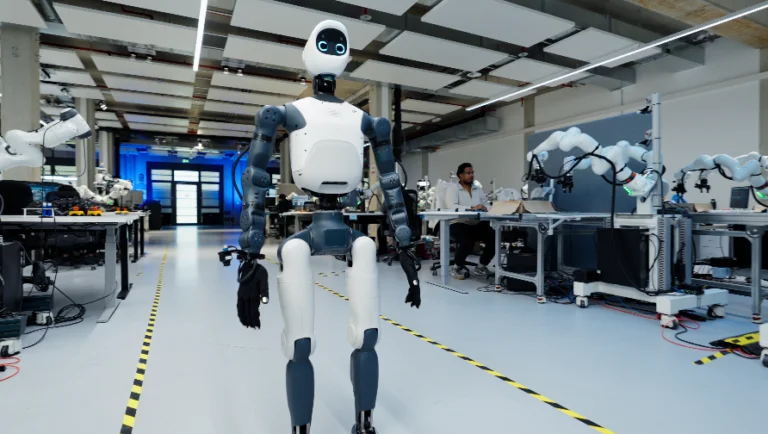
Humanoid robotics company Figure AI announced it has increased production of its Figure 03 humanoid robot from one unit per day to one per hour in less than four months.
The company said it has now produced more than 350 third-generation humanoid robots through BotQ, its high-volume manufacturing facility, which it describes as the foundation for scaling both commercial deployment and AI development.
“By overcoming the massive technical hurdles of high-volume manufacturing, Figure has unlocked a major catalyst for humanoid development: physical scale,” the company noted. “Every robot that rolls off the BotQ line at our new hourly cadence is more than just a unit of hardware — it is a data-collection engine, a development tool, and a vessel for commercial deployment.”
The California-based company credits the increase to dedicated production lines, custom manufacturing software operating across more than 150 workstations and tighter quality control across its supplier network and assembly process. The company reported an end-of-line first-pass yield above 80%, while its battery production line has reached a 99.3% first-pass yield and shipped more than 500 battery packs. It has produced more than 9,000 actuators across over 10 product variants.
Each robot undergoes more than 80 verification tests designed to expose early hardware failures before deployment, including stress tests involving full-body movements such as squatting, shoulder presses and jogging.
Figure said the growing fleet is feeding operational data back into Helix, its humanoid AI model, helping improve diagnostics, fault recovery systems and long-duration performance in real-world environments. Larger deployments have allowed it to identify and address lower-frequency “edge case” failures that typically only appear after extended operational use at scale.
Figure has also built internal fleet management and field service systems designed to monitor robot health, coordinate deployments and push over-the-air software updates across deployed robots.
Alongside the manufacturing update, the company introduced a new perception-conditioned whole-body control capability for its System 0 AI model. The update allows Figure 03 robots to use onboard stereo camera perception to navigate stairs, ramps and uneven terrain without task-specific programming or operator intervention.
The company said the model was trained through reinforcement learning in simulation and transferred directly to physical robots without additional real-world tuning, part of a broader push toward end-to-end learned control systems for humanoid robots.
In 2025, Figure AI surpassed $1 billion in committed Series C funding at a $39 billion post-money valuation to accelerate deployment of its general-purpose humanoid robots. The round was led by Parkway Venture Capital with participation from investors including Nvidia, Intel Capital, Qualcomm Ventures and Salesforce, with funding aimed at scaling BotQ production, expanding Nvidia GPU infrastructure for Helix AI training and increasing multimodal data collection for robot performance improvements.
Image credit: Figure AI