Insider Brief
- Jensen Huang told graduates at Carnegie Mellon University they are entering a new industrial era shaped by artificial intelligence, accelerated computing and scientific discovery during the university’s 128th commencement ceremony.
- Huang, who received an honorary Doctor of Science and Technology degree, described AI as a foundational technology shift that will reshape industries, expand scientific research and accelerate economic and industrial development while urging graduates to approach technological progress with persistence and long-term commitment.
- Carnegie Mellon University also highlighted its growing robotics and AI programs during the ceremony, including recognition of Beverly Da Costa as the first student to receive the university’s Bachelor of Science degree in Robotics.
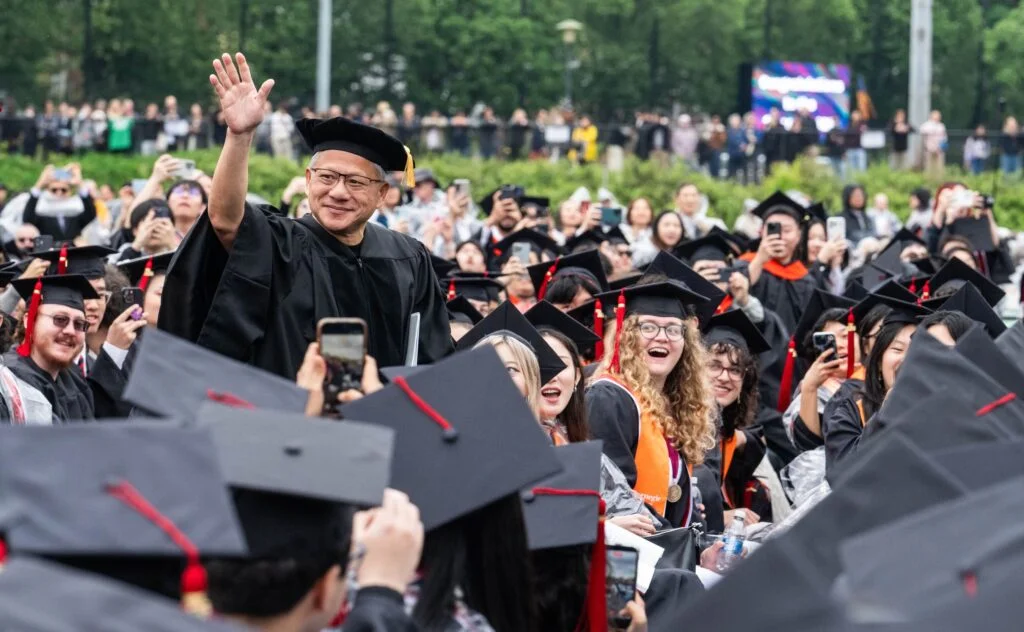
Nvidia founder and CEO Jensen Huang told Carnegie Mellon University graduates they are entering a new industrial era shaped by artificial intelligence, accelerated computing and scientific discovery during the university’s 128th commencement ceremony on Sunday.
According to Carnegie Mellon University, the Nvidia chief executive spoke to more than 5,800 undergraduate and graduate students during the ceremony, emphasizing the growing role of AI and computing infrastructure in what he described as a rapidly changing global environment.
“You are entering the world at an extraordinary moment,” Huang said. “A new industry is being born. A new era of science and discovery is beginning. AI will accelerate the expansion of human knowledge and help solve problems once beyond our reach,” he said. “No generation has entered the world with more powerful tools — or greater opportunities — than you. We are all standing at the same starting line. This is your moment to help shape what comes next. So run. Don’t walk.”
Huang, who was given an honorary Doctor of Science and Technology degree from the university, framed AI as a foundational technology shift that will reshape industries, expand scientific research capabilities and accelerate economic and industrial development.
“Carnegie Mellon has a motto I love: My heart is in the work,” he said. “So, put your heart in the work. Build something worthy of your education, your potential, and the people who believed in you long before the world did,” he said. “We have the opportunity to close the technology divide — and bring the power of computing and intelligence to billions of people for the very first time. To reindustrialize America and restore our capacity to build. And to help create a future more abundant, more capable and more hopeful than the world you inherited.”
Huang also urged graduates to approach technological development with persistence and long-term commitment, drawing on lessons from his more than three decades building Nvidia into one of the central infrastructure companies powering modern AI systems.
Prior to the commencement ceremony, Huang met with Carnegie Mellon students and reviewed research projects spanning robotics, AI and engineering disciplines.
Carnegie Mellon President Farnam Jahanian introduced Huang by highlighting Nvidia’s growing influence across research, business and technology development, particularly in areas tied to advanced computing and AI platforms.
“His influence extends far beyond the technology sector, with tools and platforms that are empowering researchers, practitioners, students, creators and entrepreneurs around the globe to tackle increasingly complex challenges and unlock new possibilities,” Jahanian said.
The university noted the ceremony also reflected Carnegie Mellon’s expanding role in robotics and AI education. Among the graduates recognized was Beverly Da Costa, the first student to receive the university’s Bachelor of Science degree in Robotics. Da Costa said her education focused heavily on practical robotics development, including hardware integration, testing and real-world system failures.
“That bakes the memories and lessons into your brain in a way that sticks, especially the mistakes,” she said. “I feel ready for what’s next.”
Image credit: Carnegie Mellon University