
Insider Brief
- Chef Robotics announced it is developing a new AI-powered food preparation system designed to automate more complex prep-table tasks beyond traditional assembly-line meal production.
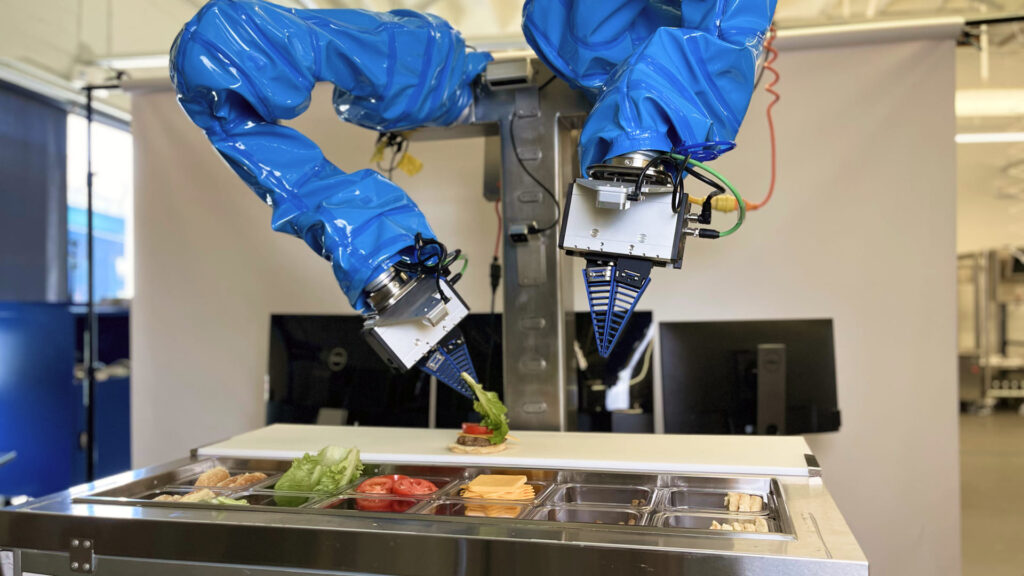
- The platform will use two robotic arms and a Food Foundation Model designed to handle less structured tasks such as assembling burgers, burritos and other made-to-order meals.
- The system targets environments including ghost kitchens, restaurants, hospitals and institutional food operations, where robots must handle a wider range of ingredients, tools and workflows.
Chef Robotics announced it is expanding beyond factory-style meal assembly and developing a new AI-powered system designed to automate more complex food production tasks typically handled at prep tables.
Unlike Chef’s existing robots, which focus on high-volume assembly-line food production, the company said its new system targets lower-volume environments where a single worker assembles an entire meal. According to Chef Robotics, those settings include ghost kitchens, fast-casual restaurants, airline catering, schools, hospitals and other food-service operations where meals are built individually rather than through a series of specialized stations.
“We started Chef by focusing on high-throughput food manufacturing, but a large part of the industry still relies on manual prep table assembly,” founder and CEO Rajat Bhageria noted in the announcement. “These environments are more complex and less structured, which makes them harder to automate. With this new physical AI system and our Food Foundation Model, we will extend physical AI to handle those real-world conditions and unlock a much broader set of applications in the food industry.”
The new platform will use two robotic arms designed to work together, allowing the system to perform more complex movements involved in preparing items such as burgers, burritos and other assembled meals. Chef said the system is being designed with food-industry-specific hardware that can withstand cleaning, varying kitchen conditions and is intended to handle a wider range of food ingredients and utensils while working safely alongside people usig simple language-based prompts.
According to the company, the system will use what it calls its Food Foundation Model, an AI model designed specifically for food preparation tasks since traditional robotics models often struggle with food because ingredients behave differently from rigid objects and can be soft, sticky or irregular in shape.
Rather than relying on separate AI models for individual tasks, Chef said its system will learn through demonstrations and adapt across different food preparation scenarios. The company said future versions could require less training when introducing new ingredients and improve consistency over time.
Image credit: Chef Robotics